

Enantioselective Photochemistry
269
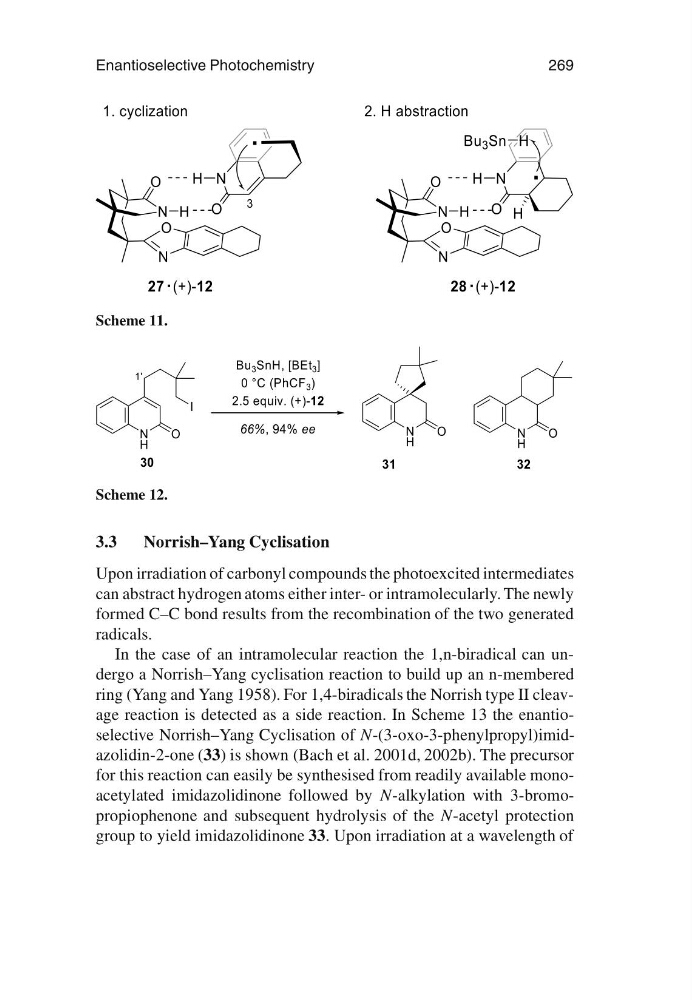
Scheme 11.
Scheme 12.
3.3
Norrish–Yang Cyclisation
Upon irradiation of carbonyl compounds the photoexcited intermediates
can abstract hydrogen atoms either inter- or intramolecularly. The newly
formed C–C bond results from the recombination of the two generated
radicals.
In the case of an intramolecular reaction the 1,n-biradical can undergo a Norrish–Yang cyclisation reaction to build up an n-membered
ring (Yang and Yang 1958). For 1,4-biradicals the Norrish type II cleavage reaction is detected as a side reaction. In Scheme 13 the enantioselective Norrish–Yang Cyclisation of N-(3-oxo-3-phenylpropyl)imidazolidin-2-one (33) is shown (Bach et al. 2001d, 2002b). The precursor
for this reaction can easily be synthesised from readily available monoacetylated imidazolidinone followed by N-alkylation with 3-bromopropiophenone and subsequent hydrolysis of the N-acetyl protection
group to yield imidazolidinone 33. Upon irradiation at a wavelength of