

New Developments in EnantioselectiveBrønsted Acid Catalysis
217
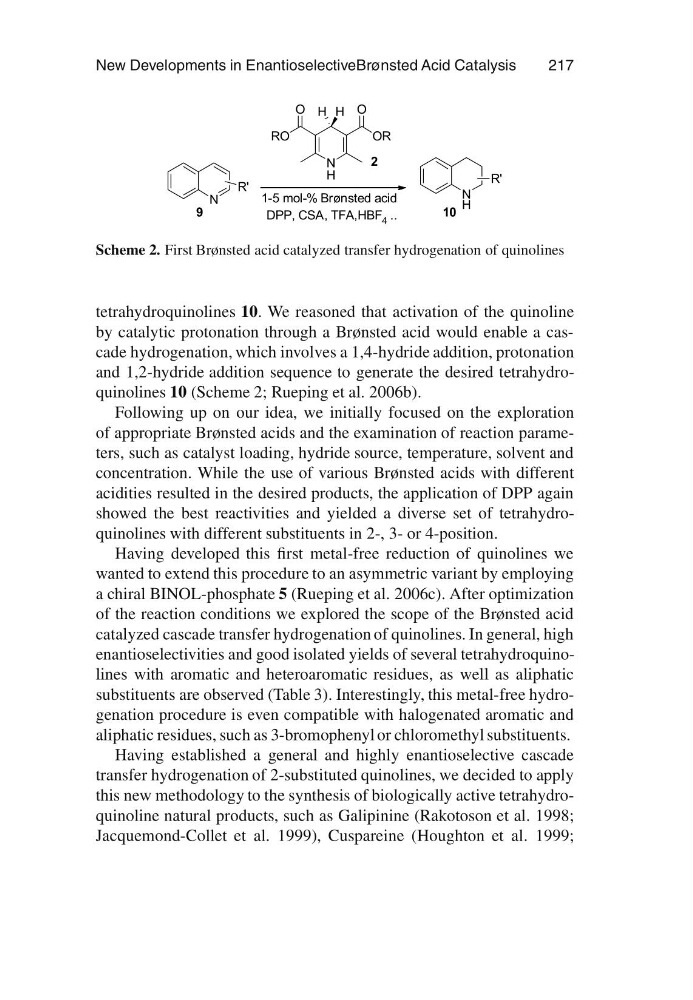
Scheme 2. First Brønsted acid catalyzed transfer hydrogenation of quinolines
tetrahydroquinolines 10. We reasoned that activation of the quinoline
by catalytic protonation through a Brønsted acid would enable a cascade hydrogenation, which involves a 1,4-hydride addition, protonation
and 1,2-hydride addition sequence to generate the desired tetrahydroquinolines 10 (Scheme 2; Rueping et al. 2006b).
Following up on our idea, we initially focused on the exploration
of appropriate Brønsted acids and the examination of reaction parameters, such as catalyst loading, hydride source, temperature, solvent and
concentration. While the use of various Brønsted acids with different
acidities resulted in the desired products, the application of DPP again
showed the best reactivities and yielded a diverse set of tetrahydroquinolines with different substituents in 2-, 3- or 4-position.
Having developed this first metal-free reduction of quinolines we
wanted to extend this procedure to an asymmetric variant by employing
a chiral BINOL-phosphate 5 (Rueping et al. 2006c). After optimization
of the reaction conditions we explored the scope of the Brønsted acid
catalyzed cascade transfer hydrogenation of quinolines. In general, high
enantioselectivities and good isolated yields of several tetrahydroquinolines with aromatic and heteroaromatic residues, as well as aliphatic
substituents are observed (Table 3). Interestingly, this metal-free hydrogenation procedure is even compatible with halogenated aromatic and
aliphatic residues, such as 3-bromophenyl or chloromethyl substituents.
Having established a general and highly enantioselective cascade
transfer hydrogenation of 2-substituted quinolines, we decided to apply
this new methodology to the synthesis of biologically active tetrahydroquinoline natural products, such as Galipinine (Rakotoson et al. 1998;
Jacquemond-Collet et al. 1999), Cuspareine (Houghton et al. 1999;