

212
M. Rueping, E. Sugiono
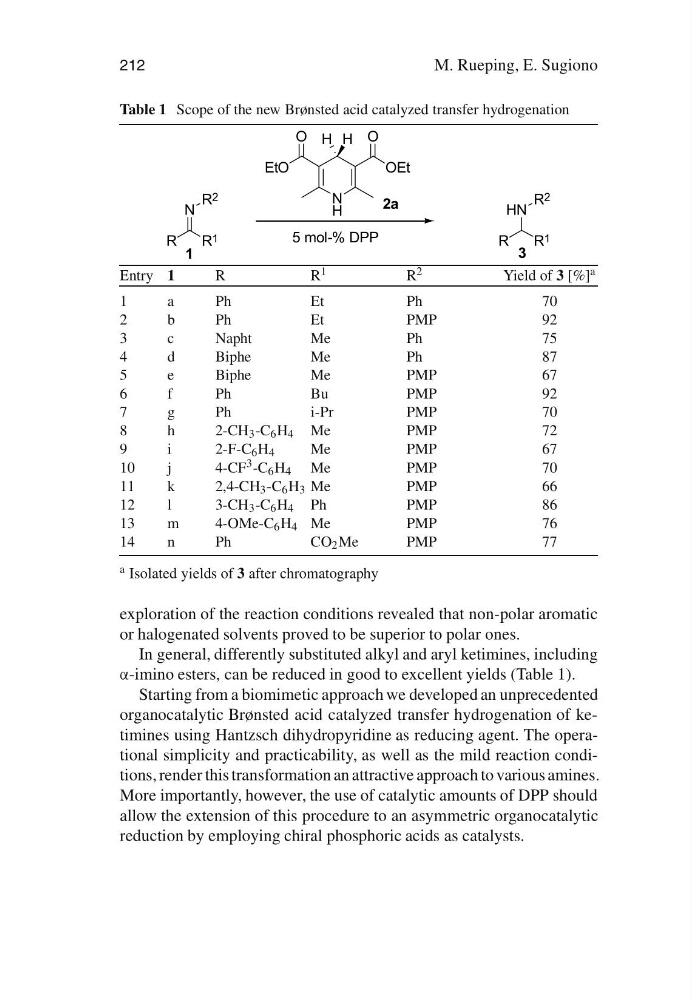
Table 1 Scope of the new Brønsted acid catalyzed transfer hydrogenation
Entry 1
R
R 1
R 2
Yield of 3 [%] a
1
a
Ph
Et
Ph
70
2
b
Ph
Et
PM P
9 2
3
c
Napht
Me
Ph
75
4
d
Biphe
Me
Ph
87
5
e
Biphe
Me
PMP
67
6
f
Ph
Bu
PMP
92
7
g
Ph
i-Pr
PM P
7 0
8
h
2 -CH 3 -C 6 H 4 Me
PMP
72
9
i
2 -F-C 6 H 4
Me
PMP
67
10
j
4-CF 3 -C 6 H 4 Me
PMP
70
11
k
2,4-CH 3 -C 6 H 3 Me
PMP
66
12
l
3-CH 3 -C 6 H 4 Ph
PMP
86
13
m
4-OMe-C 6 H 4 Me
PMP
76
14
n
Ph
CO 2 Me
PMP
77
a Isolated yields of 3 after chromatography
exploration of the reaction conditions revealed that non-polar aromatic
or halogenated solvents proved to be superior to polar ones.
In general, differently substituted alkyl and aryl ketimines, including
α-imino esters, can be reduced in good to excellent yields (Table 1).
Starting from a biomimetic approach we developed an unprecedented
organocatalytic Brønsted acid catalyzed transfer hydrogenation of ketimines using Hantzsch dihydropyridine as reducing agent. The operational simplicity and practicability, as well as the mild reaction conditions, render this transformation an attractive approach to various amines.
More importantly, however, the use of catalytic amounts of DPP should
allow the extension of this procedure to an asymmetric organocatalytic
reduction by employing chiral phosphoric acids as catalysts.