

192
K. Zeitler
a large number of other transformations by different types of nucleophilic catalysis (Enders et al. 2007; Marion et al. 2007; Zeitler 2005).
With regard to a mechanistic classification of the known carbenecatalyzed processes, a further subdivison of these two major classes
might be useful. Scheme 4 provides an attempt at a mechanism-based
classification.
Within the field of nucleophilic carbene catalysis, with the exception of umpolung-directed transformations (see below), one of the most
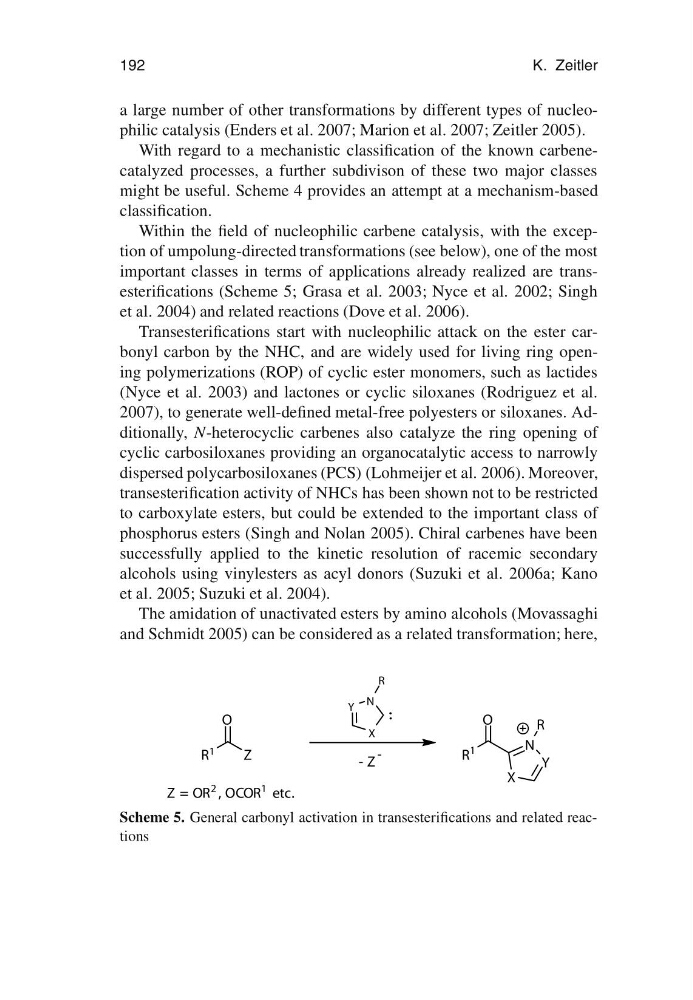
important classes in terms of applications already realized are transesterifications (Scheme 5; Grasa et al. 2003; Nyce et al. 2002; Singh
et al. 2004) and related reactions (Dove et al. 2006).
Transesterifications start with nucleophilic attack on the ester carbonyl carbon by the NHC, and are widely used for living ring opening polymerizations (ROP) of cyclic ester monomers, such as lactides
(Nyce et al. 2003) and lactones or cyclic siloxanes (Rodriguez et al.
2007), to generate well-defined metal-free polyesters or siloxanes. Additionally, N-heterocyclic carbenes also catalyze the ring opening of
cyclic carbosiloxanes providing an organocatalytic access to narrowly
dispersed polycarbosiloxanes (PCS) (Lohmeijer et al. 2006). Moreover,
transesterification activity of NHCs has been shown not to be restricted
to carboxylate esters, but could be extended to the important class of
phosphorus esters (Singh and Nolan 2005). Chiral carbenes have been
successfully applied to the kinetic resolution of racemic secondary
alcohols using vinylesters as acyl donors (Suzuki et al. 2006a; Kano
et al. 2005; Suzuki et al. 2004).
The amidation of unactivated esters by amino alcohols (Movassaghi
and Schmidt 2005) can be considered as a related transformation; here,
Scheme 5. General carbonyl activation in transesterifications and related reactions