

106
D. Enders, M.R.M. Hüttl, O. Niemeier
3.3.2 Asymmetric Intramolecular Stetter Reactions
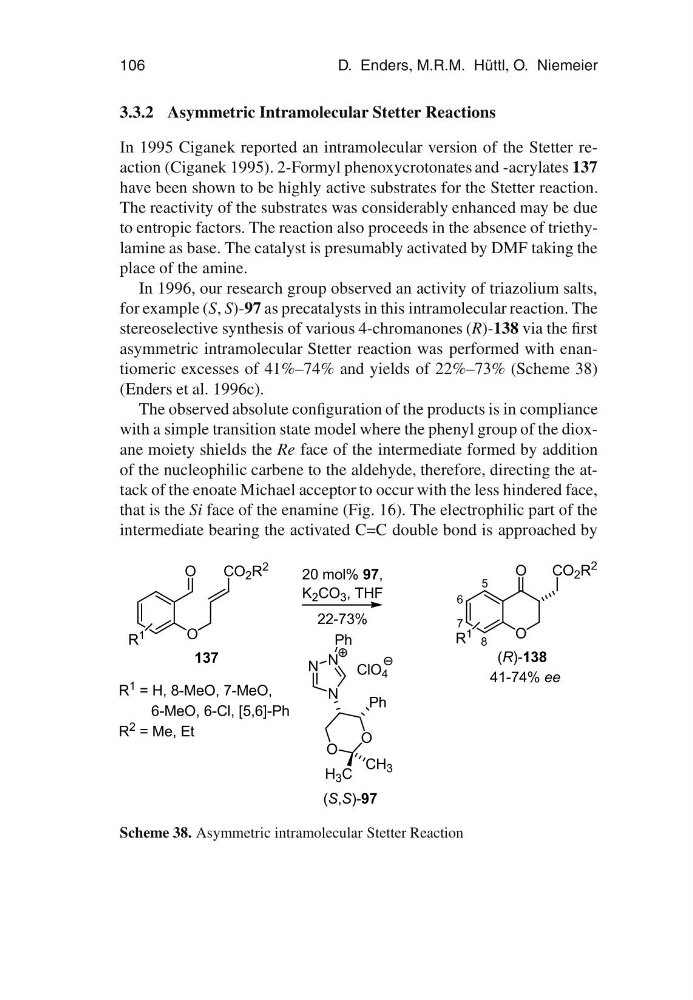
In 1995 Ciganek reported an intramolecular version of the Stetter reaction (Ciganek 1995). 2-Formyl phenoxycrotonates and -acrylates 137
have been shown to be highly active substrates for the Stetter reaction.
The reactivity of the substrates was considerably enhanced may be due
to entropic factors. The reaction also proceeds in the absence of triethylamine as base. The catalyst is presumably activated by DMF taking the
place of the amine.
In 1996, our research group observed an activity of triazolium salts,
for example (S, S)-97 as precatalysts in this intramolecular reaction. The
stereoselective synthesis of various 4-chromanones (R)-138 via the first
asymmetric intramolecular Stetter reaction was performed with enantiomeric excesses of 41%–74% and yields of 22%–73% (Scheme 38)
(Enders et al. 1996c).
The observed absolute configuration of the products is in compliance
with a simple transition state model where the phenyl group of the dioxane moiety shields the Re face of the intermediate formed by addition
of the nucleophilic carbene to the aldehyde, therefore, directing the attack of the enoate Michael acceptor to occur with the less hindered face,
that is the Si face of the enamine (Fig. 16). The electrophilic part of the
intermediate bearing the activated C=C double bond is approached by
Scheme 38. Asymmetric intramolecular Stetter Reaction