

86
D. Enders, M.R.M. Hüttl, O. Niemeier
3.2.2 Stable Carbenes
Side-by-side with the research on carbene catalyzed benzoin condensations (for reviews see: Enders and Balensiefer 2004; Zeitler 2005; Enders et al. 2007c), much effort has been devoted towards on the isolation
of stable carbenes. The chemistry of nucleophilic carbenes was intensively studied by Wanzlick et al. in the 1960s (Wanzlick 1962; Wanzlick
and Kleiner 1963). Until then, the divalent carbenes were considered as
highly reactive intermediates. In retrospective, Wanzlick et al. had Nheterocyclic carbenes in their hands, but did not believe that they would
be able to actually isolate them. Only the dimeric forms, the electron
rich olefins, were reported. It was more than 25 years later that Bertrand
et al. (Igau et al. 1988; Igau et al. 1989) and Arduengo et al. (Arduengo
et al. 1991; Arduengo et al. 1992) presented carbene compounds that
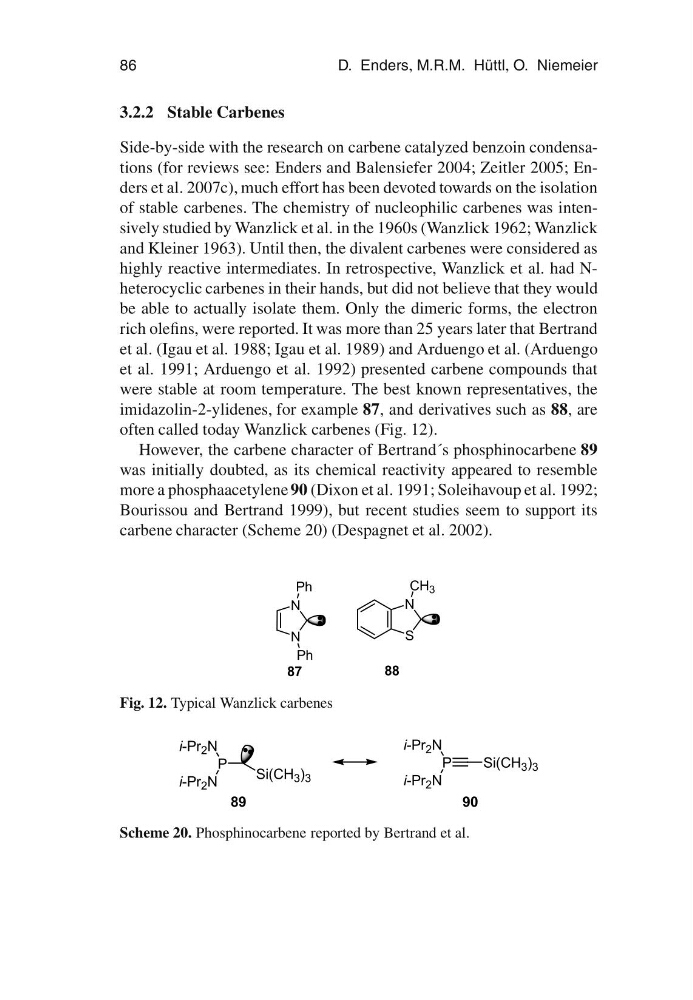
were stable at room temperature. The best known representatives, the
imidazolin-2-ylidenes, for example 87, and derivatives such as 88, are
often called today Wanzlick carbenes (Fig. 12).
However, the carbene character of Bertrand´s phosphinocarbene 89
was initially doubted, as its chemical reactivity appeared to resemble
more a phosphaacetylene 90 (Dixon et al. 1991; Soleihavoup et al. 1992;
Bourissou and Bertrand 1999), but recent studies seem to support its
carbene character (Scheme 20) (Despagnet et al. 2002).
Fig. 12. Typical Wanzlick carbenes
Scheme 20. Phosphinocarbene reported by Bertrand et al.
D. Enders, M.R.M. Hüttl, O. Niemeier
3.2.2 Stable Carbenes
Side-by-side with the research on carbene catalyzed benzoin condensations (for reviews see: Enders and Balensiefer 2004; Zeitler 2005; Enders et al. 2007c), much effort has been devoted towards on the isolation
of stable carbenes. The chemistry of nucleophilic carbenes was intensively studied by Wanzlick et al. in the 1960s (Wanzlick 1962; Wanzlick
and Kleiner 1963). Until then, the divalent carbenes were considered as
highly reactive intermediates. In retrospective, Wanzlick et al. had Nheterocyclic carbenes in their hands, but did not believe that they would
be able to actually isolate them. Only the dimeric forms, the electron
rich olefins, were reported. It was more than 25 years later that Bertrand
et al. (Igau et al. 1988; Igau et al. 1989) and Arduengo et al. (Arduengo
et al. 1991; Arduengo et al. 1992) presented carbene compounds that
were stable at room temperature. The best known representatives, the
imidazolin-2-ylidenes, for example 87, and derivatives such as 88, are
often called today Wanzlick carbenes (Fig. 12).
However, the carbene character of Bertrand´s phosphinocarbene 89
was initially doubted, as its chemical reactivity appeared to resemble
more a phosphaacetylene 90 (Dixon et al. 1991; Soleihavoup et al. 1992;
Bourissou and Bertrand 1999), but recent studies seem to support its
carbene character (Scheme 20) (Despagnet et al. 2002).
Fig. 12. Typical Wanzlick carbenes
Scheme 20. Phosphinocarbene reported by Bertrand et al.