

Biomimetic Organocatalytic C–C-Bond Formations
71
1992; Enders et al. 1993a). This strategy resembled the natural biosynthetic pathway, whereby PEP undergoes C–C linkage to aldehydes by
means of class I aldolase catalyzed reactions. Pursuing a biomimetic
route, we investigated the asymmetric organocatalytic synthesis of sialic
and ulosonic acids that led us to obtain a direct precursor of d-KDG
(58) as well as advanced intermediates of KDO (56) and analogues
(Enders and Gasperi 2007). In our biomimetic approach we chose the
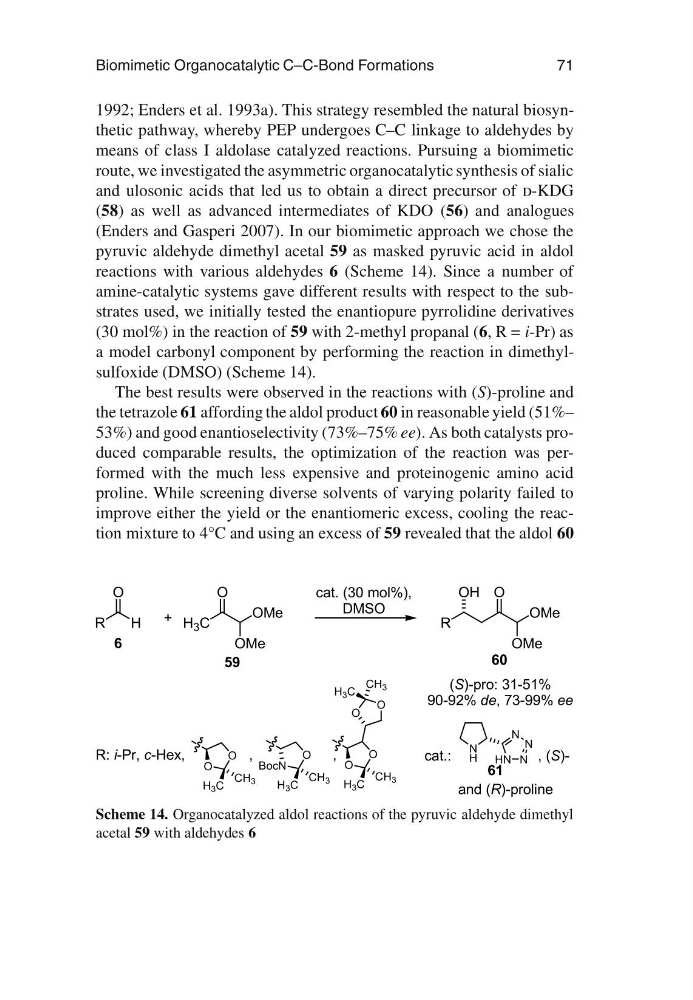
pyruvic aldehyde dimethyl acetal 59 as masked pyruvic acid in aldol
reactions with various aldehydes 6 (Scheme 14). Since a number of
amine-catalytic systems gave different results with respect to the substrates used, we initially tested the enantiopure pyrrolidine derivatives
(30 mol%) in the reaction of 59 with 2-methyl propanal (6, R = i-Pr) as
a model carbonyl component by performing the reaction in dimethylsulfoxide (DMSO) (Scheme 14).
The best results were observed in the reactions with (S)-proline and
the tetrazole 61 affording the aldol product 60 in reasonable yield (51%–
53%) and good enantioselectivity (73%–75% ee). As both catalysts produced comparable results, the optimization of the reaction was performed with the much less expensive and proteinogenic amino acid
proline. While screening diverse solvents of varying polarity failed to
improve either the yield or the enantiomeric excess, cooling the reaction mixture to 4°C and using an excess of 59 revealed that the aldol 60
Scheme 14. Organocatalyzed aldol reactions of the pyruvic aldehyde dimethyl
acetal 59 with aldehydes 6
71
1992; Enders et al. 1993a). This strategy resembled the natural biosynthetic pathway, whereby PEP undergoes C–C linkage to aldehydes by
means of class I aldolase catalyzed reactions. Pursuing a biomimetic
route, we investigated the asymmetric organocatalytic synthesis of sialic
and ulosonic acids that led us to obtain a direct precursor of d-KDG
(58) as well as advanced intermediates of KDO (56) and analogues
(Enders and Gasperi 2007). In our biomimetic approach we chose the
pyruvic aldehyde dimethyl acetal 59 as masked pyruvic acid in aldol
reactions with various aldehydes 6 (Scheme 14). Since a number of
amine-catalytic systems gave different results with respect to the substrates used, we initially tested the enantiopure pyrrolidine derivatives
(30 mol%) in the reaction of 59 with 2-methyl propanal (6, R = i-Pr) as
a model carbonyl component by performing the reaction in dimethylsulfoxide (DMSO) (Scheme 14).
The best results were observed in the reactions with (S)-proline and
the tetrazole 61 affording the aldol product 60 in reasonable yield (51%–
53%) and good enantioselectivity (73%–75% ee). As both catalysts produced comparable results, the optimization of the reaction was performed with the much less expensive and proteinogenic amino acid
proline. While screening diverse solvents of varying polarity failed to
improve either the yield or the enantiomeric excess, cooling the reaction mixture to 4°C and using an excess of 59 revealed that the aldol 60
Scheme 14. Organocatalyzed aldol reactions of the pyruvic aldehyde dimethyl
acetal 59 with aldehydes 6