

70
D. Enders, M.R.M. Hüttl, O. Niemeier
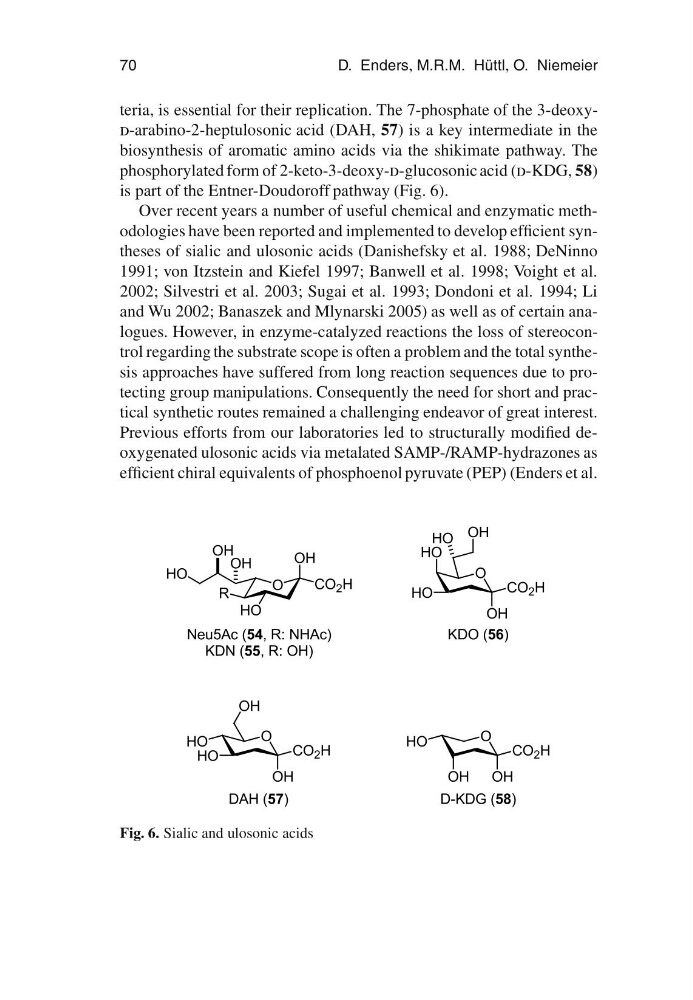
teria, is essential for their replication. The 7-phosphate of the 3-deoxyd-arabino-2-heptulosonic acid (DAH, 57) is a key intermediate in the
biosynthesis of aromatic amino acids via the shikimate pathway. The
phosphorylated form of 2-keto-3-deoxy-d-glucosonic acid (d-KDG, 58)
is part of the Entner-Doudoroff pathway (Fig. 6).
Over recent years a number of useful chemical and enzymatic methodologies have been reported and implemented to develop efficient syntheses of sialic and ulosonic acids (Danishefsky et al. 1988; DeNinno
1991; von Itzstein and Kiefel 1997; Banwell et al. 1998; Voight et al.
2002; Silvestri et al. 2003; Sugai et al. 1993; Dondoni et al. 1994; Li
and Wu 2002; Banaszek and Mlynarski 2005) as well as of certain analogues. However, in enzyme-catalyzed reactions the loss of stereocontrol regarding the substrate scope is often a problem and the total synthesis approaches have suffered from long reaction sequences due to protecting group manipulations. Consequently the need for short and practical synthetic routes remained a challenging endeavor of great interest.
Previous efforts from our laboratories led to structurally modified deoxygenated ulosonic acids via metalated SAMP-/RAMP-hydrazones as
efficient chiral equivalents of phosphoenol pyruvate (PEP) (Enders et al.
Fig. 6. Sialic and ulosonic acids
D. Enders, M.R.M. Hüttl, O. Niemeier
teria, is essential for their replication. The 7-phosphate of the 3-deoxyd-arabino-2-heptulosonic acid (DAH, 57) is a key intermediate in the
biosynthesis of aromatic amino acids via the shikimate pathway. The
phosphorylated form of 2-keto-3-deoxy-d-glucosonic acid (d-KDG, 58)
is part of the Entner-Doudoroff pathway (Fig. 6).
Over recent years a number of useful chemical and enzymatic methodologies have been reported and implemented to develop efficient syntheses of sialic and ulosonic acids (Danishefsky et al. 1988; DeNinno
1991; von Itzstein and Kiefel 1997; Banwell et al. 1998; Voight et al.
2002; Silvestri et al. 2003; Sugai et al. 1993; Dondoni et al. 1994; Li
and Wu 2002; Banaszek and Mlynarski 2005) as well as of certain analogues. However, in enzyme-catalyzed reactions the loss of stereocontrol regarding the substrate scope is often a problem and the total synthesis approaches have suffered from long reaction sequences due to protecting group manipulations. Consequently the need for short and practical synthetic routes remained a challenging endeavor of great interest.
Previous efforts from our laboratories led to structurally modified deoxygenated ulosonic acids via metalated SAMP-/RAMP-hydrazones as
efficient chiral equivalents of phosphoenol pyruvate (PEP) (Enders et al.
Fig. 6. Sialic and ulosonic acids