

56
D. Enders, M.R.M. Hüttl, O. Niemeier
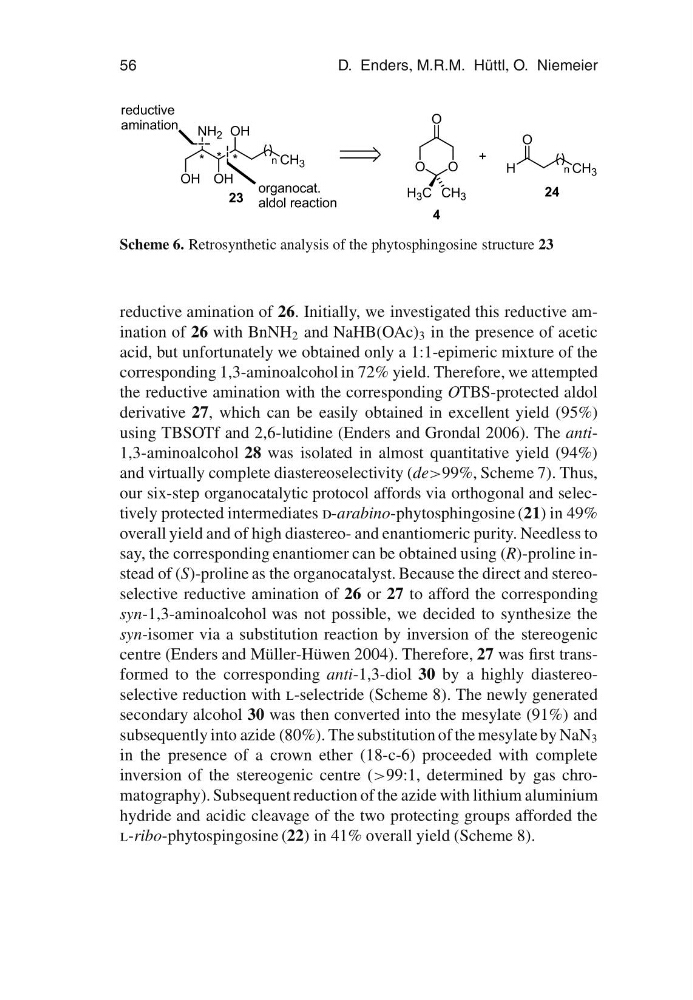
Scheme 6. Retrosynthetic analysis of the phytosphingosine structure 23
reductive amination of 26. Initially, we investigated this reductive amination of 26 with BnNH 2 and NaHB(OAc) 3 in the presence of acetic
acid, but unfortunately we obtained only a 1:1-epimeric mixture of the
corresponding 1,3-aminoalcohol in 72% yield. Therefore, we attempted
the reductive amination with the corresponding OTBS-protected aldol
derivative 27, which can be easily obtained in excellent yield (95%)
using TBSOTf and 2,6-lutidine (Enders and Grondal 2006). The anti1,3-aminoalcohol 28 was isolated in almost quantitative yield (94%)
and virtually complete diastereoselectivity (de>99%, Scheme 7). Thus,
our six-step organocatalytic protocol affords via orthogonal and selectively protected intermediates d-arabino-phytosphingosine (21) in 49%
overall yield and of high diastereo- and enantiomeric purity. Needless to
say, the corresponding enantiomer can be obtained using (R)-proline instead of (S)-proline as the organocatalyst. Because the direct and stereoselective reductive amination of 26 or 27 to afford the corresponding
syn-1,3-aminoalcohol was not possible, we decided to synthesize the
syn-isomer via a substitution reaction by inversion of the stereogenic
centre (Enders and Müller-Hüwen 2004). Therefore, 27 was first transformed to the corresponding anti-1,3-diol 30 by a highly diastereoselective reduction with l-selectride (Scheme 8). The newly generated
secondary alcohol 30 was then converted into the mesylate (91%) and
subsequently into azide (80%). The substitution of the mesylate by NaN 3
in the presence of a crown ether (18-c-6) proceeded with complete
inversion of the stereogenic centre (>99:1, determined by gas chromatography). Subsequent reduction of the azide with lithium aluminium
hydride and acidic cleavage of the two protecting groups afforded the
l-ribo-phytospingosine (22) in 41% overall yield (Scheme 8).
D. Enders, M.R.M. Hüttl, O. Niemeier
Scheme 6. Retrosynthetic analysis of the phytosphingosine structure 23
reductive amination of 26. Initially, we investigated this reductive amination of 26 with BnNH 2 and NaHB(OAc) 3 in the presence of acetic
acid, but unfortunately we obtained only a 1:1-epimeric mixture of the
corresponding 1,3-aminoalcohol in 72% yield. Therefore, we attempted
the reductive amination with the corresponding OTBS-protected aldol
derivative 27, which can be easily obtained in excellent yield (95%)
using TBSOTf and 2,6-lutidine (Enders and Grondal 2006). The anti1,3-aminoalcohol 28 was isolated in almost quantitative yield (94%)
and virtually complete diastereoselectivity (de>99%, Scheme 7). Thus,
our six-step organocatalytic protocol affords via orthogonal and selectively protected intermediates d-arabino-phytosphingosine (21) in 49%
overall yield and of high diastereo- and enantiomeric purity. Needless to
say, the corresponding enantiomer can be obtained using (R)-proline instead of (S)-proline as the organocatalyst. Because the direct and stereoselective reductive amination of 26 or 27 to afford the corresponding
syn-1,3-aminoalcohol was not possible, we decided to synthesize the
syn-isomer via a substitution reaction by inversion of the stereogenic
centre (Enders and Müller-Hüwen 2004). Therefore, 27 was first transformed to the corresponding anti-1,3-diol 30 by a highly diastereoselective reduction with l-selectride (Scheme 8). The newly generated
secondary alcohol 30 was then converted into the mesylate (91%) and
subsequently into azide (80%). The substitution of the mesylate by NaN 3
in the presence of a crown ether (18-c-6) proceeded with complete
inversion of the stereogenic centre (>99:1, determined by gas chromatography). Subsequent reduction of the azide with lithium aluminium
hydride and acidic cleavage of the two protecting groups afforded the
l-ribo-phytospingosine (22) in 41% overall yield (Scheme 8).