

Biomimetic Organocatalytic C–C-Bond Formations
55
(Carter et al. 1954; Kawano et al. 1988; Li et al. 1984; Oda 1952;
Thorpe and Sweeley 1967; Karlsson et al. 1968; Barenholz and Gatt
1967; Takamatsu et al. 1992; Okabe et al. 1968; Wertz et al. 1985; Vance
and Sweeley 1967). Due to the physiological importance of these compounds a large number of syntheses have been reported, which usually
involve many steps and extensive protecting group strategies. A number
of representative sphingolipids and analogues are depicted in Fig. 2.
Our group previously established an asymmetric stoichiometric approach to build up several sphingosines (Enders et al. 1995a) and sphinganines (Enders et al. 1995a; Enders and Müller-Hüwen 2004), which
we recently extended by a direct and flexible organocatalytic approach
to sphingoids demonstrated by the efficient asymmetric synthesis of
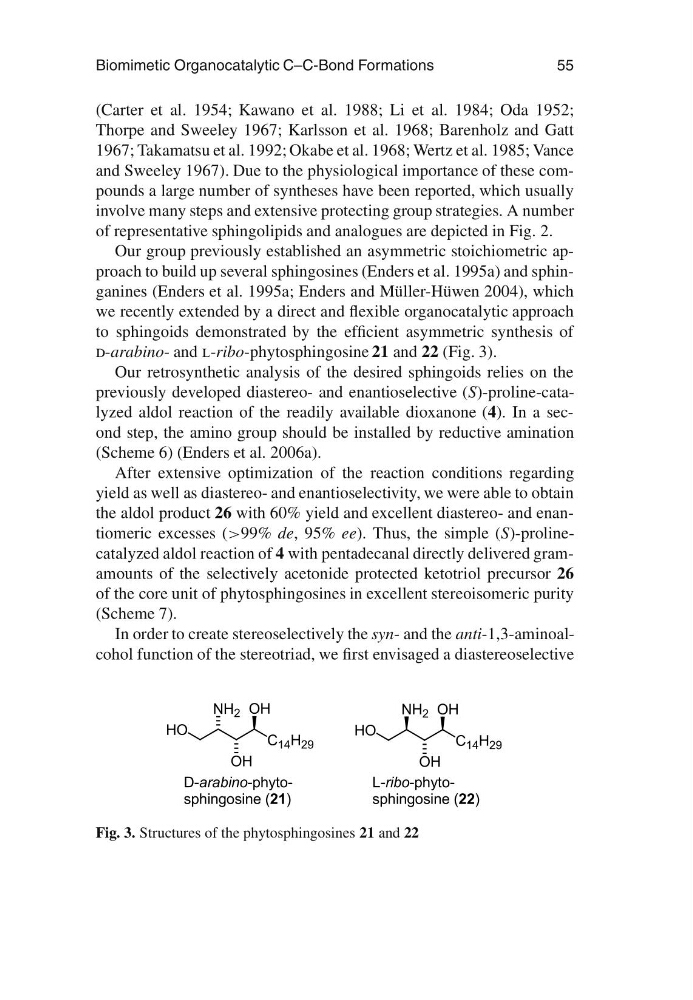
d-arabino- and l-ribo-phytosphingosine 21 and 22 (Fig. 3).
Our retrosynthetic analysis of the desired sphingoids relies on the
previously developed diastereo- and enantioselective (S)-proline-catalyzed aldol reaction of the readily available dioxanone (4). In a second step, the amino group should be installed by reductive amination
(Scheme 6) (Enders et al. 2006a).
After extensive optimization of the reaction conditions regarding
yield as well as diastereo- and enantioselectivity, we were able to obtain
the aldol product 26 with 60% yield and excellent diastereo- and enantiomeric excesses (>99% de, 95% ee). Thus, the simple (S)-prolinecatalyzed aldol reaction of 4 with pentadecanal directly delivered gramamounts of the selectively acetonide protected ketotriol precursor 26
of the core unit of phytosphingosines in excellent stereoisomeric purity
(Scheme 7).
In order to create stereoselectively the syn- and the anti-1,3-aminoalcohol function of the stereotriad, we first envisaged a diastereoselective
Fig. 3. Structures of the phytosphingosines 21 and 22
55
(Carter et al. 1954; Kawano et al. 1988; Li et al. 1984; Oda 1952;
Thorpe and Sweeley 1967; Karlsson et al. 1968; Barenholz and Gatt
1967; Takamatsu et al. 1992; Okabe et al. 1968; Wertz et al. 1985; Vance
and Sweeley 1967). Due to the physiological importance of these compounds a large number of syntheses have been reported, which usually
involve many steps and extensive protecting group strategies. A number
of representative sphingolipids and analogues are depicted in Fig. 2.
Our group previously established an asymmetric stoichiometric approach to build up several sphingosines (Enders et al. 1995a) and sphinganines (Enders et al. 1995a; Enders and Müller-Hüwen 2004), which
we recently extended by a direct and flexible organocatalytic approach
to sphingoids demonstrated by the efficient asymmetric synthesis of
d-arabino- and l-ribo-phytosphingosine 21 and 22 (Fig. 3).
Our retrosynthetic analysis of the desired sphingoids relies on the
previously developed diastereo- and enantioselective (S)-proline-catalyzed aldol reaction of the readily available dioxanone (4). In a second step, the amino group should be installed by reductive amination
(Scheme 6) (Enders et al. 2006a).
After extensive optimization of the reaction conditions regarding
yield as well as diastereo- and enantioselectivity, we were able to obtain
the aldol product 26 with 60% yield and excellent diastereo- and enantiomeric excesses (>99% de, 95% ee). Thus, the simple (S)-prolinecatalyzed aldol reaction of 4 with pentadecanal directly delivered gramamounts of the selectively acetonide protected ketotriol precursor 26
of the core unit of phytosphingosines in excellent stereoisomeric purity
(Scheme 7).
In order to create stereoselectively the syn- and the anti-1,3-aminoalcohol function of the stereotriad, we first envisaged a diastereoselective
Fig. 3. Structures of the phytosphingosines 21 and 22