

18
S.C. Pan, B. List
use of a stoichiometric amount of metal hydrides (Eq. 28; Noyori 2002;
Knowles 2002).
Although effective and industrially relevant catalytic asymmetric hydrogenations and transfer hydrogenations of olefins and ketones have
been developed, the corresponding imine reductions, although potentially highly useful for the synthesis of enantiomerically pure amines,
are less advanced (for reviews, see: Taratov and Börner 2005; Ohkuma
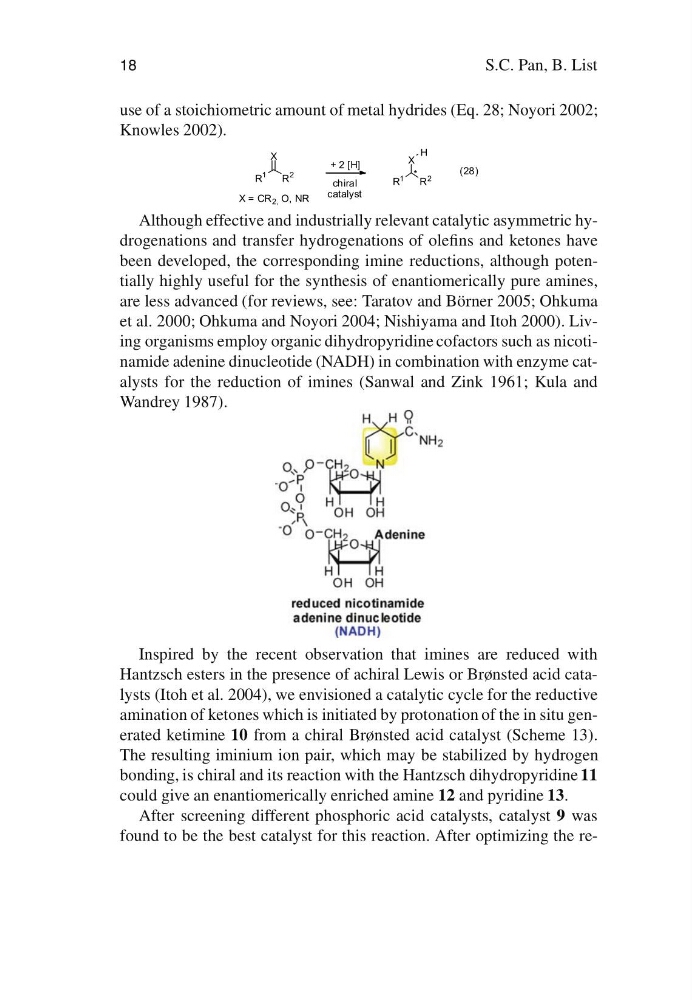
et al. 2000; Ohkuma and Noyori 2004; Nishiyama and Itoh 2000). Living organisms employ organic dihydropyridine cofactors such as nicotinamide adenine dinucleotide (NADH) in combination with enzyme catalysts for the reduction of imines (Sanwal and Zink 1961; Kula and
Wandrey 1987).
Inspired by the recent observation that imines are reduced with
Hantzsch esters in the presence of achiral Lewis or Brønsted acid catalysts (Itoh et al. 2004), we envisioned a catalytic cycle for the reductive
amination of ketones which is initiated by protonation of the in situ generated ketimine 10 from a chiral Brønsted acid catalyst (Scheme 13).
The resulting iminium ion pair, which may be stabilized by hydrogen
bonding, is chiral and its reaction with the Hantzsch dihydropyridine 11
could give an enantiomerically enriched amine 12 and pyridine 13.
After screening different phosphoric acid catalysts, catalyst 9 was
found to be the best catalyst for this reaction. After optimizing the re-
S.C. Pan, B. List
use of a stoichiometric amount of metal hydrides (Eq. 28; Noyori 2002;
Knowles 2002).
Although effective and industrially relevant catalytic asymmetric hydrogenations and transfer hydrogenations of olefins and ketones have
been developed, the corresponding imine reductions, although potentially highly useful for the synthesis of enantiomerically pure amines,
are less advanced (for reviews, see: Taratov and Börner 2005; Ohkuma
et al. 2000; Ohkuma and Noyori 2004; Nishiyama and Itoh 2000). Living organisms employ organic dihydropyridine cofactors such as nicotinamide adenine dinucleotide (NADH) in combination with enzyme catalysts for the reduction of imines (Sanwal and Zink 1961; Kula and
Wandrey 1987).
Inspired by the recent observation that imines are reduced with
Hantzsch esters in the presence of achiral Lewis or Brønsted acid catalysts (Itoh et al. 2004), we envisioned a catalytic cycle for the reductive
amination of ketones which is initiated by protonation of the in situ generated ketimine 10 from a chiral Brønsted acid catalyst (Scheme 13).
The resulting iminium ion pair, which may be stabilized by hydrogen
bonding, is chiral and its reaction with the Hantzsch dihydropyridine 11
could give an enantiomerically enriched amine 12 and pyridine 13.
After screening different phosphoric acid catalysts, catalyst 9 was
found to be the best catalyst for this reaction. After optimizing the re-