

16
S.C. Pan, B. List
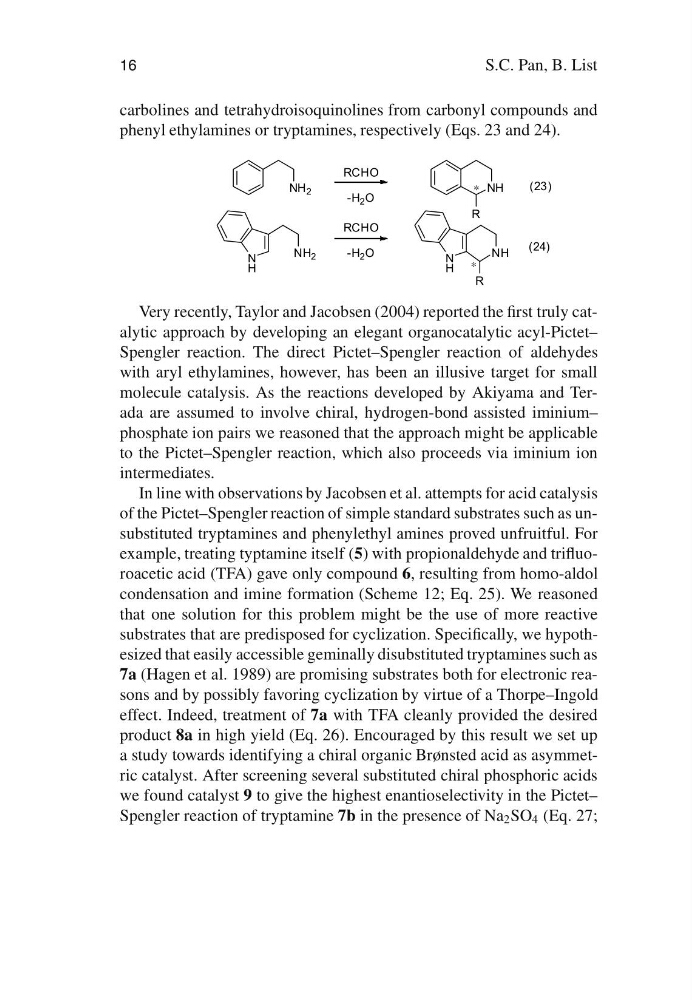
carbolines and tetrahydroisoquinolines from carbonyl compounds and
phenyl ethylamines or tryptamines, respectively (Eqs. 23 and 24).
Very recently, Taylor and Jacobsen (2004) reported the first truly catalytic approach by developing an elegant organocatalytic acyl-Pictet–
Spengler reaction. The direct Pictet–Spengler reaction of aldehydes
with aryl ethylamines, however, has been an illusive target for small
molecule catalysis. As the reactions developed by Akiyama and Terada are assumed to involve chiral, hydrogen-bond assisted iminium–
phosphate ion pairs we reasoned that the approach might be applicable
to the Pictet–Spengler reaction, which also proceeds via iminium ion
intermediates.
In line with observations by Jacobsen et al. attempts for acid catalysis
of the Pictet–Spengler reaction of simple standard substrates such as unsubstituted tryptamines and phenylethyl amines proved unfruitful. For
example, treating typtamine itself (5) with propionaldehyde and trifluoroacetic acid (TFA) gave only compound 6, resulting from homo-aldol
condensation and imine formation (Scheme 12; Eq. 25). We reasoned
that one solution for this problem might be the use of more reactive
substrates that are predisposed for cyclization. Specifically, we hypothesized that easily accessible geminally disubstituted tryptamines such as
7a (Hagen et al. 1989) are promising substrates both for electronic reasons and by possibly favoring cyclization by virtue of a Thorpe–Ingold
effect. Indeed, treatment of 7a with TFA cleanly provided the desired
product 8a in high yield (Eq. 26). Encouraged by this result we set up
a study towards identifying a chiral organic Brønsted acid as asymmetric catalyst. After screening several substituted chiral phosphoric acids
we found catalyst 9 to give the highest enantioselectivity in the Pictet–
Spengler reaction of tryptamine 7b in the presence of Na 2 SO 4 (Eq. 27;
S.C. Pan, B. List
carbolines and tetrahydroisoquinolines from carbonyl compounds and
phenyl ethylamines or tryptamines, respectively (Eqs. 23 and 24).
Very recently, Taylor and Jacobsen (2004) reported the first truly catalytic approach by developing an elegant organocatalytic acyl-Pictet–
Spengler reaction. The direct Pictet–Spengler reaction of aldehydes
with aryl ethylamines, however, has been an illusive target for small
molecule catalysis. As the reactions developed by Akiyama and Terada are assumed to involve chiral, hydrogen-bond assisted iminium–
phosphate ion pairs we reasoned that the approach might be applicable
to the Pictet–Spengler reaction, which also proceeds via iminium ion
intermediates.
In line with observations by Jacobsen et al. attempts for acid catalysis
of the Pictet–Spengler reaction of simple standard substrates such as unsubstituted tryptamines and phenylethyl amines proved unfruitful. For
example, treating typtamine itself (5) with propionaldehyde and trifluoroacetic acid (TFA) gave only compound 6, resulting from homo-aldol
condensation and imine formation (Scheme 12; Eq. 25). We reasoned
that one solution for this problem might be the use of more reactive
substrates that are predisposed for cyclization. Specifically, we hypothesized that easily accessible geminally disubstituted tryptamines such as
7a (Hagen et al. 1989) are promising substrates both for electronic reasons and by possibly favoring cyclization by virtue of a Thorpe–Ingold
effect. Indeed, treatment of 7a with TFA cleanly provided the desired
product 8a in high yield (Eq. 26). Encouraged by this result we set up
a study towards identifying a chiral organic Brønsted acid as asymmetric catalyst. After screening several substituted chiral phosphoric acids
we found catalyst 9 to give the highest enantioselectivity in the Pictet–
Spengler reaction of tryptamine 7b in the presence of Na 2 SO 4 (Eq. 27;