

CHAPTER 3 . Photooxidation of Dissolved Organic Matter
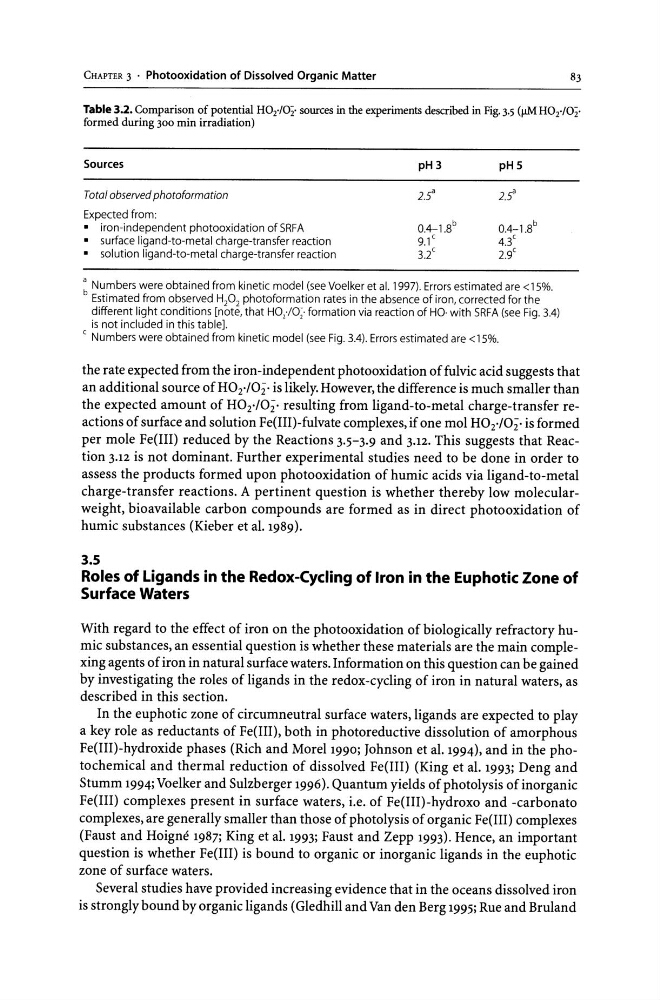
Table 3.2. Comparison of potential HOr/O;· sources in the experiments described in Fig. 3.5 (flM HOz·/O;·
formed during 300 min irradiation)
Sources
Total observed photoformation
Expected from:
• iron-independent photooxidation of SRFA
• surface ligand-to-metal charge-transfer reaction
• solution ligand-to-metal charge-transfer reaction
pH 3
2.5'
004-1.8 b
9.1'
3.2'
pHS
2.5'
004-1.8 b
4.3'
2.9'
, Numbers were obtained from kinetic model (see Voelker et al. 1997). Errors estimated are <15%.
b Estimated from observed HP2 photoformation rates in the absence of iron, corrected for the
different light conditions [note, that HO,·/O;· formation via reaction of HO· with SRFA (see Fig. 304)
is not included in this tablel.
, Numbers were obtained from kinetic model (see Fig. 304). Errors estimated are <15%.
the rate expected from the iron-independent photo oxidation of fulvic acid suggests that
an additional source ofHOz·/Oi· is likely. However, the difference is much smaller than
the expected amount of HOz'!Oi' resulting from ligand-to-metal charge-transfer reactions of surface and solution Fe(III)-fulvate complexes, if one mol HOz·/Oi· is formed
per mole Fe(III) reduced by the Reactions 3.5-3.9 and 3.12. This suggests that Reaction 3.12 is not dominant. Further experimental studies need to be done in order to
assess the products formed upon photo oxidation of humic acids via ligand-to-metal
charge-transfer reactions. A pertinent question is whether thereby low molecularweight, bioavailable carbon compounds are formed as in direct photo oxidation of
humic substances (Kieber et al. 1989).
3.5
Roles of Ligands in the Redox-Cycling of Iron in the Euphotic Zone of
Surface Waters
With regard to the effect of iron on the photo oxidation of biologically refractory humic substances, an essential question is whether these materials are the main complexing agents of iron in natural surface waters. Information on this question can be gained
by investigating the roles of ligands in the redox-cycling of iron in natural waters, as
described in this section.
In the euphotic zone of circumneutral surface waters, ligands are expected to play
a key role as reductants of Fe(III), both in photoreductive dissolution of amorphous
Fe(III)-hydroxide phases (Rich and Morel 1990; Johnson et al. 1994), and in the photochemical and thermal reduction of dissolved Fe(III) (King et al. 1993; Deng and
Stumm 1994; Voelker and Sulzberger 1996). Quantum yields of photolysis of inorganic
Fe(III) complexes present in surface waters, i.e. of Fe(III)-hydroxo and -carbonato
complexes, are generally smaller than those of photolysis of organic Fe(III) complexes
(Faust and Hoigne 1987; King et al. 1993; Faust and Zepp 1993). Hence, an important
question is whether Fe(III) is bound to organic or inorganic ligands in the euphotic
zone of surface waters.
Several studies have provided increasing evidence that in the oceans dissolved iron
is strongly bound by organic ligands (Gledhill and Van den Berg 1995; Rue and Bruland
Table 3.2. Comparison of potential HOr/O;· sources in the experiments described in Fig. 3.5 (flM HOz·/O;·
formed during 300 min irradiation)
Sources
Total observed photoformation
Expected from:
• iron-independent photooxidation of SRFA
• surface ligand-to-metal charge-transfer reaction
• solution ligand-to-metal charge-transfer reaction
pH 3
2.5'
004-1.8 b
9.1'
3.2'
pHS
2.5'
004-1.8 b
4.3'
2.9'
, Numbers were obtained from kinetic model (see Voelker et al. 1997). Errors estimated are <15%.
b Estimated from observed HP2 photoformation rates in the absence of iron, corrected for the
different light conditions [note, that HO,·/O;· formation via reaction of HO· with SRFA (see Fig. 304)
is not included in this tablel.
, Numbers were obtained from kinetic model (see Fig. 304). Errors estimated are <15%.
the rate expected from the iron-independent photo oxidation of fulvic acid suggests that
an additional source ofHOz·/Oi· is likely. However, the difference is much smaller than
the expected amount of HOz'!Oi' resulting from ligand-to-metal charge-transfer reactions of surface and solution Fe(III)-fulvate complexes, if one mol HOz·/Oi· is formed
per mole Fe(III) reduced by the Reactions 3.5-3.9 and 3.12. This suggests that Reaction 3.12 is not dominant. Further experimental studies need to be done in order to
assess the products formed upon photo oxidation of humic acids via ligand-to-metal
charge-transfer reactions. A pertinent question is whether thereby low molecularweight, bioavailable carbon compounds are formed as in direct photo oxidation of
humic substances (Kieber et al. 1989).
3.5
Roles of Ligands in the Redox-Cycling of Iron in the Euphotic Zone of
Surface Waters
With regard to the effect of iron on the photo oxidation of biologically refractory humic substances, an essential question is whether these materials are the main complexing agents of iron in natural surface waters. Information on this question can be gained
by investigating the roles of ligands in the redox-cycling of iron in natural waters, as
described in this section.
In the euphotic zone of circumneutral surface waters, ligands are expected to play
a key role as reductants of Fe(III), both in photoreductive dissolution of amorphous
Fe(III)-hydroxide phases (Rich and Morel 1990; Johnson et al. 1994), and in the photochemical and thermal reduction of dissolved Fe(III) (King et al. 1993; Deng and
Stumm 1994; Voelker and Sulzberger 1996). Quantum yields of photolysis of inorganic
Fe(III) complexes present in surface waters, i.e. of Fe(III)-hydroxo and -carbonato
complexes, are generally smaller than those of photolysis of organic Fe(III) complexes
(Faust and Hoigne 1987; King et al. 1993; Faust and Zepp 1993). Hence, an important
question is whether Fe(III) is bound to organic or inorganic ligands in the euphotic
zone of surface waters.
Several studies have provided increasing evidence that in the oceans dissolved iron
is strongly bound by organic ligands (Gledhill and Van den Berg 1995; Rue and Bruland