

82
~ 4
.:;
c
o
. ~
~ 2
8
a
100
.-'
, .. ""
200
300
Time (min)
3
b
~ 2
.:;
c
0
....
I!!
C
f!l
c
8
100
-'
..........
200
Time (min)
B. Sulzberger
"-'o 0
300
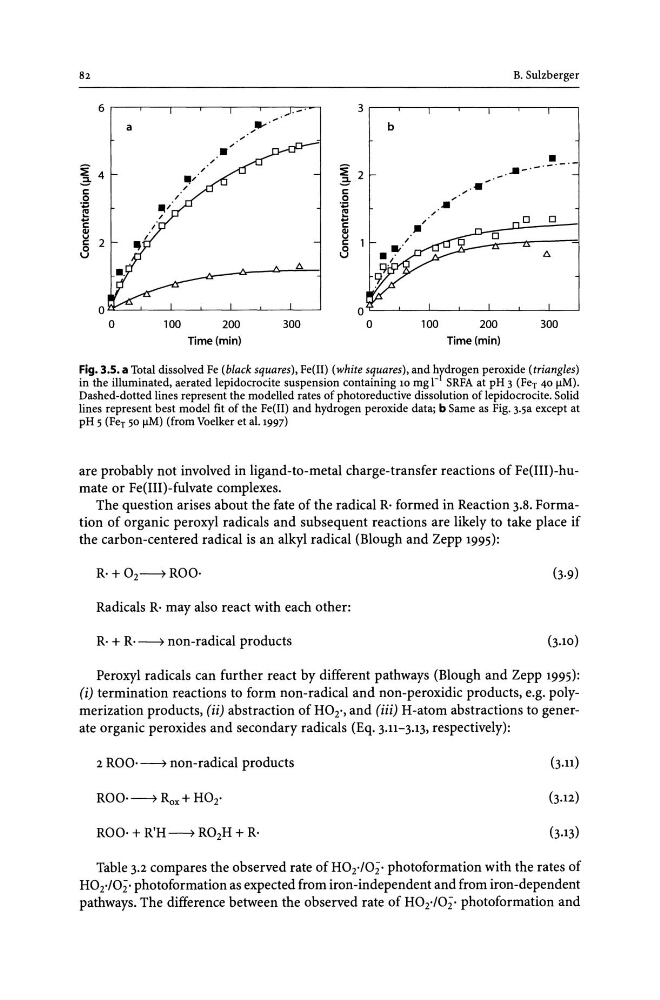
Fig. 3.5. a Total dissolved Fe (black squares), Fe(lI) (white squares), and hrdrogen peroxide (triangles)
in the illuminated, aerated lepidocrocite suspension containing 10 mg r SRFA at pH 3 (FeT 40 flM).
Dashed-dotted lines represent the modelled rates of photoreductive dissolution of lepidocrocite. Solid
lines represent best model fit of the Fe(lI) and hydrogen peroxide data; b Same as Fig. 3.5a except at
pH 5 (FeT 50 flM) (from Voelker et aI. 1997)
are probably not involved in ligand-to-metal charge-transfer reactions of Fe(III)-humate or Fe(III)-fulvate complexes.
The question arises about the fate of the radical R· formed in Reaction 3.8. Formation of organic peroxyl radicals and subsequent reactions are likely to take place if
the carbon-centered radical is an alkyl radical (Blough and Zepp 1995):
Radicals R· may also react with each other:
R· + R·~ non-radical products
Peroxyl radicals can further react by different pathways (Blough and Zepp 1995):
(i) termination reactions to form non-radical and non-peroxidic products, e.g. polymerization products, (ii) abstraction of H02·, and (iii) H-atom abstractions to generate organic peroxides and secondary radicals (Eq. 3.11-3-13, respectively):
2 ROO· ~ non-radical products
(3-11)
Table 3.2 compares the observed rate of H02·!Oi· photoformation with the rates of
H0 2 ·/Oi· photoformation as expected from iron-independent and from iron-dependent
pathways. The difference between the observed rate of H02·/Oi· photoformation and
~ 4
.:;
c
o
. ~
~ 2
8
a
100
.-'
, .. ""
200
300
Time (min)
3
b
~ 2
.:;
c
0
....
I!!
C
f!l
c
8
100
-'
..........
200
Time (min)
B. Sulzberger
"-'o 0
300
Fig. 3.5. a Total dissolved Fe (black squares), Fe(lI) (white squares), and hrdrogen peroxide (triangles)
in the illuminated, aerated lepidocrocite suspension containing 10 mg r SRFA at pH 3 (FeT 40 flM).
Dashed-dotted lines represent the modelled rates of photoreductive dissolution of lepidocrocite. Solid
lines represent best model fit of the Fe(lI) and hydrogen peroxide data; b Same as Fig. 3.5a except at
pH 5 (FeT 50 flM) (from Voelker et aI. 1997)
are probably not involved in ligand-to-metal charge-transfer reactions of Fe(III)-humate or Fe(III)-fulvate complexes.
The question arises about the fate of the radical R· formed in Reaction 3.8. Formation of organic peroxyl radicals and subsequent reactions are likely to take place if
the carbon-centered radical is an alkyl radical (Blough and Zepp 1995):
Radicals R· may also react with each other:
R· + R·~ non-radical products
Peroxyl radicals can further react by different pathways (Blough and Zepp 1995):
(i) termination reactions to form non-radical and non-peroxidic products, e.g. polymerization products, (ii) abstraction of H02·, and (iii) H-atom abstractions to generate organic peroxides and secondary radicals (Eq. 3.11-3-13, respectively):
2 ROO· ~ non-radical products
(3-11)
Table 3.2 compares the observed rate of H02·!Oi· photoformation with the rates of
H0 2 ·/Oi· photoformation as expected from iron-independent and from iron-dependent
pathways. The difference between the observed rate of H02·/Oi· photoformation and