

S. Pantoja· S. Wakeham
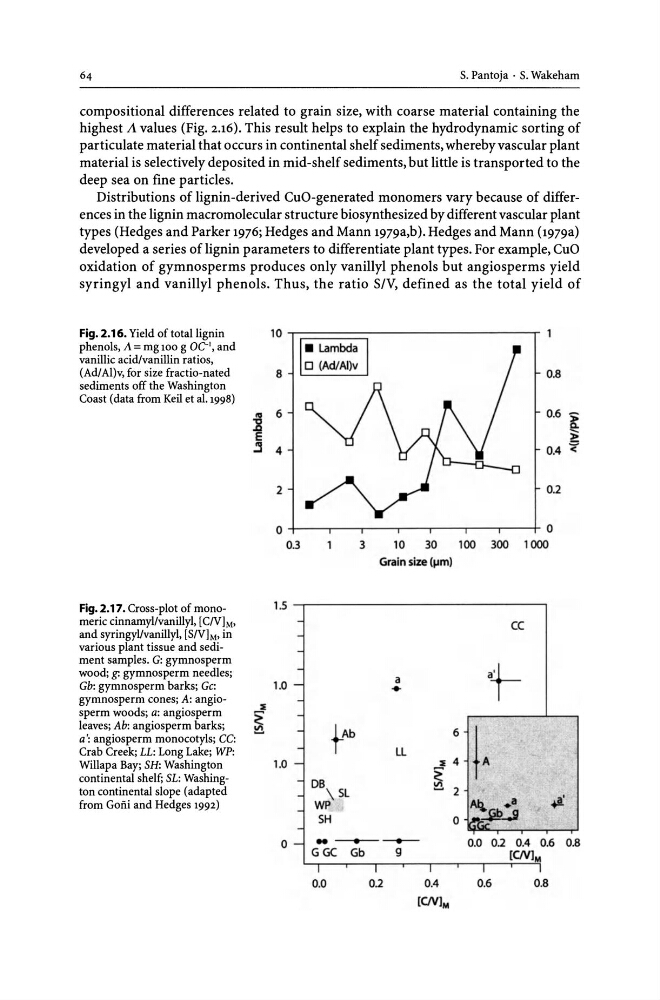
compositional differences related to grain size, with coarse material containing the
highest A values (Fig. 2.16). This result helps to explain the hydrodynamic sorting of
particulate material that occurs in continental shelf sediments, whereby vascular plant
material is selectively deposited in mid-shelf sediments, but little is transported to the
deep sea on fine particles.
Distributions of lignin-derived CuO-generated monomers vary because of differences in the lignin macromolecular structure biosynthesized by different vascular plant
types (Hedges and Parker 1976; Hedges and Mann 1979a,b). Hedges and Mann (1979a)
developed a series of lignin parameters to differentiate plant types. For example, CuO
oxidation of gymnosperms produces only vanillyl phenols but angiosperms yield
syringyl and vanillyl phenols. Thus, the ratio S/V, defined as the total yield of
Fig. 2.16. Yield of total lignin
10 Tr====:;-----------T
phenols, A = mg 100 g OC- I , and
vanillic acid/vanillin ratios,
(Adt Al)v, for size fractio-nated
8
sediments off the Washington
Coast (data from Keil et al. 1998)
'" 6
:E
E
!I 4
2
0.8
0.6
0.4
0.2
o +--~--.r--.--~-~--.r--~ 0
Fig. 2.17. Cross-plot of monomeric cinnamyUvanillyl, [CN1M,
and syringyUvani\lyl, [SN1M, in
various plant tissue and sediment samples. G: gymnosperm
wood; g: gymnosperm needles;
Gb: gymnosperm barks; Gc:
gymnosperm cones; A: angiosperm woods; a: angiosperm
leaves; Ab: angiosperm barks;
a ' : angiosperm monocotyls; CC:
Crab Creek; LL: Long Lake; WP:
Willapa Bay; SH: Washington
continental shelf; SL: Washington continental slope (adapted
from Gofii and Hedges 1992)
0.3
1.5
1.0 -
1.0 -
o -
3
10
30
Grain size (11m)
a
•
+Ab
LL
::IE
D\SL
~
WP
SH
" - - - + - - -
GGC Gb
9
I
I
I
0.0
0.2
100 300 1000
cc
16
~.
4
2
~
.a
~
0 ~:a.s
0.0 0.2 0.4 0.6
ICN1M
I
I
0.6
0.8
I '<
0.8
compositional differences related to grain size, with coarse material containing the
highest A values (Fig. 2.16). This result helps to explain the hydrodynamic sorting of
particulate material that occurs in continental shelf sediments, whereby vascular plant
material is selectively deposited in mid-shelf sediments, but little is transported to the
deep sea on fine particles.
Distributions of lignin-derived CuO-generated monomers vary because of differences in the lignin macromolecular structure biosynthesized by different vascular plant
types (Hedges and Parker 1976; Hedges and Mann 1979a,b). Hedges and Mann (1979a)
developed a series of lignin parameters to differentiate plant types. For example, CuO
oxidation of gymnosperms produces only vanillyl phenols but angiosperms yield
syringyl and vanillyl phenols. Thus, the ratio S/V, defined as the total yield of
Fig. 2.16. Yield of total lignin
10 Tr====:;-----------T
phenols, A = mg 100 g OC- I , and
vanillic acid/vanillin ratios,
(Adt Al)v, for size fractio-nated
8
sediments off the Washington
Coast (data from Keil et al. 1998)
'" 6
:E
E
!I 4
2
0.8
0.6
0.4
0.2
o +--~--.r--.--~-~--.r--~ 0
Fig. 2.17. Cross-plot of monomeric cinnamyUvanillyl, [CN1M,
and syringyUvani\lyl, [SN1M, in
various plant tissue and sediment samples. G: gymnosperm
wood; g: gymnosperm needles;
Gb: gymnosperm barks; Gc:
gymnosperm cones; A: angiosperm woods; a: angiosperm
leaves; Ab: angiosperm barks;
a ' : angiosperm monocotyls; CC:
Crab Creek; LL: Long Lake; WP:
Willapa Bay; SH: Washington
continental shelf; SL: Washington continental slope (adapted
from Gofii and Hedges 1992)
0.3
1.5
1.0 -
1.0 -
o -
3
10
30
Grain size (11m)
a
•
+Ab
LL
::IE
D\SL
~
WP
SH
" - - - + - - -
GGC Gb
9
I
I
I
0.0
0.2
100 300 1000
cc
16
~.
4
2
~
.a
~
0 ~:a.s
0.0 0.2 0.4 0.6
ICN1M
I
I
0.6
0.8
I '<
0.8