

CHAPTER 2 • Marine Organic Geochemistry: A General Overview
ronments. Further, the absence of lignin in non-vascular plants, such as marine algae,
makes it an ideal indicator of terrigenous, vascular plant-derived organic matter.
The polymeric structure of lignin precludes direct analysis by conventional techniques. Alkaline hydrolysis with CuO (Hedges and Parker 1976; Hedges and Ertel 1982)
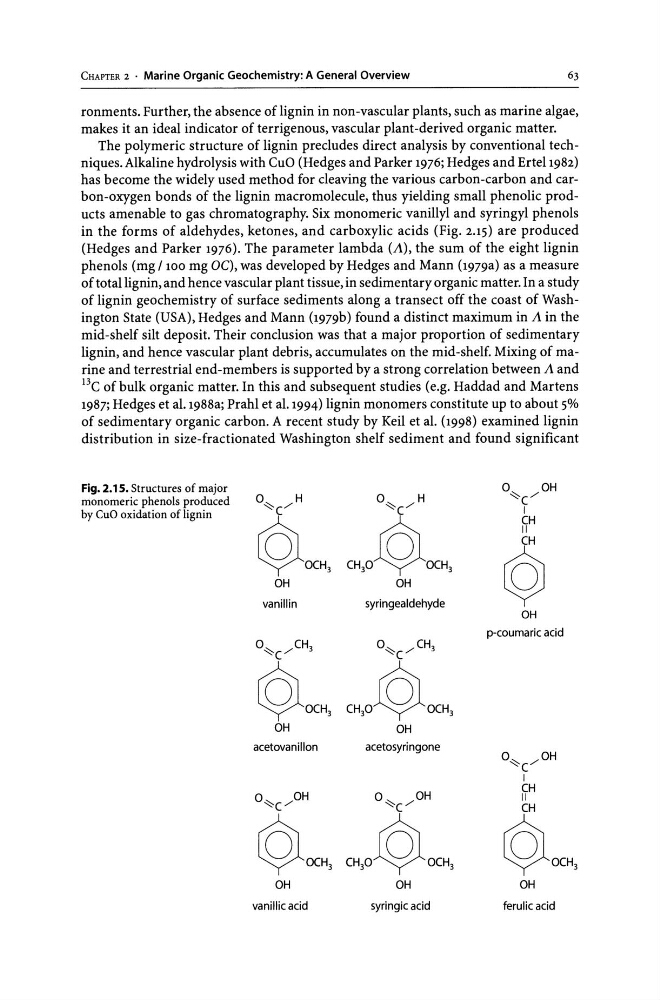
has become the widely used method for cleaving the various carbon-carbon and carbon-oxygen bonds of the lignin macromolecule, thus yielding small phenolic products amenable to gas chromatography. Six monomeric vanillyl and syringyl phenols
in the forms of aldehydes, ketones, and carboxylic acids (Fig. 2.15) are produced
(Hedges and Parker 1976). The parameter lambda (11), the sum of the eight lignin
phenols (mg / 100 mg DC), was developed by Hedges and Mann (1979a) as a measure
of total lignin, and hence vascular plant tissue, in sedimentary organic matter. In a study
of lignin geochemistry of surface sediments along a transect off the coast of Washington State (USA), Hedges and Mann (1979b) found a distinct maximum in 11 in the
mid-shelf silt deposit. Their conclusion was that a major proportion of sedimentary
lignin, and hence vascular plant debris, accumulates on the mid-shelf. Mixing of marine and terrestrial end-members is supported by a strong correlation between 11 and
!3e of bulk organic matter. In this and subsequent studies (e.g. Haddad and Martens
1987; Hedges et al. 1988a; Prahl et al. 1994) lignin monomers constitute up to about 5%
of sedimentary organic carbon. A recent study by Keil et al. (1998) examined lignin
distribution in size-fractionated Washington shelf sediment and found significant
Fig. 2.1 S. Structures of major
monomeric phenols produced
by CuO oxidation oflignin
OH
vanillin
acetovanillon
OH
vanillic acid
OH
syringealdehyde
acetosyringone
OH
syringic acid
0",
OH
~C/
I
CH
II
6
OH
p-coumaric acid
0", /OH
~C/
I
CH
II
~OCH'
OH
ferulic acid
ronments. Further, the absence of lignin in non-vascular plants, such as marine algae,
makes it an ideal indicator of terrigenous, vascular plant-derived organic matter.
The polymeric structure of lignin precludes direct analysis by conventional techniques. Alkaline hydrolysis with CuO (Hedges and Parker 1976; Hedges and Ertel 1982)
has become the widely used method for cleaving the various carbon-carbon and carbon-oxygen bonds of the lignin macromolecule, thus yielding small phenolic products amenable to gas chromatography. Six monomeric vanillyl and syringyl phenols
in the forms of aldehydes, ketones, and carboxylic acids (Fig. 2.15) are produced
(Hedges and Parker 1976). The parameter lambda (11), the sum of the eight lignin
phenols (mg / 100 mg DC), was developed by Hedges and Mann (1979a) as a measure
of total lignin, and hence vascular plant tissue, in sedimentary organic matter. In a study
of lignin geochemistry of surface sediments along a transect off the coast of Washington State (USA), Hedges and Mann (1979b) found a distinct maximum in 11 in the
mid-shelf silt deposit. Their conclusion was that a major proportion of sedimentary
lignin, and hence vascular plant debris, accumulates on the mid-shelf. Mixing of marine and terrestrial end-members is supported by a strong correlation between 11 and
!3e of bulk organic matter. In this and subsequent studies (e.g. Haddad and Martens
1987; Hedges et al. 1988a; Prahl et al. 1994) lignin monomers constitute up to about 5%
of sedimentary organic carbon. A recent study by Keil et al. (1998) examined lignin
distribution in size-fractionated Washington shelf sediment and found significant
Fig. 2.1 S. Structures of major
monomeric phenols produced
by CuO oxidation oflignin
OH
vanillin
acetovanillon
OH
vanillic acid
OH
syringealdehyde
acetosyringone
OH
syringic acid
0",
OH
~C/
I
CH
II
6
OH
p-coumaric acid
0", /OH
~C/
I
CH
II
~OCH'
OH
ferulic acid