

CHAPTER 2 • Marine Organic Geochemistry: A General Overview
Anoxic
(oxic)
Air-sea interface
Extractable phytol in plankton
Oxic/anoxic
~
Bound phytol (C b )
~------~~--~---~~~k~b~~--~L-----~~-r~~
Oxic/anoxic
kd7
Preserved
extractable
phytol (Cd
Extractable
?
Bound
dihydrophytol r-m-mm---m----~ I dihydrophytoll
kd4
Bound
C I8 ketone
Extractable
?
Bound
'--_c"-16'--a_c_id_----'I--~~:- m __ ~m __ ~LI _C_I-'-6_ac_id __ --'
I Other extractable I
degradation
products
Preserved
bound phytol
55
Anoxic
(oxic)
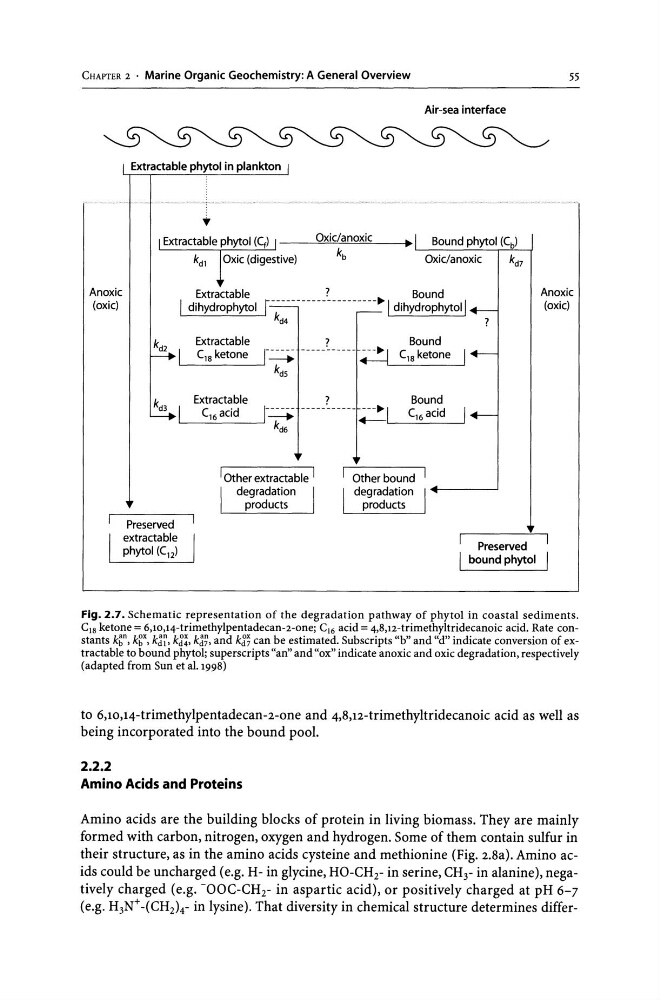
Fig. 2.7. Schematic representation of the degradation pathway of phytol in coastal sediments.
CIS ketone = 6,10,14-trimethylpentadecan-2-one; C16 acid = 4,8,12-trimethyitridecanoic acid. Rate constants kb ll , kbX, k.'ir, k2~, k.'i~, and k2~ can be estimated. Subscripts "b" and "d" indicate conversion of extractable to bound phytol; superscripts "an" and "ox" indicate anoxic and oxic degradation, respectively
(adapted from Sun et al. 1998)
to 6,10,14-trimethylpentadecan-2-one and 4,8,12-trimethyltridecanoic acid as well as
being incorporated into the bound pool.
2.2.2
Amino Acids and Proteins
Amino acids are the building blocks of protein in living biomass. They are mainly
formed with carbon, nitrogen, oxygen and hydrogen. Some of them contain sulfur in
their structure, as in the amino acids cysteine and methionine (Fig. 2.8a). Amino acids could be uncharged (e.g. H- in glycine, HO-CH2- in serine, CH r in alanine), negatively charged (e.g. -OOC-CHr in aspartic acid), or positively charged at pH 6-7
(e.g. H 3 N+-(CH 2 k in lysine). That diversity in chemical structure determines differ-
Anoxic
(oxic)
Air-sea interface
Extractable phytol in plankton
Oxic/anoxic
~
Bound phytol (C b )
~------~~--~---~~~k~b~~--~L-----~~-r~~
Oxic/anoxic
kd7
Preserved
extractable
phytol (Cd
Extractable
?
Bound
dihydrophytol r-m-mm---m----~ I dihydrophytoll
kd4
Bound
C I8 ketone
Extractable
?
Bound
'--_c"-16'--a_c_id_----'I--~~:- m __ ~m __ ~LI _C_I-'-6_ac_id __ --'
I Other extractable I
degradation
products
Preserved
bound phytol
55
Anoxic
(oxic)
Fig. 2.7. Schematic representation of the degradation pathway of phytol in coastal sediments.
CIS ketone = 6,10,14-trimethylpentadecan-2-one; C16 acid = 4,8,12-trimethyitridecanoic acid. Rate constants kb ll , kbX, k.'ir, k2~, k.'i~, and k2~ can be estimated. Subscripts "b" and "d" indicate conversion of extractable to bound phytol; superscripts "an" and "ox" indicate anoxic and oxic degradation, respectively
(adapted from Sun et al. 1998)
to 6,10,14-trimethylpentadecan-2-one and 4,8,12-trimethyltridecanoic acid as well as
being incorporated into the bound pool.
2.2.2
Amino Acids and Proteins
Amino acids are the building blocks of protein in living biomass. They are mainly
formed with carbon, nitrogen, oxygen and hydrogen. Some of them contain sulfur in
their structure, as in the amino acids cysteine and methionine (Fig. 2.8a). Amino acids could be uncharged (e.g. H- in glycine, HO-CH2- in serine, CH r in alanine), negatively charged (e.g. -OOC-CHr in aspartic acid), or positively charged at pH 6-7
(e.g. H 3 N+-(CH 2 k in lysine). That diversity in chemical structure determines differ-