

+3
NO;;
I~
+2
NO
.-------.
NHpH
I~
-1
c
0
"13
::J
-c
~
Q)
>
~
·E
·Vi
'"
'6
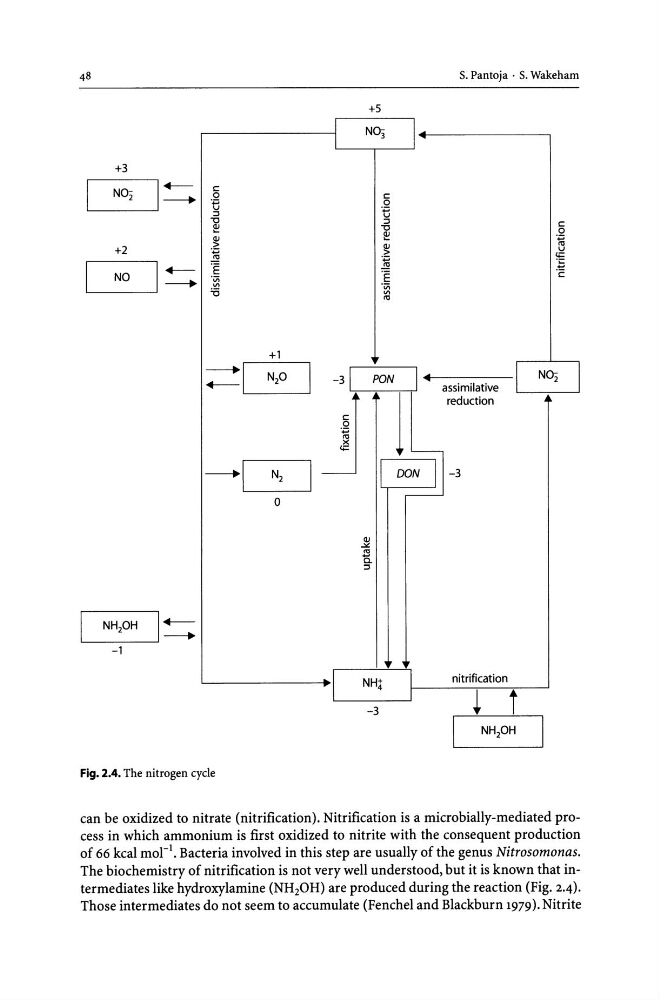
Fig. 2.4. The nitrogen cycle
+1
o
+5
I
3
c
0
. .;:::;
U
::J
-c
~
Q)
>
. .;:::;
.!!!
·E
·Vi
'"
'"
-31 paN
c
0
.~
x
<;::::
II
~
~
C.
::J
I
NHt
-3
s. Pantoja· S. Wakeham
I
C
0
. .;:::;
'"
u
<;::::
.;:
....
·c
I ..
I
NO;;
l
assimilative
1
reduction
-
DON
I -3
-
nitrification
i
NHpH
can be oxidized to nitrate (nitrification). Nitrification is a microbially-mediated process in which ammonium is first oxidized to nitrite with the consequent production
of 66 kcal mor 1. Bacteria involved in this step are usually of the genus Nitrosomonas.
The biochemistry of nitrification is not very well understood, but it is known that intermediates like hydroxylamine (NHzOH) are produced during the reaction (Fig. 2.4).
Those intermediates do not seem to accumulate (Fenchel and Blackburn 1979). Nitrite
NO;;
I~
+2
NO
.-------.
NHpH
I~
-1
c
0
"13
::J
-c
~
Q)
>
~
·E
·Vi
'"
'6
Fig. 2.4. The nitrogen cycle
+1
o
+5
I
3
c
0
. .;:::;
U
::J
-c
~
Q)
>
. .;:::;
.!!!
·E
·Vi
'"
'"
-31 paN
c
0
.~
x
<;::::
II
~
~
C.
::J
I
NHt
-3
s. Pantoja· S. Wakeham
I
C
0
. .;:::;
'"
u
<;::::
.;:
....
·c
I ..
I
NO;;
l
assimilative
1
reduction
-
DON
I -3
-
nitrification
i
NHpH
can be oxidized to nitrate (nitrification). Nitrification is a microbially-mediated process in which ammonium is first oxidized to nitrite with the consequent production
of 66 kcal mor 1. Bacteria involved in this step are usually of the genus Nitrosomonas.
The biochemistry of nitrification is not very well understood, but it is known that intermediates like hydroxylamine (NHzOH) are produced during the reaction (Fig. 2.4).
Those intermediates do not seem to accumulate (Fenchel and Blackburn 1979). Nitrite