

CHAPTER 2 • Marine Organic Geochemistry: A General Overview
u
:is
e QJ
ttl
+4
'" c
o
'':;
'0
c
8
Ol
c
'0
::l
~
'0
.~
'" c
~
.5
-4
I
photosynthesis
1
1
1
n
H2 J 1
H 2 O
r
methanogens
G
I
H 2 O,H 2 S,So
~
1
respi ration
1
°2,So,SOar
.1 autotrophs 1
•
POCandDOC 1---+1 aerobic microbes 1
y
fermenters
l
~
ilowMWDOC
I.
~ N2
sot J 1 ~ N~
HS1
denitrifiers
1----" ~
sulfate reducers
1
HS(sm- 4
I
.1
CH 4
1-+
~
Hp
H2
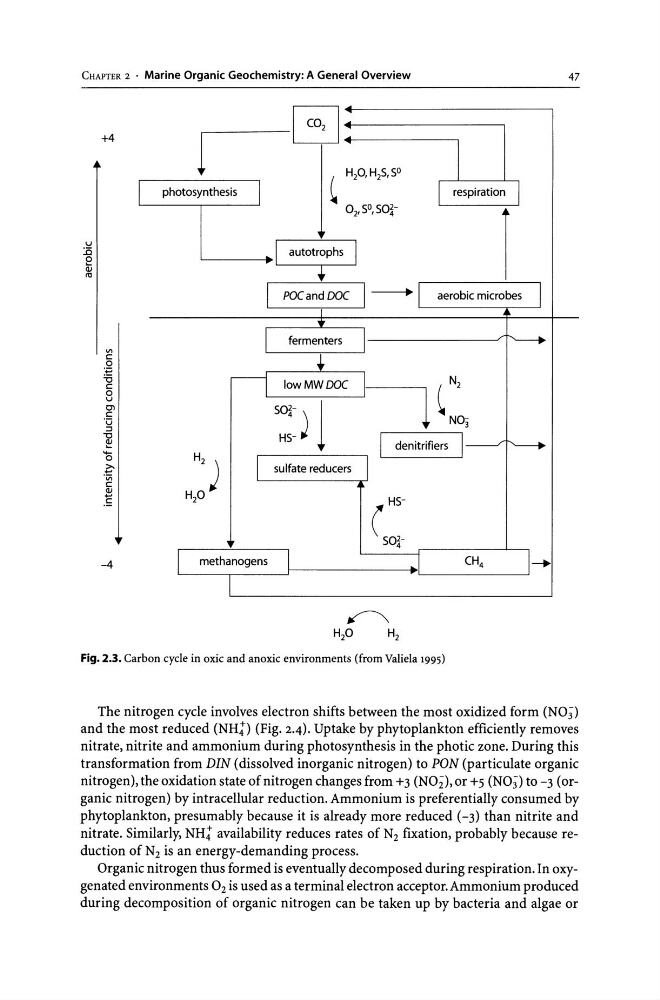
Fig. 2.3. Carbon cycle in oxic and anoxic environments (from Valiela 1995)
47
The nitrogen cycle involves electron shifts between the most oxidized form (NO;-)
and the most reduced (NH;) (Fig. 2.4). Uptake by phytoplankton efficiently removes
nitrate, nitrite and ammonium during photosynthesis in the photic zone. During this
transformation from DIN (dissolved inorganic nitrogen) to PON (particulate organic
nitrogen), the oxidation state of nitrogen changes from +3 (N02"), or +5 (NO;-) to -3 (organic nitrogen) by intracellular reduction. Ammonium is preferentially consumed by
phytoplankton, presumably because it is already more reduced (-3) than nitrite and
nitrate. Similarly, NH; availability reduces rates of N2 fixation, probably because reduction of N2 is an energy-demanding process.
Organic nitrogen thus formed is eventually decomposed during respiration. In oxygenated environments O2 is used as a terminal electron acceptor. Ammonium produced
during decomposition of organic nitrogen can be taken up by bacteria and algae or
u
:is
e QJ
ttl
+4
'" c
o
'':;
'0
c
8
Ol
c
'0
::l
~
'0
.~
'" c
~
.5
-4
I
photosynthesis
1
1
1
n
H2 J 1
H 2 O
r
methanogens
G
I
H 2 O,H 2 S,So
~
1
respi ration
1
°2,So,SOar
.1 autotrophs 1
•
POCandDOC 1---+1 aerobic microbes 1
y
fermenters
l
~
ilowMWDOC
I.
~ N2
sot J 1 ~ N~
HS1
denitrifiers
1----" ~
sulfate reducers
1
HS(sm- 4
I
.1
CH 4
1-+
~
Hp
H2
Fig. 2.3. Carbon cycle in oxic and anoxic environments (from Valiela 1995)
47
The nitrogen cycle involves electron shifts between the most oxidized form (NO;-)
and the most reduced (NH;) (Fig. 2.4). Uptake by phytoplankton efficiently removes
nitrate, nitrite and ammonium during photosynthesis in the photic zone. During this
transformation from DIN (dissolved inorganic nitrogen) to PON (particulate organic
nitrogen), the oxidation state of nitrogen changes from +3 (N02"), or +5 (NO;-) to -3 (organic nitrogen) by intracellular reduction. Ammonium is preferentially consumed by
phytoplankton, presumably because it is already more reduced (-3) than nitrite and
nitrate. Similarly, NH; availability reduces rates of N2 fixation, probably because reduction of N2 is an energy-demanding process.
Organic nitrogen thus formed is eventually decomposed during respiration. In oxygenated environments O2 is used as a terminal electron acceptor. Ammonium produced
during decomposition of organic nitrogen can be taken up by bacteria and algae or