

32
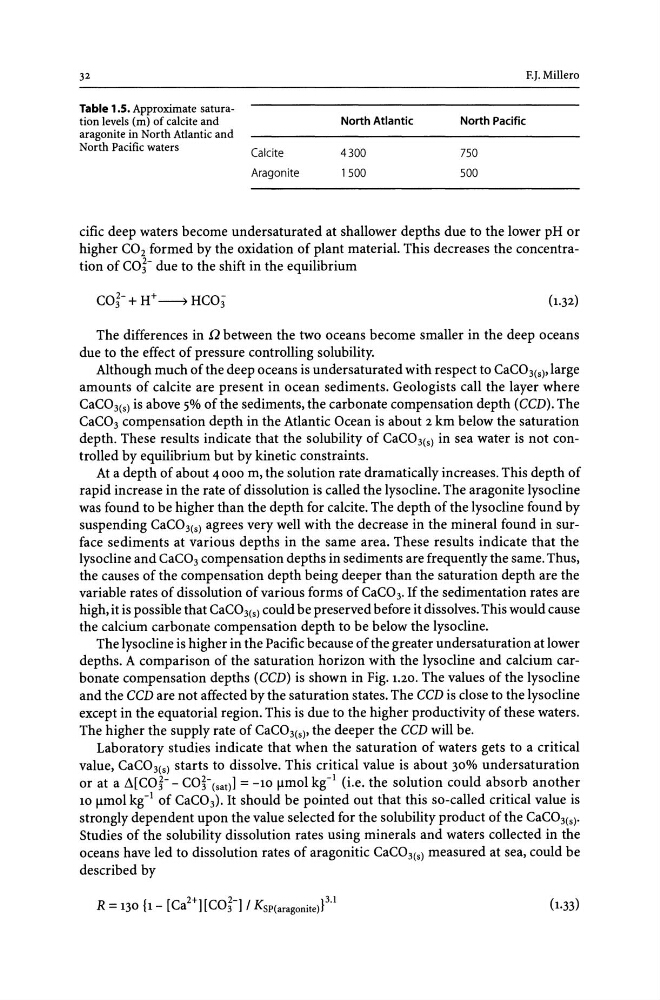
Table 1.5. Approximate saturation levels (m) of calcite and
aragonite in North Atlantic and
North Pacific waters
Calcite
Aragonite
North Atlantic
4300
'500
North Pacific
750
500
F. J. Millero
cific deep waters become undersaturated at shallower depths due to the lower pH or
higher CO 2 formed by the oxidation of plant material. This decreases the concentration of CO~- due to the shift in the equilibrium
(1.32)
The differences in Q between the two oceans become smaller in the deep oceans
due to the effect of pressure controlling solubility.
Although much of the deep oceans is undersaturated with respect to CaC03(s)' large
amounts of calcite are present in ocean sediments. Geologists call the layer where
CaC03(s) is above 5% of the sediments, the carbonate compensation depth (CCD). The
CaC0 3 compensation depth in the Atlantic Ocean is about 2 km below the saturation
depth. These results indicate that the solubility of CaC03(s) in sea water is not controlled by equilibrium but by kinetic constraints.
At a depth of about 4000 m, the solution rate dramatically increases. This depth of
rapid increase in the rate of dissolution is called the lysocline. The aragonite lysocline
was found to be higher than the depth for calcite. The depth of the lysocline found by
suspending CaC0 3 (s) agrees very well with the decrease in the mineral found in surface sediments at various depths in the same area. These results indicate that the
lysocline and CaC0 3 compensation depths in sediments are frequently the same. Thus,
the causes of the compensation depth being deeper than the saturation depth are the
variable rates of dissolution of various forms of CaC03• If the sedimentation rates are
high, it is possible that CaC0 3 (s) could be preserved before it dissolves. This would cause
the calcium carbonate compensation depth to be below the lysocline.
The lysocline is higher in the Pacific because of the greater undersaturation at lower
depths. A comparison of the saturation horizon with the lysocline and calcium carbonate compensation depths (CCD) is shown in Fig. 1.20. The values of the lysocline
and the CCD are not affected by the saturation states. The CCD is close to the lysocline
except in the equatorial region. This is due to the higher productivity of these waters.
The higher the supply rate of CaC03(s)' the deeper the CCD will be.
Laboratory studies indicate that when the saturation of waters gets to a critical
value, CaC0 3 (s) starts to dissolve. This critical value is about 30% undersaturation
or at a d[CO~- - CO~-(sat)l = -10 Ilmol kg- 1 (i.e. the solution could absorb another
10 Ilmol kg- 1 of CaC0 3 ). It should be pointed out that this so-called critical value is
strongly dependent upon the value selected for the solubility product of the CaC03(s).
Studies of the solubility dissolution rates using minerals and waters collected in the
oceans have led to dissolution rates of aragonitic CaC03(s) measured at sea, could be
described by
Table 1.5. Approximate saturation levels (m) of calcite and
aragonite in North Atlantic and
North Pacific waters
Calcite
Aragonite
North Atlantic
4300
'500
North Pacific
750
500
F. J. Millero
cific deep waters become undersaturated at shallower depths due to the lower pH or
higher CO 2 formed by the oxidation of plant material. This decreases the concentration of CO~- due to the shift in the equilibrium
(1.32)
The differences in Q between the two oceans become smaller in the deep oceans
due to the effect of pressure controlling solubility.
Although much of the deep oceans is undersaturated with respect to CaC03(s)' large
amounts of calcite are present in ocean sediments. Geologists call the layer where
CaC03(s) is above 5% of the sediments, the carbonate compensation depth (CCD). The
CaC0 3 compensation depth in the Atlantic Ocean is about 2 km below the saturation
depth. These results indicate that the solubility of CaC03(s) in sea water is not controlled by equilibrium but by kinetic constraints.
At a depth of about 4000 m, the solution rate dramatically increases. This depth of
rapid increase in the rate of dissolution is called the lysocline. The aragonite lysocline
was found to be higher than the depth for calcite. The depth of the lysocline found by
suspending CaC0 3 (s) agrees very well with the decrease in the mineral found in surface sediments at various depths in the same area. These results indicate that the
lysocline and CaC0 3 compensation depths in sediments are frequently the same. Thus,
the causes of the compensation depth being deeper than the saturation depth are the
variable rates of dissolution of various forms of CaC03• If the sedimentation rates are
high, it is possible that CaC0 3 (s) could be preserved before it dissolves. This would cause
the calcium carbonate compensation depth to be below the lysocline.
The lysocline is higher in the Pacific because of the greater undersaturation at lower
depths. A comparison of the saturation horizon with the lysocline and calcium carbonate compensation depths (CCD) is shown in Fig. 1.20. The values of the lysocline
and the CCD are not affected by the saturation states. The CCD is close to the lysocline
except in the equatorial region. This is due to the higher productivity of these waters.
The higher the supply rate of CaC03(s)' the deeper the CCD will be.
Laboratory studies indicate that when the saturation of waters gets to a critical
value, CaC0 3 (s) starts to dissolve. This critical value is about 30% undersaturation
or at a d[CO~- - CO~-(sat)l = -10 Ilmol kg- 1 (i.e. the solution could absorb another
10 Ilmol kg- 1 of CaC0 3 ). It should be pointed out that this so-called critical value is
strongly dependent upon the value selected for the solubility product of the CaC03(s).
Studies of the solubility dissolution rates using minerals and waters collected in the
oceans have led to dissolution rates of aragonitic CaC03(s) measured at sea, could be
described by