

422
M.e. Gennaro· S. Angelino
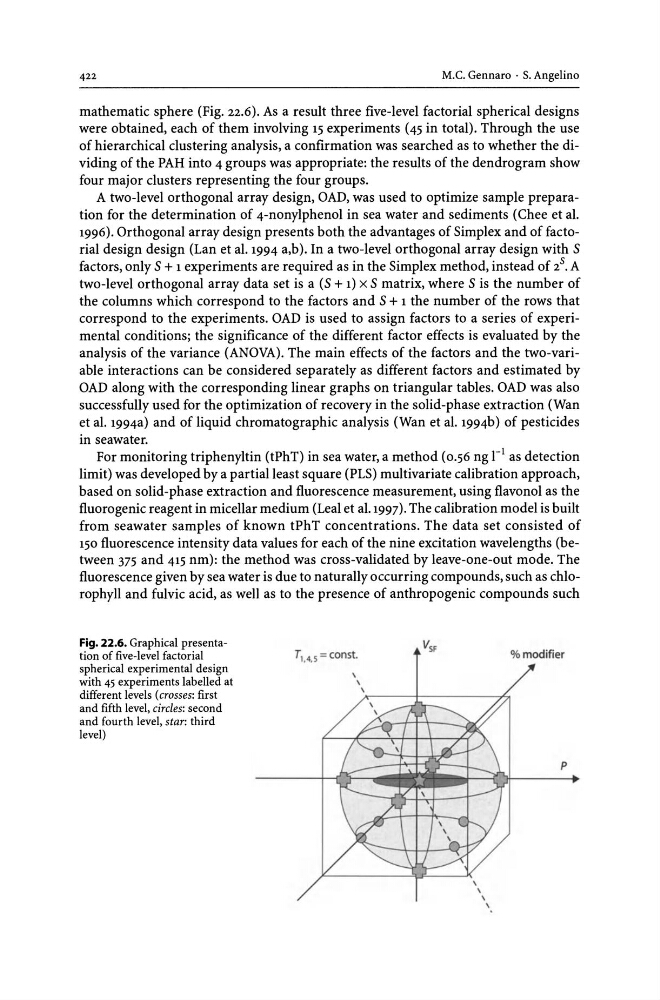
mathematic sphere (Fig. 22.6). As a result three five-level factorial spherical designs
were obtained, each of them involving 15 experiments (45 in total). Through the use
of hierarchical clustering analysis, a confirmation was searched as to whether the dividing of the PAH into 4 groups was appropriate: the results of the dendrogram show
four major clusters representing the four groups.
A two-level orthogonal array design, OAD, was used to optimize sample preparation for the determination of 4-nonylphenol in sea water and sediments (Chee et al.
1996). Orthogonal array design presents both the advantages of Simplex and of factorial design design (Lan et al. 1994 a,b). In a two-level orthogonal array design with S
factors, only S + 1 experiments are required as in the Simplex method, instead of 2 S • A
two-level orthogonal array data set is a (S + 1) x S matrix, where S is the number of
the columns which correspond to the factors and S + 1 the number of the rows that
correspond to the experiments. OAD is used to assign factors to a series of experimental conditions; the significance of the different factor effects is evaluated by the
analysis of the variance (ANOVA). The main effects of the factors and the two-variable interactions can be considered separately as different factors and estimated by
OAD along with the corresponding linear graphs on triangular tables. OAD was also
successfully used for the optimization of recovery in the solid-phase extraction (Wan
et al. 1994a) and of liquid chromatographic analysis (Wan et al. 1994b) of pesticides
in seawater.
For monitoring triphenyltin (tPhT) in sea water, a method (0.56 ng 1-1 as detection
limit) was developed by a partial least square (PLS) multivariate calibration approach,
based on solid-phase extraction and fluorescence measurement, using flavonol as the
fluorogenic reagent in micellar medium (Leal et al.1997). The calibration model is built
from seawater samples of known tPhT concentrations. The data set consisted of
150 fluorescence intensity data values for each of the nine excitation wavelengths (between 375 and 415 nm): the method was cross-validated by leave-one-out mode. The
fluorescence given by sea water is due to naturally occurring compounds, such as chlorophyll and fulvic acid, as well as to the presence of anthropogenic compounds such
Fig. 22.6. Graphical presentation of five-level factorial
spherical experimental design
with 45 experiments labelled at
different levels (crosses: first
and fifth level, circles: second
and fourth level, star: third
level)
TI ••• S = const.
% modifier
p
M.e. Gennaro· S. Angelino
mathematic sphere (Fig. 22.6). As a result three five-level factorial spherical designs
were obtained, each of them involving 15 experiments (45 in total). Through the use
of hierarchical clustering analysis, a confirmation was searched as to whether the dividing of the PAH into 4 groups was appropriate: the results of the dendrogram show
four major clusters representing the four groups.
A two-level orthogonal array design, OAD, was used to optimize sample preparation for the determination of 4-nonylphenol in sea water and sediments (Chee et al.
1996). Orthogonal array design presents both the advantages of Simplex and of factorial design design (Lan et al. 1994 a,b). In a two-level orthogonal array design with S
factors, only S + 1 experiments are required as in the Simplex method, instead of 2 S • A
two-level orthogonal array data set is a (S + 1) x S matrix, where S is the number of
the columns which correspond to the factors and S + 1 the number of the rows that
correspond to the experiments. OAD is used to assign factors to a series of experimental conditions; the significance of the different factor effects is evaluated by the
analysis of the variance (ANOVA). The main effects of the factors and the two-variable interactions can be considered separately as different factors and estimated by
OAD along with the corresponding linear graphs on triangular tables. OAD was also
successfully used for the optimization of recovery in the solid-phase extraction (Wan
et al. 1994a) and of liquid chromatographic analysis (Wan et al. 1994b) of pesticides
in seawater.
For monitoring triphenyltin (tPhT) in sea water, a method (0.56 ng 1-1 as detection
limit) was developed by a partial least square (PLS) multivariate calibration approach,
based on solid-phase extraction and fluorescence measurement, using flavonol as the
fluorogenic reagent in micellar medium (Leal et al.1997). The calibration model is built
from seawater samples of known tPhT concentrations. The data set consisted of
150 fluorescence intensity data values for each of the nine excitation wavelengths (between 375 and 415 nm): the method was cross-validated by leave-one-out mode. The
fluorescence given by sea water is due to naturally occurring compounds, such as chlorophyll and fulvic acid, as well as to the presence of anthropogenic compounds such
Fig. 22.6. Graphical presentation of five-level factorial
spherical experimental design
with 45 experiments labelled at
different levels (crosses: first
and fifth level, circles: second
and fourth level, star: third
level)
TI ••• S = const.
% modifier
p