

CHAPTER 20 . Potentiometry for the Study of Acid-Base Properties of Sediments
377
instance, selecting the granulometric fraction <63 flm. This fraction is suggested for
environmental analyses in the literature (Forstner 19S9) because it has a similar composition as that of the suspended particulate, which is the primary cause of the transport of the pollutants within the water systems. It also presents a better surface/weight
rate in comparison with the unsieved sediment and remains more easily dispersed in
the solution.
As an index of the homogeneity of the sample, we may use the relative standard
deviation percentual values (RSD%) calculated from the mean values of the parameters used in sediment characterization (metals, elemental analyses). Using as a reference the RSD% value obtained by the analysis of certified sediments, we may consider
that the homogeneity of the sample is satisfactory when the RDS% value calculated
from 5 replications is less than 2%.
To perform titrations, the pretreated sediment is placed in suspension in a solution containing HCIs x 10- 3 M with a controlled ionic strength (om::; I::; 1 M KCI). The
solid is maintained in suspension by a magnetic stirrer and the temperature is kept
constant at 25.0 ±0.1 °C by water circulation in the outer chamber of the titration cell.
For each titration, different solid solution ratios, namely from 0.25-2% w/v were considered. The suspensions are then titrated from pH 2-10 with standard carbonate-free
KOH. The same HCI solution is used to calibrate the electrodes (a glass electrode and
a silver/silver chloride reference half-cell) in hydrogen ion concentration units. The
experimental data are collected using an automatic titrator which includes an electrometer and a computer-controlled motor-driven piston burette. The titration program allows the evaluation of equilibrium potential values and determines the amount
of titrant based on the actual buffering properties of the titrated solution, so that there
is a difference in pH values of 0.05-0.0S between two successive readings. The EMF is
considered to be stable when the variation is less than 0.05 m V min -1.
Normally, for pH < 7, a constant signal is reached within 3 to 4 min with good reproducibility; in the alkaline region instead, a longer time is needed, and it is dependent
upon both the pH as well as the quantity of the sediment: obviously, the most critical
pH region is the unbuffered one between 7 and 10, and more time is needed for higher
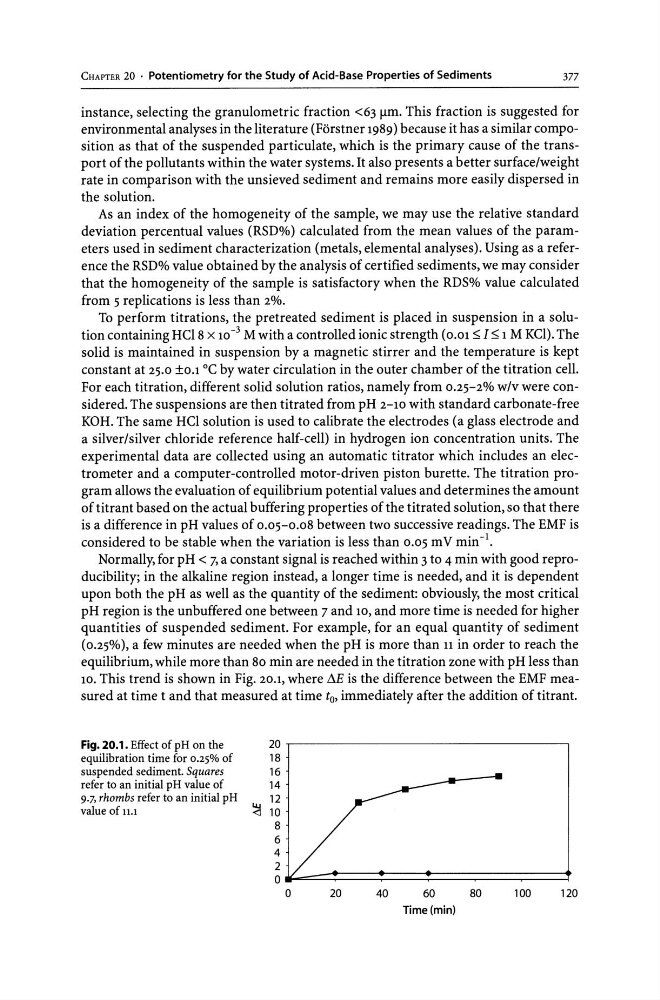
quantities of suspended sediment. For example, for an equal quantity of sediment
(0.25%), a few minutes are needed when the pH is more than 11 in order to reach the
equilibrium, while more than So min are needed in the titration zone with pH less than
10. This trend is shown in Fig. 20.1, where LV! is the difference between the EMF measured at time t and that measured at time to, immediately after the addition of titrant.
Fig. 20.1. Effect of pH on the
equilibration time for 0.25% of
suspended sediment. Squares
refer to an initial pH value of
9.7, rhombs refer to an initial pH
value of 11.1
~
20
18
16
14
12
10
8
6
4
2
0
0
20
40
60
Time (min)
80
100
120
377
instance, selecting the granulometric fraction <63 flm. This fraction is suggested for
environmental analyses in the literature (Forstner 19S9) because it has a similar composition as that of the suspended particulate, which is the primary cause of the transport of the pollutants within the water systems. It also presents a better surface/weight
rate in comparison with the unsieved sediment and remains more easily dispersed in
the solution.
As an index of the homogeneity of the sample, we may use the relative standard
deviation percentual values (RSD%) calculated from the mean values of the parameters used in sediment characterization (metals, elemental analyses). Using as a reference the RSD% value obtained by the analysis of certified sediments, we may consider
that the homogeneity of the sample is satisfactory when the RDS% value calculated
from 5 replications is less than 2%.
To perform titrations, the pretreated sediment is placed in suspension in a solution containing HCIs x 10- 3 M with a controlled ionic strength (om::; I::; 1 M KCI). The
solid is maintained in suspension by a magnetic stirrer and the temperature is kept
constant at 25.0 ±0.1 °C by water circulation in the outer chamber of the titration cell.
For each titration, different solid solution ratios, namely from 0.25-2% w/v were considered. The suspensions are then titrated from pH 2-10 with standard carbonate-free
KOH. The same HCI solution is used to calibrate the electrodes (a glass electrode and
a silver/silver chloride reference half-cell) in hydrogen ion concentration units. The
experimental data are collected using an automatic titrator which includes an electrometer and a computer-controlled motor-driven piston burette. The titration program allows the evaluation of equilibrium potential values and determines the amount
of titrant based on the actual buffering properties of the titrated solution, so that there
is a difference in pH values of 0.05-0.0S between two successive readings. The EMF is
considered to be stable when the variation is less than 0.05 m V min -1.
Normally, for pH < 7, a constant signal is reached within 3 to 4 min with good reproducibility; in the alkaline region instead, a longer time is needed, and it is dependent
upon both the pH as well as the quantity of the sediment: obviously, the most critical
pH region is the unbuffered one between 7 and 10, and more time is needed for higher
quantities of suspended sediment. For example, for an equal quantity of sediment
(0.25%), a few minutes are needed when the pH is more than 11 in order to reach the
equilibrium, while more than So min are needed in the titration zone with pH less than
10. This trend is shown in Fig. 20.1, where LV! is the difference between the EMF measured at time t and that measured at time to, immediately after the addition of titrant.
Fig. 20.1. Effect of pH on the
equilibration time for 0.25% of
suspended sediment. Squares
refer to an initial pH value of
9.7, rhombs refer to an initial pH
value of 11.1
~
20
18
16
14
12
10
8
6
4
2
0
0
20
40
60
Time (min)
80
100
120