

CHAPTER 15 . Redox Processes of Chromium in Sea Water
0 . 1 8 . . , . . . - - - - - - - - - - - - - - - - ,
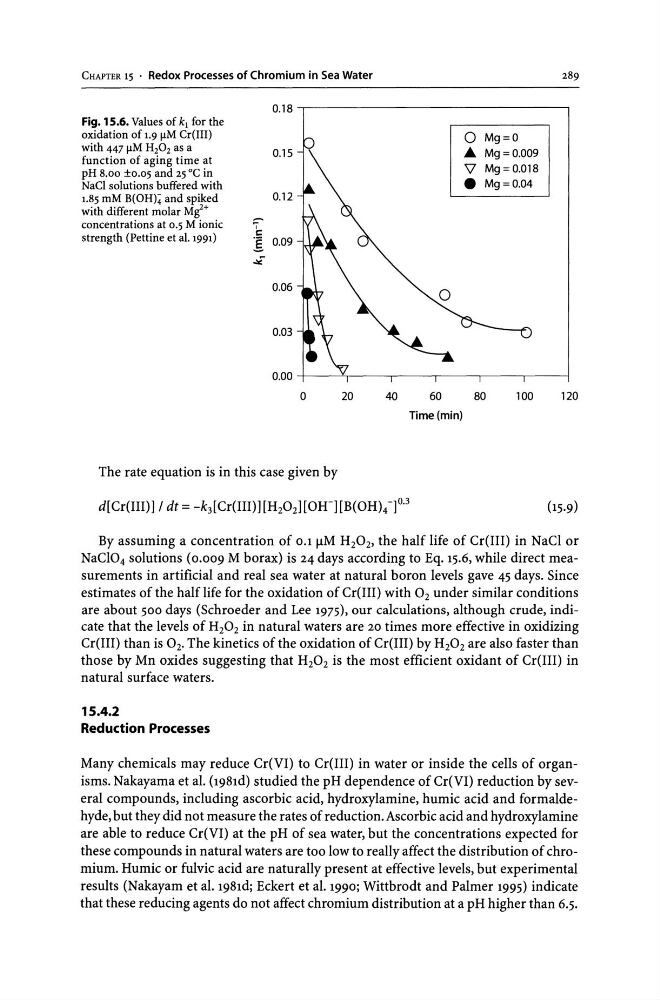
Fig. 15.6. Values of kj for the
oxidation of 1.9 flM Cr(III)
with 447 f!M H20 2 as a
function of aging time at
pH 8.00 ±0.05 and 25°C in
NaCI solutions buffered with
1.85 mM B(OH):; and spiked
with different molar Mi+
concentrations at 0.5 M ionic
strength (Pettine et a1.1991)
'i
c:
I
.:¥
0.15
0.12
0.09
0.06
0.03
0 Mg=O
•
Mg=0.009
'V Mg=0.018
•
Mg=O.04
0.00 +------"-r--.....,.--,-----y---,---j
o
20
40
The rate equation is in this case given by
60
Time (min)
80
100
120
By assuming a concentration of 0.1 flM H20 2, the half life of Cr(III) in NaCI or
NaCI04 solutions (0.009 M borax) is 24 days according to Eq. 15.6, while direct measurements in artificial and real sea water at natural boron levels gave 45 days. Since
estimates of the half life for the oxidation of Cr(III) with O2 under similar conditions
are about 500 days (Schroeder and Lee 1975), our calculations, although crude, indicate that the levels of H20 2 in natural waters are 20 times more effective in oxidizing
Cr(III) than is 02' The kinetics of the oxidation of Cr(III) by H20 2 are also faster than
those by Mn oxides suggesting that H20 2 is the most efficient oxidant of Cr(III) in
natural surface waters.
15.4.2
Reduction Processes
Many chemicals may reduce Cr(VI) to Cr(III) in water or inside the cells of organisms. Nakayama et al. (1981d) studied the pH dependence of Cr(VI) reduction by several compounds, including ascorbic acid, hydroxylamine, humic acid and formaldehyde, but they did not measure the rates of reduction. Ascorbic acid and hydroxylamine
are able to reduce Cr(VI) at the pH of sea water, but the concentrations expected for
these compounds in natural waters are too low to really affect the distribution of chromium. Humic or fulvic acid are naturally present at effective levels, but experimental
results (Nakayam et al. 1981d; Eckert et al. 1990; Wittbrodt and Palmer 1995) indicate
that these reducing agents do not affect chromium distribution at a pH higher than 6.5.
0 . 1 8 . . , . . . - - - - - - - - - - - - - - - - ,
Fig. 15.6. Values of kj for the
oxidation of 1.9 flM Cr(III)
with 447 f!M H20 2 as a
function of aging time at
pH 8.00 ±0.05 and 25°C in
NaCI solutions buffered with
1.85 mM B(OH):; and spiked
with different molar Mi+
concentrations at 0.5 M ionic
strength (Pettine et a1.1991)
'i
c:
I
.:¥
0.15
0.12
0.09
0.06
0.03
0 Mg=O
•
Mg=0.009
'V Mg=0.018
•
Mg=O.04
0.00 +------"-r--.....,.--,-----y---,---j
o
20
40
The rate equation is in this case given by
60
Time (min)
80
100
120
By assuming a concentration of 0.1 flM H20 2, the half life of Cr(III) in NaCI or
NaCI04 solutions (0.009 M borax) is 24 days according to Eq. 15.6, while direct measurements in artificial and real sea water at natural boron levels gave 45 days. Since
estimates of the half life for the oxidation of Cr(III) with O2 under similar conditions
are about 500 days (Schroeder and Lee 1975), our calculations, although crude, indicate that the levels of H20 2 in natural waters are 20 times more effective in oxidizing
Cr(III) than is 02' The kinetics of the oxidation of Cr(III) by H20 2 are also faster than
those by Mn oxides suggesting that H20 2 is the most efficient oxidant of Cr(III) in
natural surface waters.
15.4.2
Reduction Processes
Many chemicals may reduce Cr(VI) to Cr(III) in water or inside the cells of organisms. Nakayama et al. (1981d) studied the pH dependence of Cr(VI) reduction by several compounds, including ascorbic acid, hydroxylamine, humic acid and formaldehyde, but they did not measure the rates of reduction. Ascorbic acid and hydroxylamine
are able to reduce Cr(VI) at the pH of sea water, but the concentrations expected for
these compounds in natural waters are too low to really affect the distribution of chromium. Humic or fulvic acid are naturally present at effective levels, but experimental
results (Nakayam et al. 1981d; Eckert et al. 1990; Wittbrodt and Palmer 1995) indicate
that these reducing agents do not affect chromium distribution at a pH higher than 6.5.