

288
M.Pettine
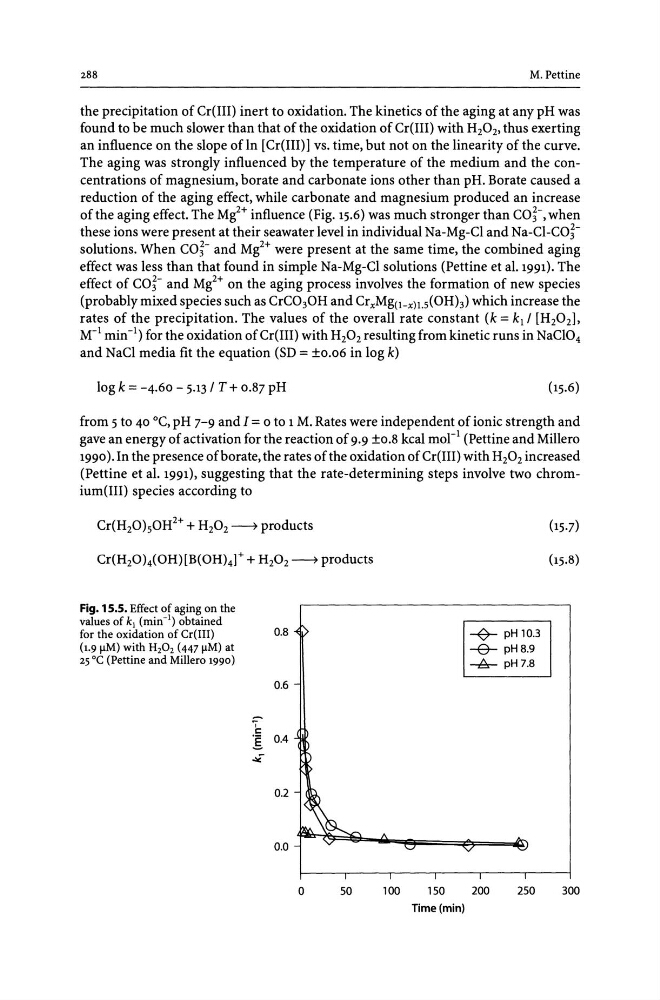
the precipitation of Cr(IlI) inert to oxidation. The kinetics of the aging at any pH was
found to be much slower than that of the oxidation of Cr(IlI) with H 2 0 2 , thus exerting
an influence on the slope ofln [Cr(III)] vs. time, but not on the linearity of the curve.
The aging was strongly influenced by the temperature of the medium and the concentrations of magnesium, borate and carbonate ions other than pH. Borate caused a
reduction of the aging effect, while carbonate and magnesium produced an increase
of the aging effect. The Mg2+ influence (Fig. 15.6) was much stronger than CO~-, when
these ions were present at their seawater level in individual Na-Mg-CI and Na-Cl-CO~solutions. When CO~- and Mg2+ were present at the same time, the combined aging
effect was less than that found in simple Na-Mg-CI solutions (Pettine et al. 1991). The
effect of CO~- and Mg2+ on the aging process involves the formation of new species
(probably mixed species such as CrC030H and CrxMg(l_x)l.s(OHh) which increase the
rates of the precipitation. The values of the overall rate constant (k = kll [H20 2],
M- I min -I) for the oxidation of Cr(III) with H 2 0 2 resulting from kinetic runs in NaCI0 4
and NaCI media fit the equation (SD = ±0.06 in log k)
log k = -4.60 - 5.131 T + 0.87 pH
from 5 to 40°C, pH 7-9 and I = 0 to 1 M. Rates were independent of ionic strength and
gave an energy of activation for the reaction of 9.9 ±0.8 kcal mOrl (Pettine and Millero
1990). In the presence of borate, the rates of the oxidation of Cr(IlI) with H 2 0 2 increased
(Pettine et al. 1991), suggesting that the rate-determining steps involve two chromium(III) species according to
Fig. 15.5. Effect of aging on the
values of kl (min-I) obtained
for the oxidation of Cr(III)
(1.9 liM) with H20 2 (447 11M) at
25 DC (Pettine and Millero 1990)
,. c
:g
..c
O.S
0.6
0.4
0.2
0.0
o
50
100
150
TIme (min)
~ pH 10.3
-e- pHS.9
-A- pH7.S
200
250
(15·8)
300
M.Pettine
the precipitation of Cr(IlI) inert to oxidation. The kinetics of the aging at any pH was
found to be much slower than that of the oxidation of Cr(IlI) with H 2 0 2 , thus exerting
an influence on the slope ofln [Cr(III)] vs. time, but not on the linearity of the curve.
The aging was strongly influenced by the temperature of the medium and the concentrations of magnesium, borate and carbonate ions other than pH. Borate caused a
reduction of the aging effect, while carbonate and magnesium produced an increase
of the aging effect. The Mg2+ influence (Fig. 15.6) was much stronger than CO~-, when
these ions were present at their seawater level in individual Na-Mg-CI and Na-Cl-CO~solutions. When CO~- and Mg2+ were present at the same time, the combined aging
effect was less than that found in simple Na-Mg-CI solutions (Pettine et al. 1991). The
effect of CO~- and Mg2+ on the aging process involves the formation of new species
(probably mixed species such as CrC030H and CrxMg(l_x)l.s(OHh) which increase the
rates of the precipitation. The values of the overall rate constant (k = kll [H20 2],
M- I min -I) for the oxidation of Cr(III) with H 2 0 2 resulting from kinetic runs in NaCI0 4
and NaCI media fit the equation (SD = ±0.06 in log k)
log k = -4.60 - 5.131 T + 0.87 pH
from 5 to 40°C, pH 7-9 and I = 0 to 1 M. Rates were independent of ionic strength and
gave an energy of activation for the reaction of 9.9 ±0.8 kcal mOrl (Pettine and Millero
1990). In the presence of borate, the rates of the oxidation of Cr(IlI) with H 2 0 2 increased
(Pettine et al. 1991), suggesting that the rate-determining steps involve two chromium(III) species according to
Fig. 15.5. Effect of aging on the
values of kl (min-I) obtained
for the oxidation of Cr(III)
(1.9 liM) with H20 2 (447 11M) at
25 DC (Pettine and Millero 1990)
,. c
:g
..c
O.S
0.6
0.4
0.2
0.0
o
50
100
150
TIme (min)
~ pH 10.3
-e- pHS.9
-A- pH7.S
200
250
(15·8)
300