

CHAPTER 15 • Redox Processes of Chromium in Sea Water
Cr(VI) can exist in a number of different forms as a function of pH, including
H2Cr04,HCr04,CrO~- and the dimerCr20~- (see Fig. 15.1b and Appendix). At micromolar or lower levels of Cr(VI), typical of marine environments, the concentration of the
dimer is negligible and the predominant Cr(VI) species at pH > 7 is chromate (Fig. 15.1b).
The reduction of CrO~- to Cr(OH); has been described by Elderfield (1970) as
The equilibrium constant for Reaction 15.1 from free energies of formation given
by Hem (1977) is log K = 66.19 at 25°C and I = 0 M. This gives log K = 65.31 at the ionic
strength of seawater by assuming YCr(OH); = 0.82 (Elderfield 1970) and )H+ = 0.97 and
YCrOJ-= 0.13 (Millero and Schreiber 1982). According to the above reaction, the equilibrium ratio of dissolved Cr is given by (Murray et al. 1983)
log([Cr(VI)] I [Cr(III)]) = 6 pH + 3 pe -log K
At pH 8.1 and pe 12.5, the ratio of Cr(VI) to Cr(Ill) should be about 10 20 in both diluted and saline solutions; Cr(VI) should predominate. If pe is 6.5, consistent with
control of sea water pe by the 021H202 couple and H20 2 = 0.1 f.LM (Moffett and Zika
1983), the ratio falls to about 10 2 . 8 , again suggesting a large dominance of Cr(VI).
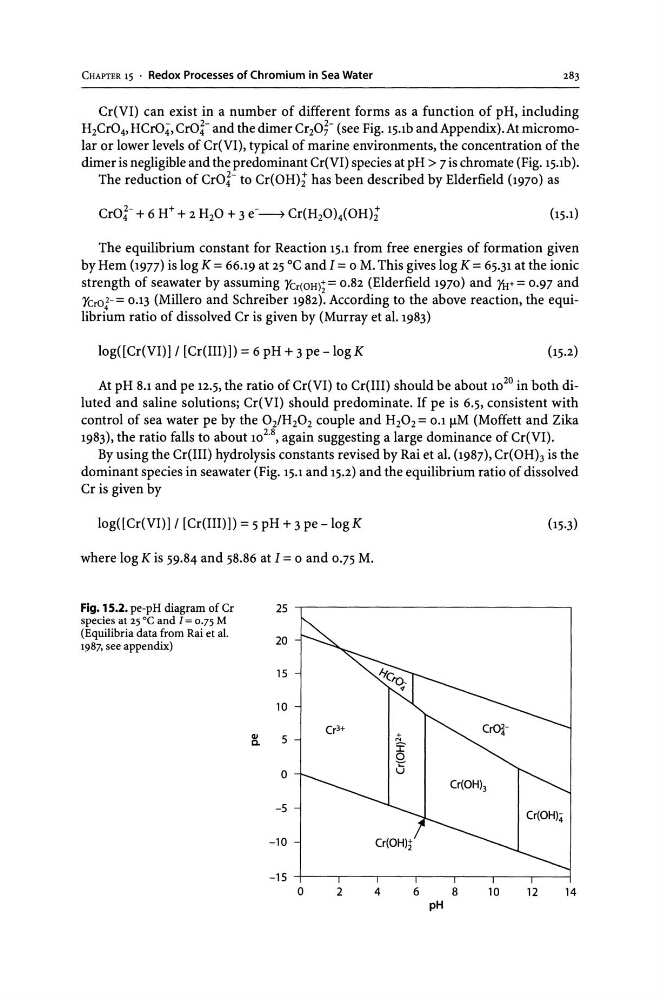
By using the Cr(III) hydrolysis constants revised by Rai et al. (1987), Cr(OHh is the
dominant species in seawater (Fig. 15-1 and 15.2) and the equilibrium ratio of dissolved
Cr is given by
log([Cr(VI)] I [Cr(III)]) = 5 pH + 3 pe -log K
where log K is 59.84 and 58.86 at 1= 0 and 0.75 M.
Fig. 15.2. pe-pH diagram of Cr
species at 25 ·C and 1= 0.75 M
(Equilibria data from Rai et al.
1987, see appendix)
25 ,--------------------------------,
20
15
10
~
5
o
-5
-10
-15 +------.----,---------,----,-----,,---------,----1
o
2
4
6
8
10
12
14
pH
Cr(VI) can exist in a number of different forms as a function of pH, including
H2Cr04,HCr04,CrO~- and the dimerCr20~- (see Fig. 15.1b and Appendix). At micromolar or lower levels of Cr(VI), typical of marine environments, the concentration of the
dimer is negligible and the predominant Cr(VI) species at pH > 7 is chromate (Fig. 15.1b).
The reduction of CrO~- to Cr(OH); has been described by Elderfield (1970) as
The equilibrium constant for Reaction 15.1 from free energies of formation given
by Hem (1977) is log K = 66.19 at 25°C and I = 0 M. This gives log K = 65.31 at the ionic
strength of seawater by assuming YCr(OH); = 0.82 (Elderfield 1970) and )H+ = 0.97 and
YCrOJ-= 0.13 (Millero and Schreiber 1982). According to the above reaction, the equilibrium ratio of dissolved Cr is given by (Murray et al. 1983)
log([Cr(VI)] I [Cr(III)]) = 6 pH + 3 pe -log K
At pH 8.1 and pe 12.5, the ratio of Cr(VI) to Cr(Ill) should be about 10 20 in both diluted and saline solutions; Cr(VI) should predominate. If pe is 6.5, consistent with
control of sea water pe by the 021H202 couple and H20 2 = 0.1 f.LM (Moffett and Zika
1983), the ratio falls to about 10 2 . 8 , again suggesting a large dominance of Cr(VI).
By using the Cr(III) hydrolysis constants revised by Rai et al. (1987), Cr(OHh is the
dominant species in seawater (Fig. 15-1 and 15.2) and the equilibrium ratio of dissolved
Cr is given by
log([Cr(VI)] I [Cr(III)]) = 5 pH + 3 pe -log K
where log K is 59.84 and 58.86 at 1= 0 and 0.75 M.
Fig. 15.2. pe-pH diagram of Cr
species at 25 ·C and 1= 0.75 M
(Equilibria data from Rai et al.
1987, see appendix)
25 ,--------------------------------,
20
15
10
~
5
o
-5
-10
-15 +------.----,---------,----,-----,,---------,----1
o
2
4
6
8
10
12
14
pH