

282
M. Pettine
important hydroxyl complex in seawater. Recently, Rai et al. (1987) have revised the
hydrolysis constants of Cr(IlI) and suggested that Cr(OH); contributes only marginally to the total soluble chromium (III), while Cr(OHh is the dominant complex in
aquatic systems at the most common pH. The hydrolysis constants of Cr 3 + resulting
from these recent findings (Rai et al. 1987; Rai et al. 1989) have been compared with
those proposed by Baes and Mesmer (1976) (see appendix). The Cr(III) speciation
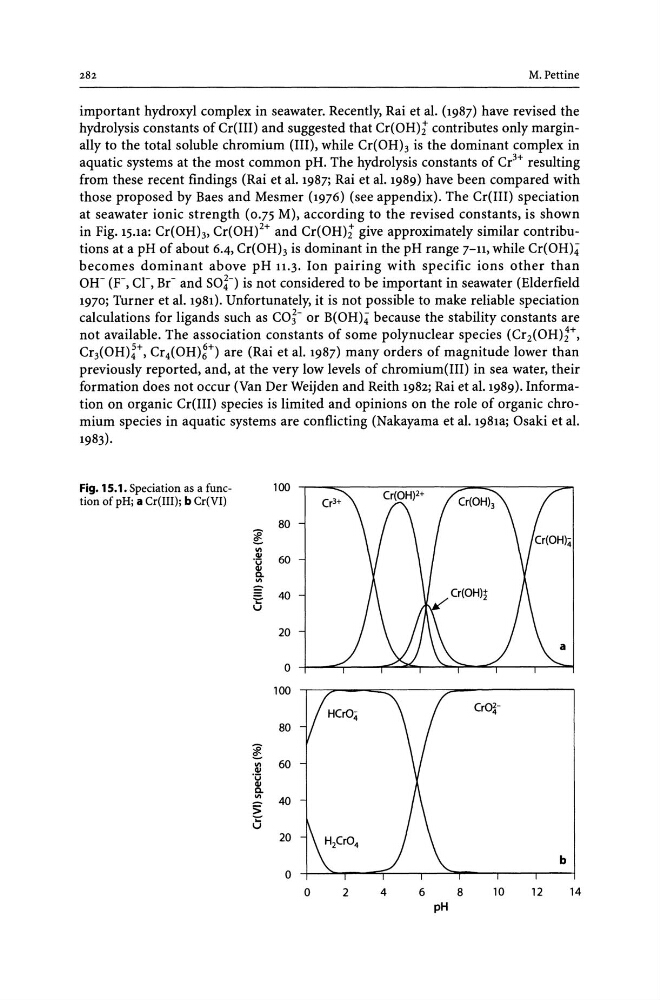
at seawater ionic strength (0.75 M), according to the revised constants, is shown
in Fig. 15.1a: Cr(OHh, Cr(OH)2+ and Cr(OH); give approximately similar contributions at a pH of about 6.4, Cr(OHh is dominant in the pH range 7-11, while Cr(OH)4"
becomes dominant above pH 11.3. Ion pairing with specific ions other than
OW (F-, cr, Br- and SO~-) is not considered to be important in seawater (Elderfield
1970; Turner et al. 1981). Unfortunately, it is not possible to make reliable speciation
calculations for ligands such as CO;- or B(OH)4" because the stability constants are
not available. The association constants of some polynuclear species (Cr2(OH)i+'
Cr3(OH)r, Cr4(OH)g+) are (Rai et al. 1987) many orders of magnitude lower than
previously reported, and, at the very low levels of chromium(III) in sea water, their
formation does not occur (Van Der Weijden and Reith 1982; Rai et al.1989). Information on organic Cr(I1I) species is limited and opinions on the role of organic chromium species in aquatic systems are conflicting (Nakayama et al. 1981a; Osaki et al.
1983).
Fig. 15.1. Speciation as a func100
tion of pH; a Cr(III); b Cr(VJ)
Cr3+
80
~
III
.~
60
8. III
~
40
20
a
0
100
C~80
~
III
60
G/
.~
Co
III
40
5
a20
b
0
0
2
4
6
8
10
12
14
pH
M. Pettine
important hydroxyl complex in seawater. Recently, Rai et al. (1987) have revised the
hydrolysis constants of Cr(IlI) and suggested that Cr(OH); contributes only marginally to the total soluble chromium (III), while Cr(OHh is the dominant complex in
aquatic systems at the most common pH. The hydrolysis constants of Cr 3 + resulting
from these recent findings (Rai et al. 1987; Rai et al. 1989) have been compared with
those proposed by Baes and Mesmer (1976) (see appendix). The Cr(III) speciation
at seawater ionic strength (0.75 M), according to the revised constants, is shown
in Fig. 15.1a: Cr(OHh, Cr(OH)2+ and Cr(OH); give approximately similar contributions at a pH of about 6.4, Cr(OHh is dominant in the pH range 7-11, while Cr(OH)4"
becomes dominant above pH 11.3. Ion pairing with specific ions other than
OW (F-, cr, Br- and SO~-) is not considered to be important in seawater (Elderfield
1970; Turner et al. 1981). Unfortunately, it is not possible to make reliable speciation
calculations for ligands such as CO;- or B(OH)4" because the stability constants are
not available. The association constants of some polynuclear species (Cr2(OH)i+'
Cr3(OH)r, Cr4(OH)g+) are (Rai et al. 1987) many orders of magnitude lower than
previously reported, and, at the very low levels of chromium(III) in sea water, their
formation does not occur (Van Der Weijden and Reith 1982; Rai et al.1989). Information on organic Cr(I1I) species is limited and opinions on the role of organic chromium species in aquatic systems are conflicting (Nakayama et al. 1981a; Osaki et al.
1983).
Fig. 15.1. Speciation as a func100
tion of pH; a Cr(III); b Cr(VJ)
Cr3+
80
~
III
.~
60
8. III
~
40
20
a
0
100
C~80
~
III
60
G/
.~
Co
III
40
5
a20
b
0
0
2
4
6
8
10
12
14
pH