

12
F.J. Millero
to equilibrium with seawater. Although this process is slow, his calculations indicate
that the addition of 1 095 molecules of CO2 to the atmosphere, will decrease to 15 molecules after 1000 years. Most of the added CO2 (985 molecules) will end up as part of
the inorganic pool as bicarbonate and carbonate ions.
The CO2 produced from the burning of fossil fuel can be taken up by the oceans by
two methods:
1. the Solubility Pump and
2. the Biology Pump.
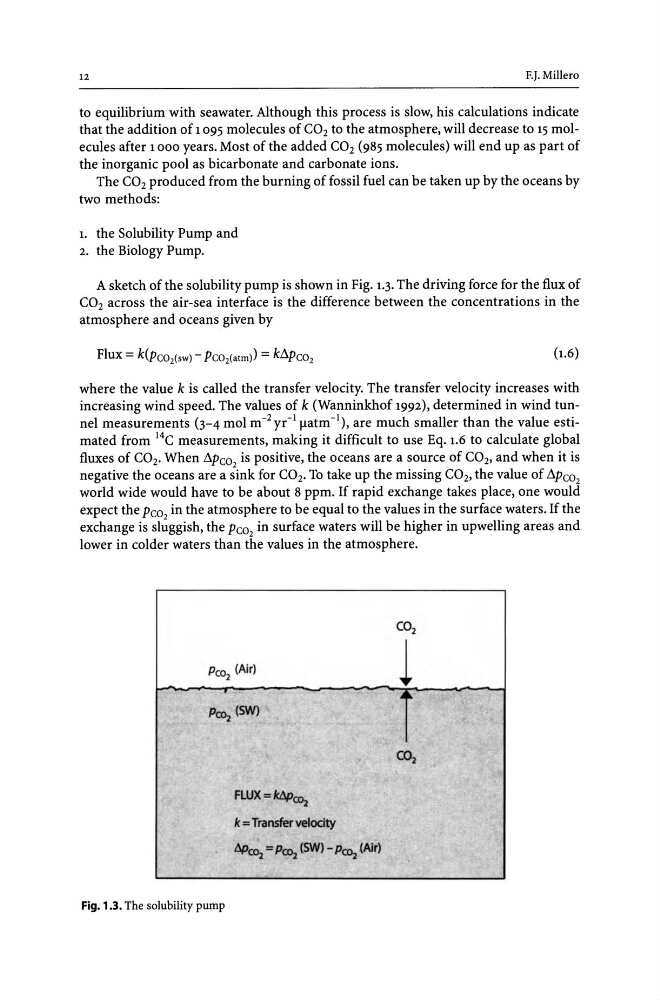
A sketch of the solubility pump is shown in Fig. 1.3. The driving force for the flux of
CO2 across the air-sea interface is the difference between the concentrations in the
atmosphere and oceans given by
(1.6)
where the value k is called the transfer velocity. The transfer velocity increases with
increasing wind speed. The values of k (Wanninkhof 1992), determined in wind tunnel measurements (3-4 mol m- 2 yr- 1 flatm-1), are much smaller than the value estimated from 14C measurements, making it difficult to use Eq. 1.6 to calculate global
fluxes of CO 2 , When !1pc0 2 is positive, the oceans are a source of CO2, and when it is
negative the oceans are a sink for CO2, To take up the missing CO2, the value of !1pc0 2
world wide would have to be about 8 ppm. If rapid exchange takes place, one would
expect the Pc0 2 in the atmosphere to be equal to the values in the surface waters. If the
exchange is sluggish, the Pc0 2 in surface waters will be higher in upwelling areas and
lower in colder waters than the values in the atmosphere.
Pc~ (Air)
p~(SW)
FLUX = Ict.p~
k = Transfer velocity
llp~ = p~ (SW) - p~ (Air)
Fig. 1.3. The solubility pump
F.J. Millero
to equilibrium with seawater. Although this process is slow, his calculations indicate
that the addition of 1 095 molecules of CO2 to the atmosphere, will decrease to 15 molecules after 1000 years. Most of the added CO2 (985 molecules) will end up as part of
the inorganic pool as bicarbonate and carbonate ions.
The CO2 produced from the burning of fossil fuel can be taken up by the oceans by
two methods:
1. the Solubility Pump and
2. the Biology Pump.
A sketch of the solubility pump is shown in Fig. 1.3. The driving force for the flux of
CO2 across the air-sea interface is the difference between the concentrations in the
atmosphere and oceans given by
(1.6)
where the value k is called the transfer velocity. The transfer velocity increases with
increasing wind speed. The values of k (Wanninkhof 1992), determined in wind tunnel measurements (3-4 mol m- 2 yr- 1 flatm-1), are much smaller than the value estimated from 14C measurements, making it difficult to use Eq. 1.6 to calculate global
fluxes of CO 2 , When !1pc0 2 is positive, the oceans are a source of CO2, and when it is
negative the oceans are a sink for CO2, To take up the missing CO2, the value of !1pc0 2
world wide would have to be about 8 ppm. If rapid exchange takes place, one would
expect the Pc0 2 in the atmosphere to be equal to the values in the surface waters. If the
exchange is sluggish, the Pc0 2 in surface waters will be higher in upwelling areas and
lower in colder waters than the values in the atmosphere.
Pc~ (Air)
p~(SW)
FLUX = Ict.p~
k = Transfer velocity
llp~ = p~ (SW) - p~ (Air)
Fig. 1.3. The solubility pump