

CHAPTER 1 • The Carbonate System in Marine Environments
11
bon in various reservoirs and the global carbon cycle. The most recent estimates are
shown in Fig. 1.2. The inorganic carbon estimates are reasonably accurate, but estimates for the carbon in the marine biosphere and humus are less precisely known.
Most of the carbon in the oceans resides below the thermocline. The amount of carbon stored in carbonate rocks and sediments is a lot larger than the cycled COz, but is
not important on short time scales (years).
The recent interest in the distribution of COz in the oceans is related to the need to
understand how the increase of COz in the atmosphere and the expected increase in
temperature will affect the climate. The classical measurements of Pc0 2 in the atmosphere were made by Keeling and Whorf (1994) at the Mauna Loa Observatory in
Hawaii, started in 1958. More recent measurements have been made throughout the
world and on the air trapped in ice cores. These measurements clearly demonstrate
that the COz in the atmosphere is increasing due to the burning of fossil fuels. Although
the rates of increase are the same as the increase in the use of fossil fuels, the amounts
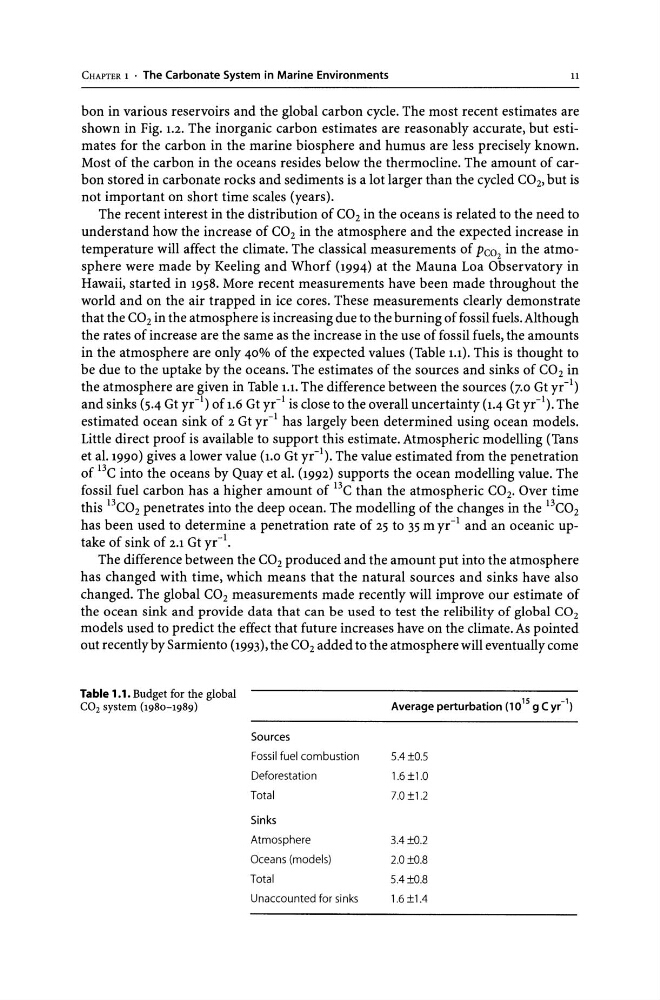
in the atmosphere are only 40% of the expected values (Table 1.1). This is thought to
be due to the uptake by the oceans. The estimates of the sources and sinks of COz in
the atmosphere are given in Table 1.1. The difference between the sources (7.0 Gt yr- 1 )
and sinks (5.4 Gt yr- 1 ) ofl.6 Gt yr- 1 is close to the overall uncertainty (1.4 Gt yr- 1 ). The
estimated ocean sink of 2 Gt yr- 1 has largely been determined using ocean models.
Little direct proof is available to support this estimate. Atmospheric modelling (Tans
et al.1990) gives a lower value (1.0 Gt yr- 1 ). The value estimated from the penetration
of BC into the oceans by Quay et al. (1992) supports the ocean modelling value. The
fossil fuel carbon has a higher amount of BC than the atmospheric COz. Over time
this BCOz penetrates into the deep ocean. The modelling of the changes in the BCO z
has been used to determine a penetration rate of 25 to 35 m yr- 1 and an oceanic uptake of sink of 2.1 Gt yr- 1 •
The difference between the COz produced and the amount put into the atmosphere
has changed with time, which means that the natural sources and sinks have also
changed. The global COz measurements made recently will improve our estimate of
the ocean sink and provide data that can be used to test the relibility of global CO2
models used to predict the effect that future increases have on the climate. As pointed
out recently by Sarmiento (1993), the COz added to the atmosphere will eventually come
Table 1.1. Budget for the global
CO2 system (1980-1989)
Sources
Fossil fuel combustion
Deforestation
Total
Sinks
Atmosphere
Oceans (models)
Total
Unaccounted for sinks
Average perturbation (lOIS g Cyr- I )
5.4 ±O.5
1.6 ±1.0
7.0±1.2
3.4 ±O.2
2.0±O.B
5.4 ±O.B
1.6 ±1.4
11
bon in various reservoirs and the global carbon cycle. The most recent estimates are
shown in Fig. 1.2. The inorganic carbon estimates are reasonably accurate, but estimates for the carbon in the marine biosphere and humus are less precisely known.
Most of the carbon in the oceans resides below the thermocline. The amount of carbon stored in carbonate rocks and sediments is a lot larger than the cycled COz, but is
not important on short time scales (years).
The recent interest in the distribution of COz in the oceans is related to the need to
understand how the increase of COz in the atmosphere and the expected increase in
temperature will affect the climate. The classical measurements of Pc0 2 in the atmosphere were made by Keeling and Whorf (1994) at the Mauna Loa Observatory in
Hawaii, started in 1958. More recent measurements have been made throughout the
world and on the air trapped in ice cores. These measurements clearly demonstrate
that the COz in the atmosphere is increasing due to the burning of fossil fuels. Although
the rates of increase are the same as the increase in the use of fossil fuels, the amounts
in the atmosphere are only 40% of the expected values (Table 1.1). This is thought to
be due to the uptake by the oceans. The estimates of the sources and sinks of COz in
the atmosphere are given in Table 1.1. The difference between the sources (7.0 Gt yr- 1 )
and sinks (5.4 Gt yr- 1 ) ofl.6 Gt yr- 1 is close to the overall uncertainty (1.4 Gt yr- 1 ). The
estimated ocean sink of 2 Gt yr- 1 has largely been determined using ocean models.
Little direct proof is available to support this estimate. Atmospheric modelling (Tans
et al.1990) gives a lower value (1.0 Gt yr- 1 ). The value estimated from the penetration
of BC into the oceans by Quay et al. (1992) supports the ocean modelling value. The
fossil fuel carbon has a higher amount of BC than the atmospheric COz. Over time
this BCOz penetrates into the deep ocean. The modelling of the changes in the BCO z
has been used to determine a penetration rate of 25 to 35 m yr- 1 and an oceanic uptake of sink of 2.1 Gt yr- 1 •
The difference between the COz produced and the amount put into the atmosphere
has changed with time, which means that the natural sources and sinks have also
changed. The global COz measurements made recently will improve our estimate of
the ocean sink and provide data that can be used to test the relibility of global CO2
models used to predict the effect that future increases have on the climate. As pointed
out recently by Sarmiento (1993), the COz added to the atmosphere will eventually come
Table 1.1. Budget for the global
CO2 system (1980-1989)
Sources
Fossil fuel combustion
Deforestation
Total
Sinks
Atmosphere
Oceans (models)
Total
Unaccounted for sinks
Average perturbation (lOIS g Cyr- I )
5.4 ±O.5
1.6 ±1.0
7.0±1.2
3.4 ±O.2
2.0±O.B
5.4 ±O.B
1.6 ±1.4