

CHAPTER 13 • Mercury in Marine Environments
251
Water column
Diffusion
Burial
Diffusion
14kgyrl
200kgyr 1
<0.03kgyrl
u
Hg(lI)
MMHg
¢:::::::> I
Fe/Mn oxides-Hg
¢:::::::>
DMHg
I
RS-Hg
<0.05 kg
260 kg
Oxic sediment
max. 50 kg yr 1
I
I
¢:::::::>
MMHg
associated
Hg
dissolved
64 kg
FeS-Hg
SnHg
I
\
FeS 2 -Hg
SnP3-Hg
8
1
DMHg
I
RS-Hg
RS-Hg
I
2xl04kg
Anoxic Sediment
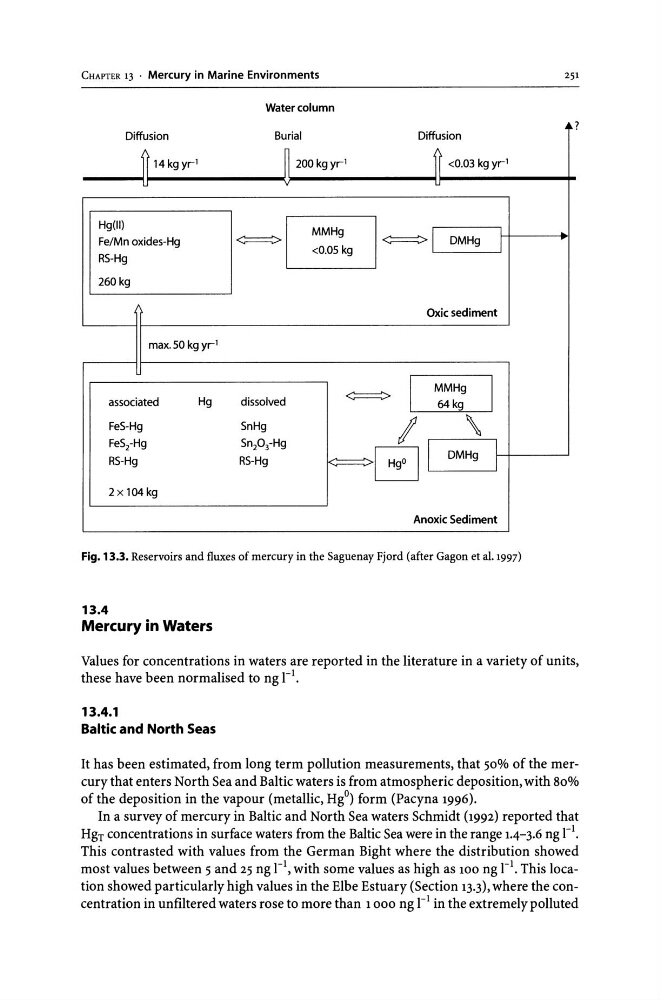
Fig. 13.3. Reservoirs and fluxes of mercury in the Saguenay Fjord (after Gagon et al. 1997)
13.4
Mercury in Waters
Values for concentrations in waters are reported in the literature in a variety of units,
these have been normalised to ng r1.
13.4.1
Baltic and North Seas
It has been estimated, from long term pollution measurements, that 50% of the mercury that enters North Sea and Baltic waters is from atmospheric deposition, with 80%
of the deposition in the vapour (metallic, Hgo) form (Pacyna 1996).
In a survey of mercury in Baltic and North Sea waters Schmidt (1992) reported that
Hgr concentrations in surface waters from the Baltic Sea were in the range 1.4-3.6 ng r1.
This contrasted with values from the German Bight where the distribution showed
most values between 5 and 25 ng r1, with some values as high as 100 ng r1. This location showed particularly high values in the Elbe Estuary (Section 13.3), where the concentration in unfiltered waters rose to more than 1000 ng r1 in the extremely polluted
251
Water column
Diffusion
Burial
Diffusion
14kgyrl
200kgyr 1
<0.03kgyrl
u
Hg(lI)
MMHg
¢:::::::> I
Fe/Mn oxides-Hg
¢:::::::>
DMHg
I
RS-Hg
<0.05 kg
260 kg
Oxic sediment
max. 50 kg yr 1
I
I
¢:::::::>
MMHg
associated
Hg
dissolved
64 kg
FeS-Hg
SnHg
I
\
FeS 2 -Hg
SnP3-Hg
8
1
DMHg
I
RS-Hg
RS-Hg
I
2xl04kg
Anoxic Sediment
Fig. 13.3. Reservoirs and fluxes of mercury in the Saguenay Fjord (after Gagon et al. 1997)
13.4
Mercury in Waters
Values for concentrations in waters are reported in the literature in a variety of units,
these have been normalised to ng r1.
13.4.1
Baltic and North Seas
It has been estimated, from long term pollution measurements, that 50% of the mercury that enters North Sea and Baltic waters is from atmospheric deposition, with 80%
of the deposition in the vapour (metallic, Hgo) form (Pacyna 1996).
In a survey of mercury in Baltic and North Sea waters Schmidt (1992) reported that
Hgr concentrations in surface waters from the Baltic Sea were in the range 1.4-3.6 ng r1.
This contrasted with values from the German Bight where the distribution showed
most values between 5 and 25 ng r1, with some values as high as 100 ng r1. This location showed particularly high values in the Elbe Estuary (Section 13.3), where the concentration in unfiltered waters rose to more than 1000 ng r1 in the extremely polluted