

214
C. De Stefano . C. Foti . A. Gianguzza . S. Sammartano
lates, and of many newly synthesized organotin(IV) complexes, has been extensively
studied by different authors (Arakawa and Wada 1993; Barnes and Magos 1968; Mennie
and Craig 1993; Thayer 1978, 1984; Gianguzza et al. 1994).
11.2
Aqueous Solution Chemistry of Organotin(lV) Compounds
In contrast with the significant number of studies on toxicity of organotin compounds,
there are relatively few data in literature about the chemical behaviour of these compounds in aqueous solutions.
Organotin cations are considered as acids, in the Lewis scale, of different hardness,
depending on the groups bonded to the tin(IV) (Tobias 1966). Consequently they show
a strong tendency to hydrolysis in aqueous solution, as demonstrated by Tobias et al.
(1966). The majority of investigations into the aqueous solution chemistry of organotin
compounds are reported in the literature in the sixties, when the use of these compounds was widespread. Unfortunately, the thermodynamic parameters reported in
all these studies refer to a non-interacting ionic medium and a single value of ionic
strength. From these data, therefore, it is impossible to know the behaviour of organotin
compounds in a multicomponent solution, which is necessary to describe the chemical speciation of these compounds in natural fluids. Moreover, a number of these investigations refer to the interactions of organotin moieties with organic ligands of
biological interest (with the aim of contributing to knowledge of their biological activity), often neglecting the hydrolysis processes of organotin cations. However, the
majority of investigations carried out into the aqueous chemistry of some alkyltin
compounds demonstrated that hydrolysis processes are very important in the chemical speciation studies of this class of compounds. After the hydrolytic equilibria have
been examined in the presence of non-complexing agents, it is possible to study the interaction of the organometallic cations with other ligands in order to define their chemical speciation in natural waters.
Since most of the organometallic cations have more than one water molecule in
the first coordination sphere, there are several stepwise proton transfer equilibria.
Condensation reactions of the monomeric conjugate bases often lead to the formation of polynuclear hydroxo-complexes in solution giving very complicated systems.
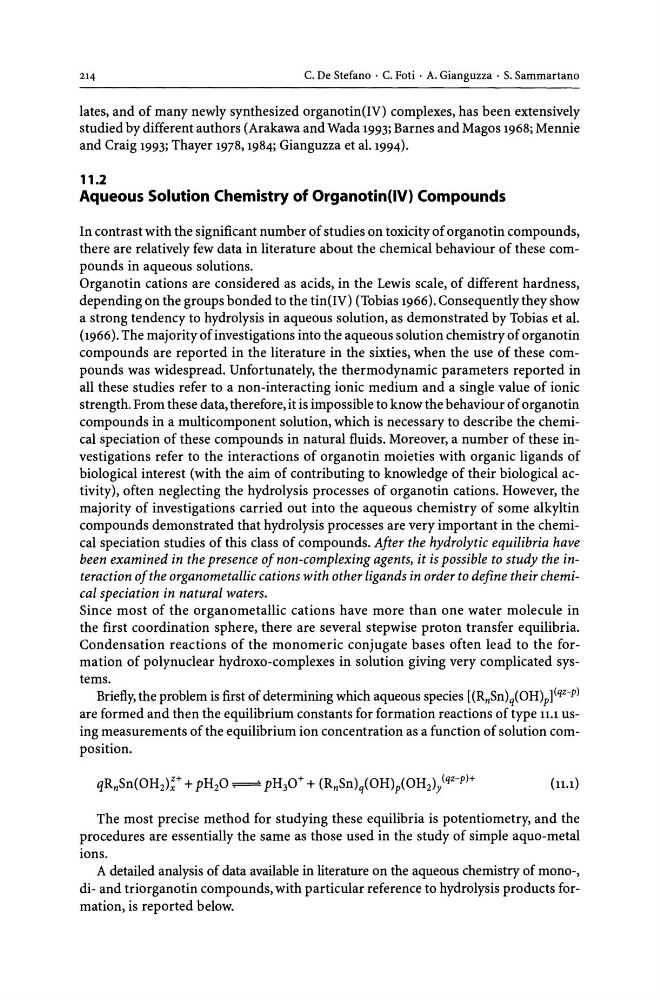
Briefly, the problem is first of determining which aqueous species [(RnSn)q(OH)pl(qz-P)
are formed and then the equilibrium constants for formation reactions of type 11.1 using measurements of the equilibrium ion concentration as a function of solution composition.
(11.1)
The most precise method for studying these equilibria is potentiometry, and the
procedures are essentially the same as those used in the study of simple aquo-metal
ions.
A detailed analysis of data available in literature on the aqueous chemistry of mono-,
di- and triorganotin compounds, with particular reference to hydrolysis products formation, is reported below.
C. De Stefano . C. Foti . A. Gianguzza . S. Sammartano
lates, and of many newly synthesized organotin(IV) complexes, has been extensively
studied by different authors (Arakawa and Wada 1993; Barnes and Magos 1968; Mennie
and Craig 1993; Thayer 1978, 1984; Gianguzza et al. 1994).
11.2
Aqueous Solution Chemistry of Organotin(lV) Compounds
In contrast with the significant number of studies on toxicity of organotin compounds,
there are relatively few data in literature about the chemical behaviour of these compounds in aqueous solutions.
Organotin cations are considered as acids, in the Lewis scale, of different hardness,
depending on the groups bonded to the tin(IV) (Tobias 1966). Consequently they show
a strong tendency to hydrolysis in aqueous solution, as demonstrated by Tobias et al.
(1966). The majority of investigations into the aqueous solution chemistry of organotin
compounds are reported in the literature in the sixties, when the use of these compounds was widespread. Unfortunately, the thermodynamic parameters reported in
all these studies refer to a non-interacting ionic medium and a single value of ionic
strength. From these data, therefore, it is impossible to know the behaviour of organotin
compounds in a multicomponent solution, which is necessary to describe the chemical speciation of these compounds in natural fluids. Moreover, a number of these investigations refer to the interactions of organotin moieties with organic ligands of
biological interest (with the aim of contributing to knowledge of their biological activity), often neglecting the hydrolysis processes of organotin cations. However, the
majority of investigations carried out into the aqueous chemistry of some alkyltin
compounds demonstrated that hydrolysis processes are very important in the chemical speciation studies of this class of compounds. After the hydrolytic equilibria have
been examined in the presence of non-complexing agents, it is possible to study the interaction of the organometallic cations with other ligands in order to define their chemical speciation in natural waters.
Since most of the organometallic cations have more than one water molecule in
the first coordination sphere, there are several stepwise proton transfer equilibria.
Condensation reactions of the monomeric conjugate bases often lead to the formation of polynuclear hydroxo-complexes in solution giving very complicated systems.
Briefly, the problem is first of determining which aqueous species [(RnSn)q(OH)pl(qz-P)
are formed and then the equilibrium constants for formation reactions of type 11.1 using measurements of the equilibrium ion concentration as a function of solution composition.
(11.1)
The most precise method for studying these equilibria is potentiometry, and the
procedures are essentially the same as those used in the study of simple aquo-metal
ions.
A detailed analysis of data available in literature on the aqueous chemistry of mono-,
di- and triorganotin compounds, with particular reference to hydrolysis products formation, is reported below.