

Chapter 11
Hydrolysis Processes of Organotin(lV) Compounds
in Sea Water
C. De Stefano . C. Foti . A. Gianguzza . S. Sammartano
11.1
Introduction
Organotin(IV) compounds include a variety of organometallic moieties characterized by a central tin atom covalently bonded to various organic groups (methyl, ethyl,
propyl, butyl, octyl, phenyl, etc.) through one or more carbon atoms. Their general formula can be indicated as RnSnX(4_n) (R = organic group; X = halide, nitrate, acetate,
hydroxide, etc.; n = 1 to 4). Because the tin-carbon bond is reported to be stable up
to 200°C (Zuckerman et al. 1978), these compounds must be considered thermally
stable under environmental conditions. Some factors, such as ultraviolet (UV) and
gamma (y) irradiation and biological and chemical cleavage, influence the degradation of organotin compounds by a progressive removing of organic groups, according
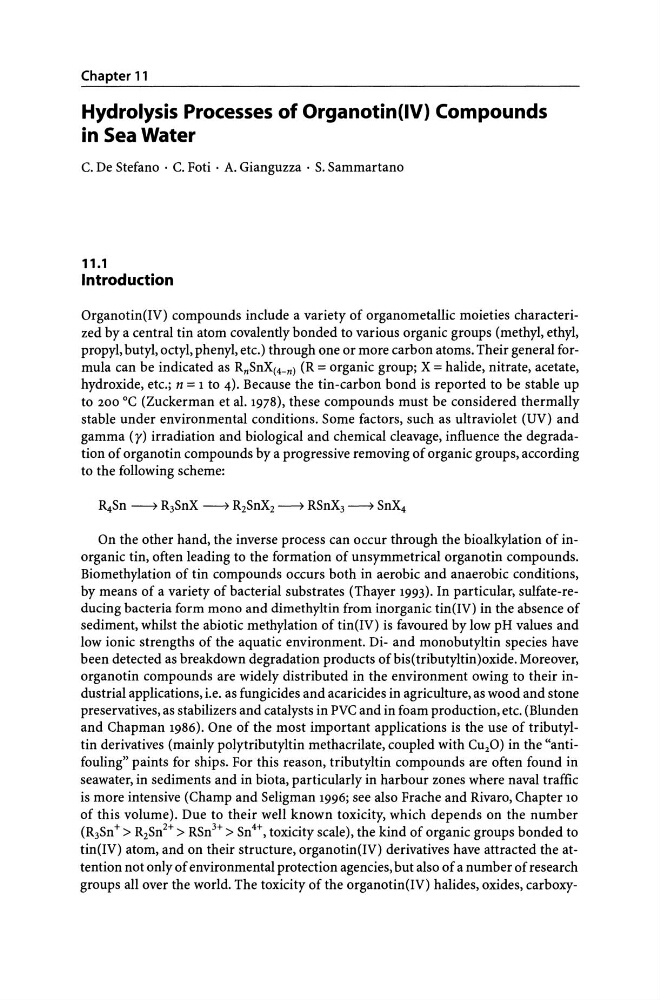
to the following scheme:
On the other hand, the inverse process can occur through the bioalkylation of inorganic tin, often leading to the formation of unsymmetrical organotin compounds.
Biomethylation of tin compounds occurs both in aerobic and anaerobic conditions,
by means of a variety of bacterial substrates (Thayer 1993). In particular, sulfate-reducing bacteria form mono and dimethyltin from inorganic tin(IV) in the absence of
sediment, whilst the abiotic methylation of tin (IV) is favoured by low pH values and
low ionic strengths of the aquatic environment. Di- and monobutyltin species have
been detected as breakdown degradation products of bis( tributyltin)oxide. Moreover,
organotin compounds are widely distributed in the environment owing to their industrial applications, i.e. as fungicides and acaricides in agriculture, as wood and stone
preservatives, as stabilizers and catalysts in PVC and in foam production, etc. (Blunden
and Chapman 1986). One of the most important applications is the use of tributyltin derivatives (mainly polytributyltin methacrilate, coupled with Cu 2 0) in the "antifouling" paints for ships. For this reason, tributyltin compounds are often found in
seawater, in sediments and in biota, particularly in harbour zones where naval traffic
is more intensive (Champ and Seligman 1996; see also Frache and Rivaro, Chapter 10
of this volume). Due to their well known toxicity, which depends on the number
(R 3 Sn + > R 2 Sn 2 + > RSn3+ > Sn 4 +, toxicity scale), the kind of organic groups bonded to
tin(IV) atom, and on their structure, organotin(IV) derivatives have attracted the attention not only of environmental protection agencies, but also of a number of research
groups all over the world. The toxicity of the organotin(IV) halides, oxides, carboxy-
Hydrolysis Processes of Organotin(lV) Compounds
in Sea Water
C. De Stefano . C. Foti . A. Gianguzza . S. Sammartano
11.1
Introduction
Organotin(IV) compounds include a variety of organometallic moieties characterized by a central tin atom covalently bonded to various organic groups (methyl, ethyl,
propyl, butyl, octyl, phenyl, etc.) through one or more carbon atoms. Their general formula can be indicated as RnSnX(4_n) (R = organic group; X = halide, nitrate, acetate,
hydroxide, etc.; n = 1 to 4). Because the tin-carbon bond is reported to be stable up
to 200°C (Zuckerman et al. 1978), these compounds must be considered thermally
stable under environmental conditions. Some factors, such as ultraviolet (UV) and
gamma (y) irradiation and biological and chemical cleavage, influence the degradation of organotin compounds by a progressive removing of organic groups, according
to the following scheme:
On the other hand, the inverse process can occur through the bioalkylation of inorganic tin, often leading to the formation of unsymmetrical organotin compounds.
Biomethylation of tin compounds occurs both in aerobic and anaerobic conditions,
by means of a variety of bacterial substrates (Thayer 1993). In particular, sulfate-reducing bacteria form mono and dimethyltin from inorganic tin(IV) in the absence of
sediment, whilst the abiotic methylation of tin (IV) is favoured by low pH values and
low ionic strengths of the aquatic environment. Di- and monobutyltin species have
been detected as breakdown degradation products of bis( tributyltin)oxide. Moreover,
organotin compounds are widely distributed in the environment owing to their industrial applications, i.e. as fungicides and acaricides in agriculture, as wood and stone
preservatives, as stabilizers and catalysts in PVC and in foam production, etc. (Blunden
and Chapman 1986). One of the most important applications is the use of tributyltin derivatives (mainly polytributyltin methacrilate, coupled with Cu 2 0) in the "antifouling" paints for ships. For this reason, tributyltin compounds are often found in
seawater, in sediments and in biota, particularly in harbour zones where naval traffic
is more intensive (Champ and Seligman 1996; see also Frache and Rivaro, Chapter 10
of this volume). Due to their well known toxicity, which depends on the number
(R 3 Sn + > R 2 Sn 2 + > RSn3+ > Sn 4 +, toxicity scale), the kind of organic groups bonded to
tin(IV) atom, and on their structure, organotin(IV) derivatives have attracted the attention not only of environmental protection agencies, but also of a number of research
groups all over the world. The toxicity of the organotin(IV) halides, oxides, carboxy-