

CHAPTER 8 . Determination of Organic Complexation
40 , - - - - - - - - - - - - - - - - ,
A
35
30
25
~
E- 20
15
10
5
0
-0.15
-0.35
-055
-0.75
E(V)
100
25
B
C
<>
80
2
~
<>
:i'
j
E- 60
!::!. 15
<>
.....
~
.!!
i
<>
:;;
?3 40
<>
S
!::!.
<>
!::!.
20
<>
05
<>
<>
<> <>
0
0
0
50
100
150
0
[CUl,o,al (nM)
20
CL = 54.37 ±2.08
log KCu(II)L = 11.97 ±0.01
log KCu(I)L = 1556±0.01
40
60
80
[Cul l • bile (nM)
100
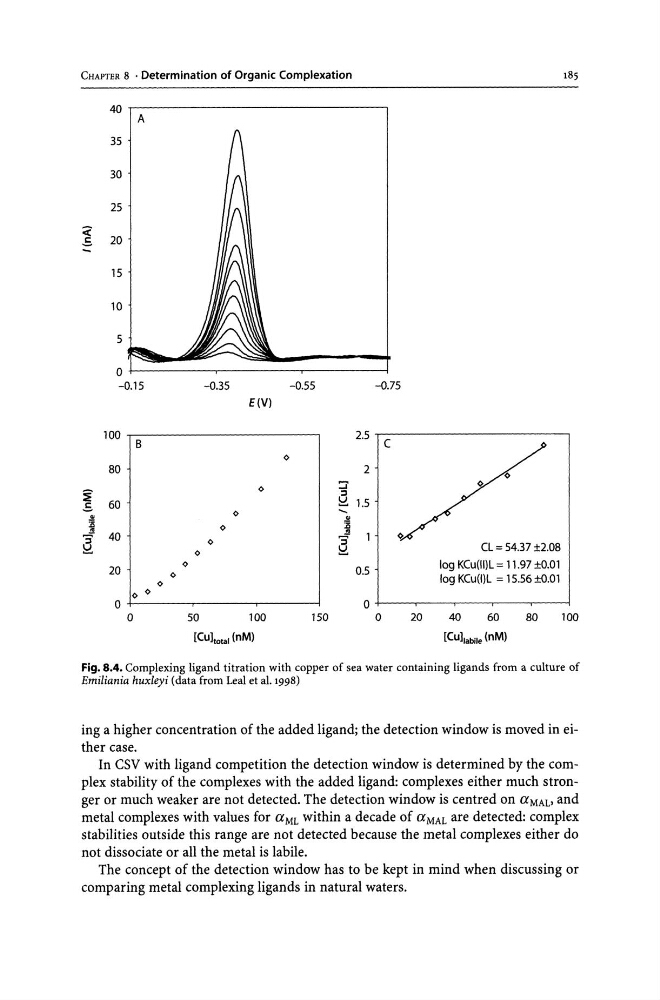
Fig. 8.4. Complexing ligand titration with copper of sea water containing ligands from a culture of
Emiliania huxleyi (data from Leal et al.1998)
ing a higher concentration of the added ligand; the detection window is moved in either case.
In CSV with ligand competition the detection window is determined by the complex stability of the complexes with the added ligand: complexes either much stronger or much weaker are not detected. The detection window is centred on aMAL, and
metal complexes with values for aML within a decade of aMAL are detected: complex
stabilities outside this range are not detected because the metal complexes either do
not dissociate or all the metal is labile.
The concept of the detection window has to be kept in mind when discussing or
comparing metal complexing ligands in natural waters.
40 , - - - - - - - - - - - - - - - - ,
A
35
30
25
~
E- 20
15
10
5
0
-0.15
-0.35
-055
-0.75
E(V)
100
25
B
C
<>
80
2
~
<>
:i'
j
E- 60
!::!. 15
<>
.....
~
.!!
i
<>
:;;
?3 40
<>
S
!::!.
<>
!::!.
20
<>
05
<>
<>
<> <>
0
0
0
50
100
150
0
[CUl,o,al (nM)
20
CL = 54.37 ±2.08
log KCu(II)L = 11.97 ±0.01
log KCu(I)L = 1556±0.01
40
60
80
[Cul l • bile (nM)
100
Fig. 8.4. Complexing ligand titration with copper of sea water containing ligands from a culture of
Emiliania huxleyi (data from Leal et al.1998)
ing a higher concentration of the added ligand; the detection window is moved in either case.
In CSV with ligand competition the detection window is determined by the complex stability of the complexes with the added ligand: complexes either much stronger or much weaker are not detected. The detection window is centred on aMAL, and
metal complexes with values for aML within a decade of aMAL are detected: complex
stabilities outside this range are not detected because the metal complexes either do
not dissociate or all the metal is labile.
The concept of the detection window has to be kept in mind when discussing or
comparing metal complexing ligands in natural waters.