

CHAPTER 7 . Vapour-Particle Phase Interactions of Organic Pollutants in the Marine Atmosphere
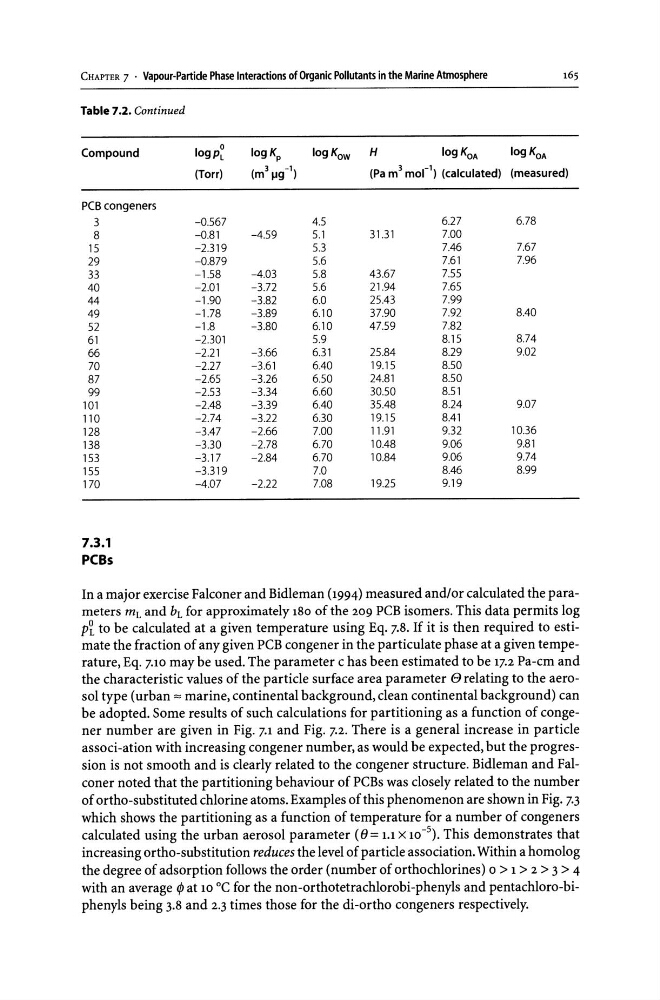
Table 7.2. Continued
Compound
PCB congeners
3
8
15
29
33
40
44
49
52
61
66
70
87
99
101
110
128
138
153
155
170
7.3.1
PCBs
logp~
10gK p
(Torr)
(m3 Ilg- l )
-0.567
-0.81
-4.59
-2.319
-0.879
-1.58
-4.03
-2.01
-3.72
-1.90
-3.82
-1.78
-3.89
-1.8
-3.80
-2.301
-2.21
-3.66
-2.27
-3.61
-2.65
-3.26
-2.53
-3.34
-2.48
-3.39
-2.74
-3.22
-3.47
-2.66
-3.30
-2.78
-3.17
-2.84
-3.319
-4.07
-2.22
10gKow
H
10gKoA
(Pa m 3 mor l ) (calculated)
4.5
6.27
5.1
31.31
7.00
5.3
7.46
5.6
7.61
5.8
43.67
7.55
5.6
21.94
7.65
6.0
25.43
7.99
6.10
37.90
7.92
6.10
47.59
7.82
5.9
8.15
6.31
25.84
8.29
6.40
19.15
8.50
6.50
24.81
8.50
6.60
30.50
8.51
6.40
35.48
8.24
6.30
19.15
8.41
7.00
11.91
9.32
6.70
10.48
9.06
6.70
10.84
9.06
7.0
8.46
7.08
19.25
9.19
165
10gKoA
(measured)
6.78
7.67
7.96
8.40
8.74
9.02
9.07
10.36
9.81
9.74
8.99
In a major exercise Falconer and Bidleman (1994) measured and/or calculated the parameters mL and bL for approximately 180 of the 209 PCB isomers. This data permits log
pl to be calculated at a given temperature using Eq. 7.8. If it is then required to estimate the fraction of any given PCB congener in the particulate phase at a given temperature, Eq. 7.10 may be used. The parameter c has been estimated to be 17.2 Pa-cm and
the characteristic values of the particle surface area parameter e relating to the aerosol type (urban"" marine, continental background, clean continental background) can
be adopted. Some results of such calculations for partitioning as a function of congener number are given in Fig. 7.1 and Fig. 7.2. There is a general increase in particle
associ-ation with increasing congener number, as would be expected, but the progression is not smooth and is clearly related to the congener structure. Bidleman and Falconer noted that the partitioning behaviour of PCBs was closely related to the number
of ortho-substituted chlorine atoms. Examples of this phenomenon are shown in Fig. 7.3
which shows the partitioning as a function of temperature for a number of congeners
calculated using the urban aerosol parameter (e = 1.1 X 10 -\ This demonstrates that
increasing ortho-substitution reduces the level of particle association. Within a homolog
the degree of adsorption follows the order (number of orthochlorines) 0 > 1 > 2 > 3 > 4
with an average ¢ at 10°C for the non-orthotetrachlorobi-phenyls and pentachloro-biphenyls being 3.8 and 2.3 times those for the di-ortho congeners respectively.
Table 7.2. Continued
Compound
PCB congeners
3
8
15
29
33
40
44
49
52
61
66
70
87
99
101
110
128
138
153
155
170
7.3.1
PCBs
logp~
10gK p
(Torr)
(m3 Ilg- l )
-0.567
-0.81
-4.59
-2.319
-0.879
-1.58
-4.03
-2.01
-3.72
-1.90
-3.82
-1.78
-3.89
-1.8
-3.80
-2.301
-2.21
-3.66
-2.27
-3.61
-2.65
-3.26
-2.53
-3.34
-2.48
-3.39
-2.74
-3.22
-3.47
-2.66
-3.30
-2.78
-3.17
-2.84
-3.319
-4.07
-2.22
10gKow
H
10gKoA
(Pa m 3 mor l ) (calculated)
4.5
6.27
5.1
31.31
7.00
5.3
7.46
5.6
7.61
5.8
43.67
7.55
5.6
21.94
7.65
6.0
25.43
7.99
6.10
37.90
7.92
6.10
47.59
7.82
5.9
8.15
6.31
25.84
8.29
6.40
19.15
8.50
6.50
24.81
8.50
6.60
30.50
8.51
6.40
35.48
8.24
6.30
19.15
8.41
7.00
11.91
9.32
6.70
10.48
9.06
6.70
10.84
9.06
7.0
8.46
7.08
19.25
9.19
165
10gKoA
(measured)
6.78
7.67
7.96
8.40
8.74
9.02
9.07
10.36
9.81
9.74
8.99
In a major exercise Falconer and Bidleman (1994) measured and/or calculated the parameters mL and bL for approximately 180 of the 209 PCB isomers. This data permits log
pl to be calculated at a given temperature using Eq. 7.8. If it is then required to estimate the fraction of any given PCB congener in the particulate phase at a given temperature, Eq. 7.10 may be used. The parameter c has been estimated to be 17.2 Pa-cm and
the characteristic values of the particle surface area parameter e relating to the aerosol type (urban"" marine, continental background, clean continental background) can
be adopted. Some results of such calculations for partitioning as a function of congener number are given in Fig. 7.1 and Fig. 7.2. There is a general increase in particle
associ-ation with increasing congener number, as would be expected, but the progression is not smooth and is clearly related to the congener structure. Bidleman and Falconer noted that the partitioning behaviour of PCBs was closely related to the number
of ortho-substituted chlorine atoms. Examples of this phenomenon are shown in Fig. 7.3
which shows the partitioning as a function of temperature for a number of congeners
calculated using the urban aerosol parameter (e = 1.1 X 10 -\ This demonstrates that
increasing ortho-substitution reduces the level of particle association. Within a homolog
the degree of adsorption follows the order (number of orthochlorines) 0 > 1 > 2 > 3 > 4
with an average ¢ at 10°C for the non-orthotetrachlorobi-phenyls and pentachloro-biphenyls being 3.8 and 2.3 times those for the di-ortho congeners respectively.