

134
S.G. Wakeham
To date, the most complete data set available for examining trends from plankton to
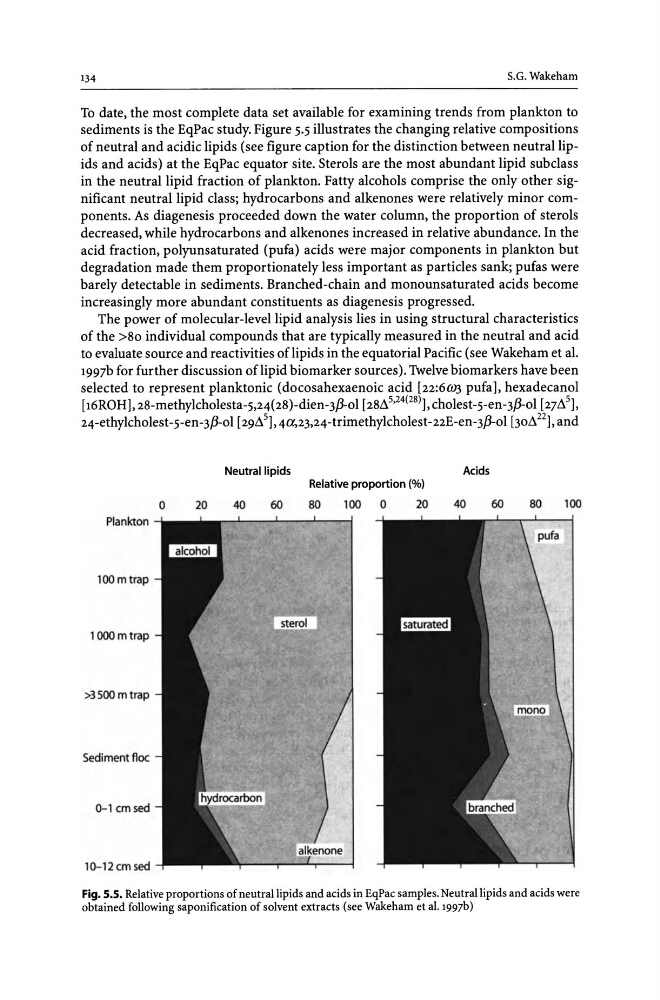
sediments is the EqPac study. Figure 5.5 illustrates the changing relative compositions
of neutral and acidic lipids (see figure caption for the distinction between neutral lipids and acids) at the EqPac equator site. Sterols are the most abundant lipid subclass
in the neutral lipid fraction of plankton. Fatty alcohols comprise the only other significant neutral lipid class; hydrocarbons and alkenones were relatively minor components. As diagenesis proceeded down the water column, the proportion of sterols
decreased, while hydrocarbons and alkenones increased in relative abundance. In the
acid fraction, polyunsaturated (pufa) acids were major components in plankton but
degradation made them proportionately less important as particles sank; pufas were
barely detectable in sediments. Branched-chain and monounsaturated acids become
increasingly more abundant constituents as diagenesis progressed.
The power of molecular-level lipid analysis lies in using structural characteristics
of the >80 individual compounds that are typically measured in the neutral and acid
to evaluate source and reactivities oflipids in the equatorial Pacific (see Wakeham et al.
1997b for further discussion oflipid biomarker sources). Twelve biomarkers have been
selected to represent planktonic (docosahexaenoic acid [22:6W3 pufal, hexadecanol
[I6ROH], 28-methylcholesta-s,24(28)-dien-3/3-ol [2M s . 24 (28)], cholest -s-en -3/3-01 [27~5],
24-ethylcholest -s-en-3/3-01 [29~5], 4a,23,24-trimethylcholest -22E-en -3f3-01130~ 22], and
Neutral lipids
Acids
Relative proportion (%)
o
20
40
60
80
100
0
20
40
60
80
100
Plankton
100 m trap
1000 mtrap
>3S00 mtrap
Sediment floc
0-1 em sed
10-12 em sed
Fig. 5.5. Relative proportions of neutral lipids and acids in EqPac samples. Neutral lipids and acids were
obtained following saponification of solvent extracts (see Wakeham et al. 1997b)
S.G. Wakeham
To date, the most complete data set available for examining trends from plankton to
sediments is the EqPac study. Figure 5.5 illustrates the changing relative compositions
of neutral and acidic lipids (see figure caption for the distinction between neutral lipids and acids) at the EqPac equator site. Sterols are the most abundant lipid subclass
in the neutral lipid fraction of plankton. Fatty alcohols comprise the only other significant neutral lipid class; hydrocarbons and alkenones were relatively minor components. As diagenesis proceeded down the water column, the proportion of sterols
decreased, while hydrocarbons and alkenones increased in relative abundance. In the
acid fraction, polyunsaturated (pufa) acids were major components in plankton but
degradation made them proportionately less important as particles sank; pufas were
barely detectable in sediments. Branched-chain and monounsaturated acids become
increasingly more abundant constituents as diagenesis progressed.
The power of molecular-level lipid analysis lies in using structural characteristics
of the >80 individual compounds that are typically measured in the neutral and acid
to evaluate source and reactivities oflipids in the equatorial Pacific (see Wakeham et al.
1997b for further discussion oflipid biomarker sources). Twelve biomarkers have been
selected to represent planktonic (docosahexaenoic acid [22:6W3 pufal, hexadecanol
[I6ROH], 28-methylcholesta-s,24(28)-dien-3/3-ol [2M s . 24 (28)], cholest -s-en -3/3-01 [27~5],
24-ethylcholest -s-en-3/3-01 [29~5], 4a,23,24-trimethylcholest -22E-en -3f3-01130~ 22], and
Neutral lipids
Acids
Relative proportion (%)
o
20
40
60
80
100
0
20
40
60
80
100
Plankton
100 m trap
1000 mtrap
>3S00 mtrap
Sediment floc
0-1 em sed
10-12 em sed
Fig. 5.5. Relative proportions of neutral lipids and acids in EqPac samples. Neutral lipids and acids were
obtained following saponification of solvent extracts (see Wakeham et al. 1997b)