

132
S.G. Wakeham
Oceanic carbon
Lipid
3.0
60
498m
498m
2.0
40
20
1.0
0
0.0
3.0
- 60
1478m
'i'
'i'
"
"
"I
"I
E 2.0
E 40
CI
CI
.§.
.§.
)(
)(
:::I 1.0
:::I 20
c;::
c;::
X
~
:::i
0
0.0
3.0
60
2898m
2898m
2.0
40
20
1.0
0
0.0
1994
1995
1994
1995
Date
Date
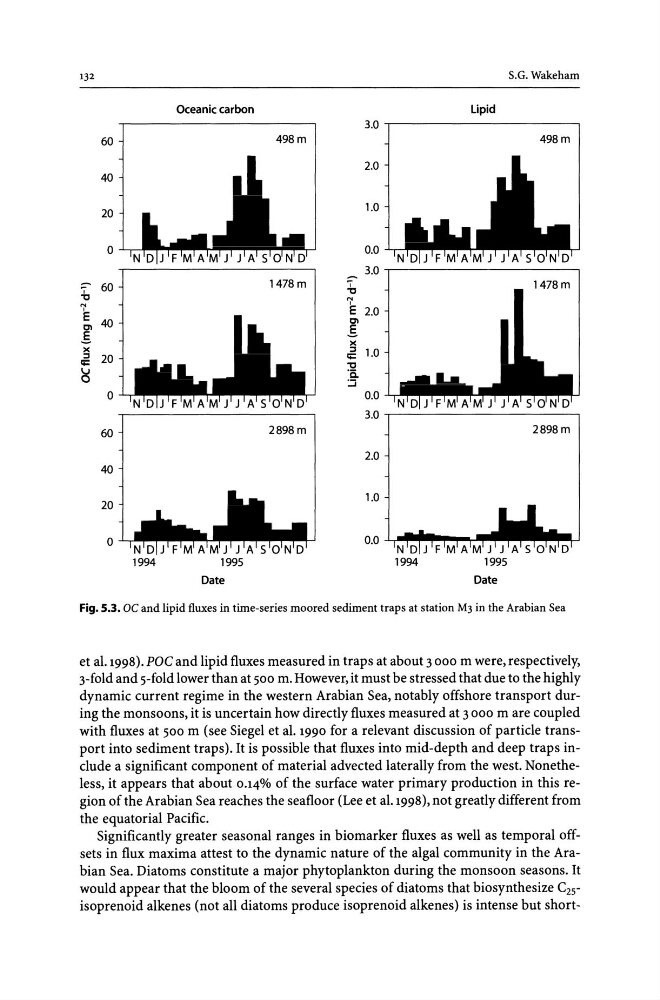
Fig. 5.3. DC and lipid fluxes in time-series moored sediment traps at station M3 in the Arabian Sea
et al. 1998). POC and lipid fluxes measured in traps at about 3 000 m were, respectively,
3-fold and 5-fold lower than at 500 m. However, it must be stressed that due to the highly
dynamic current regime in the western Arabian Sea, notably offshore transport during the monsoons, it is uncertain how directly fluxes measured at 3 000 m are coupled
with fluxes at 500 m (see Siegel et al. 1990 for a relevant discussion of particle transport into sediment traps). It is possible that fluxes into mid-depth and deep traps include a significant component of material advected laterally from the west. Nonetheless, it appears that about 0.14% of the surface water primary production in this region of the Arabian Sea reaches the seafloor (Lee et al.1998), not greatly different from
the equatorial Pacific.
Significantly greater seasonal ranges in biomarker fluxes as well as temporal offsets in flux maxima attest to the dynamic nature of the algal community in the Arabian Sea. Diatoms constitute a major phytoplankton during the monsoon seasons. It
would appear that the bloom of the several species of diatoms that biosynthesize C2Sisoprenoid alkenes (not all diatoms produce isoprenoid alkenes) is intense but short-
S.G. Wakeham
Oceanic carbon
Lipid
3.0
60
498m
498m
2.0
40
20
1.0
0
0.0
3.0
- 60
1478m
'i'
'i'
"
"
"I
"I
E 2.0
E 40
CI
CI
.§.
.§.
)(
)(
:::I 1.0
:::I 20
c;::
c;::
X
~
:::i
0
0.0
3.0
60
2898m
2898m
2.0
40
20
1.0
0
0.0
1994
1995
1994
1995
Date
Date
Fig. 5.3. DC and lipid fluxes in time-series moored sediment traps at station M3 in the Arabian Sea
et al. 1998). POC and lipid fluxes measured in traps at about 3 000 m were, respectively,
3-fold and 5-fold lower than at 500 m. However, it must be stressed that due to the highly
dynamic current regime in the western Arabian Sea, notably offshore transport during the monsoons, it is uncertain how directly fluxes measured at 3 000 m are coupled
with fluxes at 500 m (see Siegel et al. 1990 for a relevant discussion of particle transport into sediment traps). It is possible that fluxes into mid-depth and deep traps include a significant component of material advected laterally from the west. Nonetheless, it appears that about 0.14% of the surface water primary production in this region of the Arabian Sea reaches the seafloor (Lee et al.1998), not greatly different from
the equatorial Pacific.
Significantly greater seasonal ranges in biomarker fluxes as well as temporal offsets in flux maxima attest to the dynamic nature of the algal community in the Arabian Sea. Diatoms constitute a major phytoplankton during the monsoon seasons. It
would appear that the bloom of the several species of diatoms that biosynthesize C2Sisoprenoid alkenes (not all diatoms produce isoprenoid alkenes) is intense but short-