

130
S.G. Wakeham
constituents of epicuticular waxes of terrigenous vascular plants (Kolattukudy 1976).
Vascular plant compounds in deep-sea sediments are quite common (e.g. Prahl et al.
1989; Santos et al. 1994) and are evidence oflong-range atmospheric transport of continental material to the open ocean. The algal signal that so dominated sediment trap
material was only relatively minor in the sediment, whereas the vascular plant signal
that was barely discernable in the trap dominated sedimentary hydrocarbons. Even
though the composition of hydrocarbons sinking out of the upper Arabian Sea reflects
its phytoplanktonic origin, the planktonic signal has been selectively degraded during transport to the sediments leaving behind a vascular plant component to be preferentially preserved. Thus, not only is sedimentary organic matter quantitatively a small
fraction of surface water productivity, the composition of that remaining organic
matter may be qualitatively quite different from that produced in overlying waters.
5.3
Lipid Fluxes to the Deep Sea
The vertical export of organic matter between surface waters and sediments reflects
quantitative and qualitative balances between production of poe in surface waters and
its degradation during transit. The export flux of poe through the water column
generally correlates with primary production over geographically diverse locations,
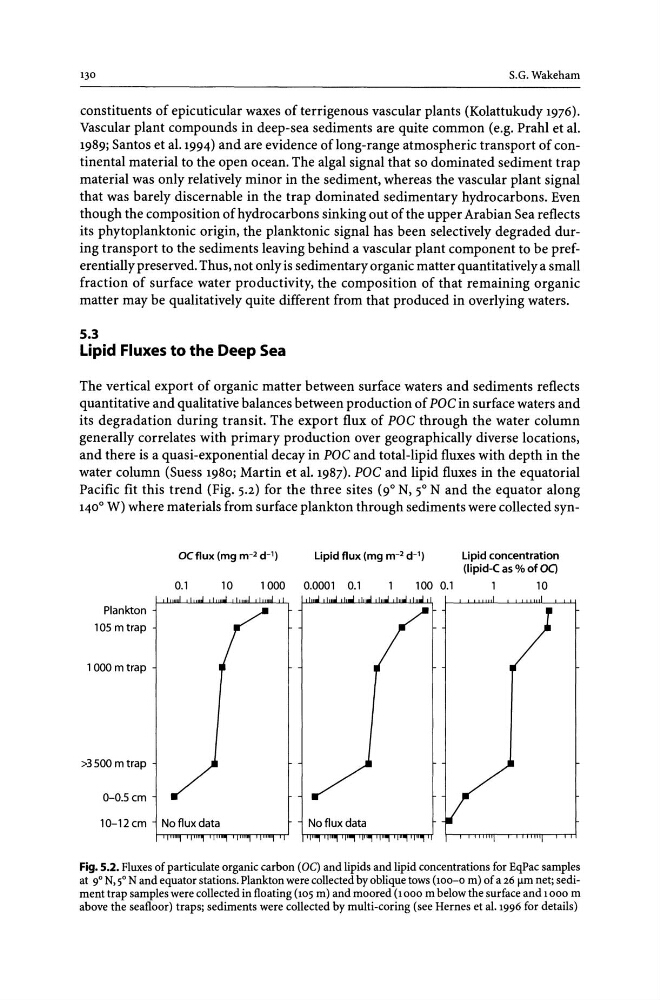
and there is a quasi-exponential decay in poe and total-lipid fluxes with depth in the
water column (Suess 1980; Martin et al.1987). poe and lipid fluxes in the equatorial
Pacific fit this trend (Fig. 5.2) for the three sites (9° N, 5° N and the equator along
140° W) where materials from surface plankton through sediments were collected synPlankton
10Smtrap
l000mtrap
>3S00mtrap
O-O.5cm
10-12cm
OCflux (mg m-2 d-')
0.1
10
1000
Lipid flux (mg m- 2 d-')
0.0001 0.1
100 0.1
Lipid concentration
(lipid-C as % of OC)
1
10
Fig. 5.2. Fluxes of particulate organic carbon (OC) and lipids and lipid concentrations for EqPac samples
at 9 0 N,5° N and equator stations. Plankton were collected by oblique tows (100-0 m) of a 26 Iffi1 net; sedimenttrap samples were collected in floating (105 m) and moored (1000 m below the surface and 1 000 m
above the seafloor) traps; sediments were collected by multi-coring (see Hernes et al.1996 for details)
S.G. Wakeham
constituents of epicuticular waxes of terrigenous vascular plants (Kolattukudy 1976).
Vascular plant compounds in deep-sea sediments are quite common (e.g. Prahl et al.
1989; Santos et al. 1994) and are evidence oflong-range atmospheric transport of continental material to the open ocean. The algal signal that so dominated sediment trap
material was only relatively minor in the sediment, whereas the vascular plant signal
that was barely discernable in the trap dominated sedimentary hydrocarbons. Even
though the composition of hydrocarbons sinking out of the upper Arabian Sea reflects
its phytoplanktonic origin, the planktonic signal has been selectively degraded during transport to the sediments leaving behind a vascular plant component to be preferentially preserved. Thus, not only is sedimentary organic matter quantitatively a small
fraction of surface water productivity, the composition of that remaining organic
matter may be qualitatively quite different from that produced in overlying waters.
5.3
Lipid Fluxes to the Deep Sea
The vertical export of organic matter between surface waters and sediments reflects
quantitative and qualitative balances between production of poe in surface waters and
its degradation during transit. The export flux of poe through the water column
generally correlates with primary production over geographically diverse locations,
and there is a quasi-exponential decay in poe and total-lipid fluxes with depth in the
water column (Suess 1980; Martin et al.1987). poe and lipid fluxes in the equatorial
Pacific fit this trend (Fig. 5.2) for the three sites (9° N, 5° N and the equator along
140° W) where materials from surface plankton through sediments were collected synPlankton
10Smtrap
l000mtrap
>3S00mtrap
O-O.5cm
10-12cm
OCflux (mg m-2 d-')
0.1
10
1000
Lipid flux (mg m- 2 d-')
0.0001 0.1
100 0.1
Lipid concentration
(lipid-C as % of OC)
1
10
Fig. 5.2. Fluxes of particulate organic carbon (OC) and lipids and lipid concentrations for EqPac samples
at 9 0 N,5° N and equator stations. Plankton were collected by oblique tows (100-0 m) of a 26 Iffi1 net; sedimenttrap samples were collected in floating (105 m) and moored (1000 m below the surface and 1 000 m
above the seafloor) traps; sediments were collected by multi-coring (see Hernes et al.1996 for details)