

CHAPTER 5 . Organic Matter Preservation: Lipid Behavior from Plankton to Sediments
129
35
br25
,----,
Trap
30
25
20
17
HEH
sterenes
15
r----1
10
5
J
1,,1.1.1
II
II I . .J lb. '_J J
fo
o
10
20
30
40
50
60
70
80
90
20 ~~---------------------------------------------------;
18
16
14
12
~ 10
8
6
4
2
o
o
10
27
20
30
40
50
TIme (min)
31
Sediment
29
33
35
37
60
70
80
90
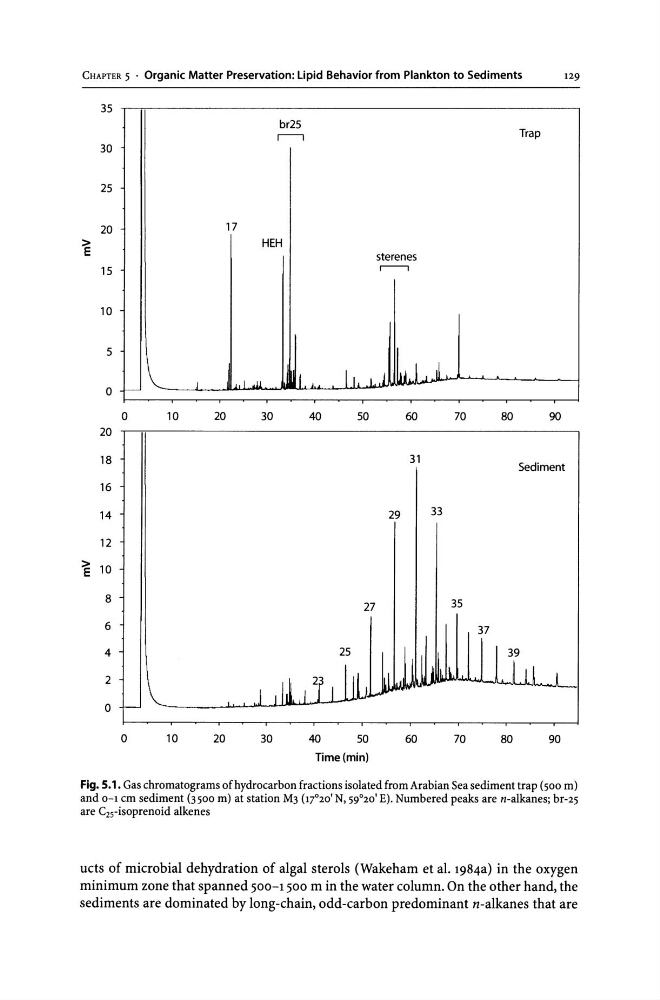
Fig. 5.1. Gas chromatograms of hydrocarbon fractions isolated from Arabian Sea sediment trap (500 m)
and 0-1 cm sediment (3500 m) at station M3 (17°20' N, 59°20' E). Numbered peaks are n-alkanes; br-25
are C2s-isoprenoid alkenes
ucts of microbial dehydration of algal sterols (Wakeham et al. 1984a) in the oxygen
minimum zone that spanned 500-1500 m in the water column. On the other hand, the
sediments are dominated by long-chain, odd-carbon predominant n-alkanes that are
129
35
br25
,----,
Trap
30
25
20
17
HEH
sterenes
15
r----1
10
5
J
1,,1.1.1
II
II I . .J lb. '_J J
fo
o
10
20
30
40
50
60
70
80
90
20 ~~---------------------------------------------------;
18
16
14
12
~ 10
8
6
4
2
o
o
10
27
20
30
40
50
TIme (min)
31
Sediment
29
33
35
37
60
70
80
90
Fig. 5.1. Gas chromatograms of hydrocarbon fractions isolated from Arabian Sea sediment trap (500 m)
and 0-1 cm sediment (3500 m) at station M3 (17°20' N, 59°20' E). Numbered peaks are n-alkanes; br-25
are C2s-isoprenoid alkenes
ucts of microbial dehydration of algal sterols (Wakeham et al. 1984a) in the oxygen
minimum zone that spanned 500-1500 m in the water column. On the other hand, the
sediments are dominated by long-chain, odd-carbon predominant n-alkanes that are