

120
F.J. Millero
the data were slightly smaller than the values determined in our previous study, especially at higher temperatures. This is probably due to the inhibition of the oxidation
of sulfite in the presence of sulfide. This finding is supported by the previous observations that sulfite in the presence of H2S is more stable in sea water than predicted
by its rate of oxidation.
The values of kl' k2 and k3 as a function of salinity (S) and temperature (T in K)
have been fitted to the equations (pH = 8.2)
In kl = 26.90 + 0.0322S - 8123.211 T
These equations should be valid for estuarine and sea waters over a wide range of
salinity and temperature. This kinetic model can be used to predict the product distribution for the oxidation of sulfide in natural waters with low concentrations of trace
metals. The agreement between the model and the observed distribution of reaction
products does not provide conclusive proof that the reaction pathways of the overall
model actually describe the series of elemental reactions that occur. The detailed
mechanisms might involve many elemental reaction steps.
The rates of oxidation of hydrogen sulfide, the effect of metals and the intermediates formed have been examined in a number of natural anoxic basins. A comparison
of the measurements made in the Cariaco Trench with laboratory studies on NaHS
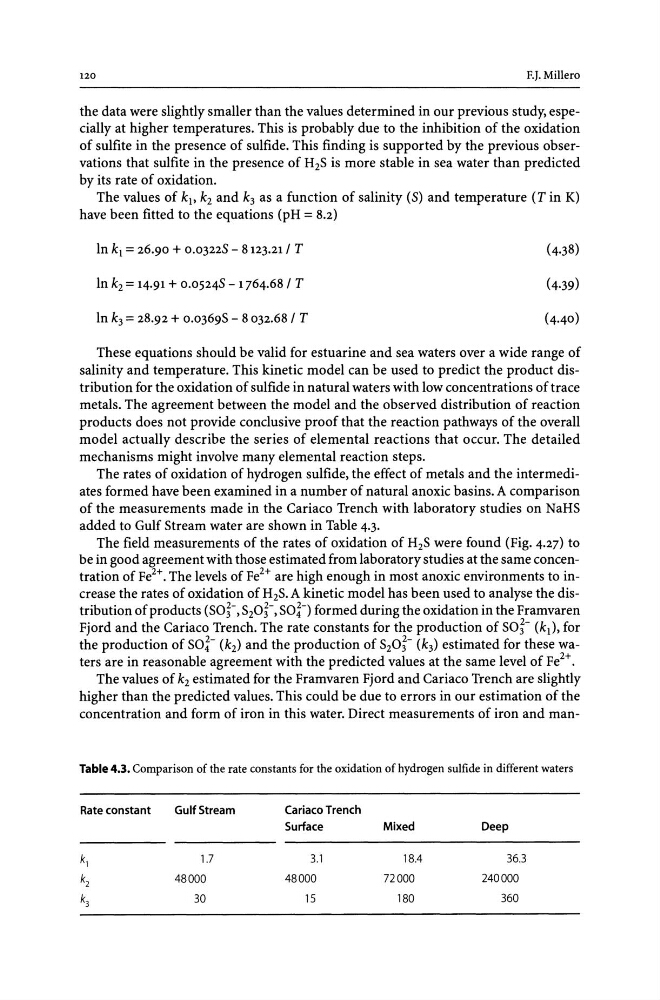
added to Gulf Stream water are shown in Table 4.3.
The field measurements of the rates of oxidation of H 2 S were found (Fig. 4.27) to
be in good agreement with those estimated from laboratory studies at the same concentration of Fe 2 +. The levels of Fe 2 + are high enough in most anoxic environments to increase the rates of oxidation of H 2 S. A kinetic model has been used to analyse the distribution of products (SO~-, S20~-, SO~-) formed during the oxidation in the Framvaren
Fjord and the Cariaco Trench. The rate constants for the production of SO~- (k1), for
the production of SO~- (k 2 ) and the production of S20~- (k3) estimated for these waters are in reasonable agreement with the predicted values at the same level of Fe2+.
The values of k2 estimated for the Framvaren Fjord and Cariaco Trench are slightly
higher than the predicted values. This could be due to errors in our estimation of the
concentration and form of iron in this water. Direct measurements of iron and manTable 4.3. Comparison of the rate constants for the oxidation of hydrogen sulfide in different waters
Rate constant
Gulf Stream
Cariaco Trench
Surface
Mixed
Deep
kl
1.7
3.1
18.4
36.3
k2
48000
48000
72000
240000
k3
30
15
180
360
F.J. Millero
the data were slightly smaller than the values determined in our previous study, especially at higher temperatures. This is probably due to the inhibition of the oxidation
of sulfite in the presence of sulfide. This finding is supported by the previous observations that sulfite in the presence of H2S is more stable in sea water than predicted
by its rate of oxidation.
The values of kl' k2 and k3 as a function of salinity (S) and temperature (T in K)
have been fitted to the equations (pH = 8.2)
In kl = 26.90 + 0.0322S - 8123.211 T
These equations should be valid for estuarine and sea waters over a wide range of
salinity and temperature. This kinetic model can be used to predict the product distribution for the oxidation of sulfide in natural waters with low concentrations of trace
metals. The agreement between the model and the observed distribution of reaction
products does not provide conclusive proof that the reaction pathways of the overall
model actually describe the series of elemental reactions that occur. The detailed
mechanisms might involve many elemental reaction steps.
The rates of oxidation of hydrogen sulfide, the effect of metals and the intermediates formed have been examined in a number of natural anoxic basins. A comparison
of the measurements made in the Cariaco Trench with laboratory studies on NaHS
added to Gulf Stream water are shown in Table 4.3.
The field measurements of the rates of oxidation of H 2 S were found (Fig. 4.27) to
be in good agreement with those estimated from laboratory studies at the same concentration of Fe 2 +. The levels of Fe 2 + are high enough in most anoxic environments to increase the rates of oxidation of H 2 S. A kinetic model has been used to analyse the distribution of products (SO~-, S20~-, SO~-) formed during the oxidation in the Framvaren
Fjord and the Cariaco Trench. The rate constants for the production of SO~- (k1), for
the production of SO~- (k 2 ) and the production of S20~- (k3) estimated for these waters are in reasonable agreement with the predicted values at the same level of Fe2+.
The values of k2 estimated for the Framvaren Fjord and Cariaco Trench are slightly
higher than the predicted values. This could be due to errors in our estimation of the
concentration and form of iron in this water. Direct measurements of iron and manTable 4.3. Comparison of the rate constants for the oxidation of hydrogen sulfide in different waters
Rate constant
Gulf Stream
Cariaco Trench
Surface
Mixed
Deep
kl
1.7
3.1
18.4
36.3
k2
48000
48000
72000
240000
k3
30
15
180
360