

CHAPTER 4 . Redox Processes in Anoxic Waters
113
nism that results in the formation of several reduced sulfur species (i.e. thiosulfate,
sulfite, elemental sulfur and polysulfide) as well as sulfate. In recent years we have studied the oxidation of H2S (Millero 1986; Millero and Hershey 1989; Zhang and Millero
1994) and H2S03 (Zhang and Millero 1991) with O2, H20 2, Mn02 and FeOOH in the
laboratory (Millero et al. 1987a, 1989; Zhang and Millero 1993a; Yao and Millero 1995a,b,
1996) and in the field (Millero 1991a,b,c; Zhang and Millero 1993b; Yao and Millero
1995b). These results have been used to develop a kinetic model that can characterize
the rates and distributions of products in natural waters. The results of these studies
are briefly reviewed in this section.
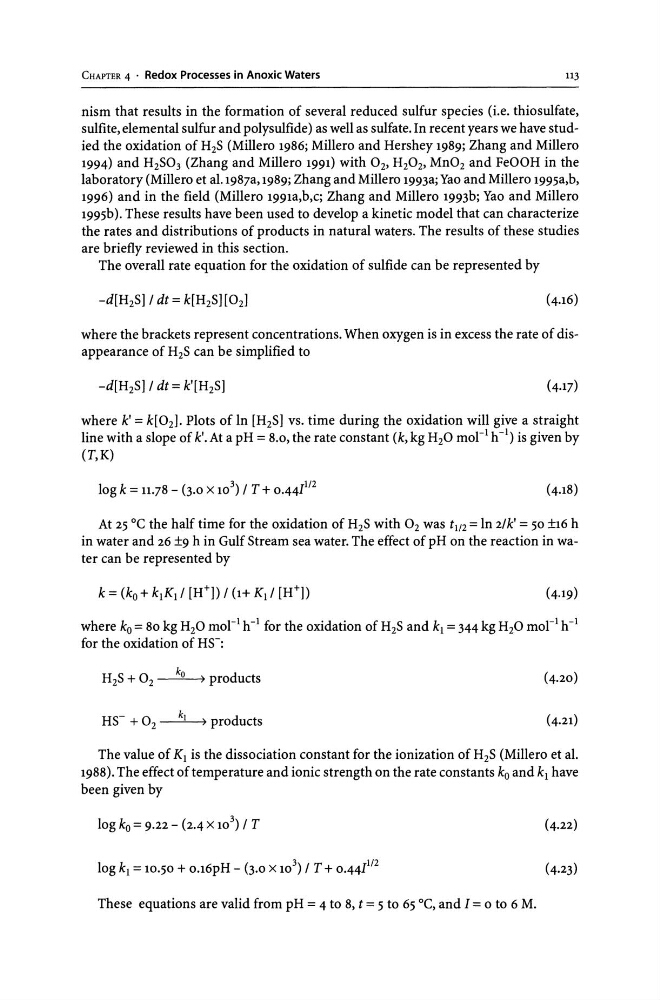
The overall rate equation for the oxidation of sulfide can be represented by
where the brackets represent concentrations. When oxygen is in excess the rate of disappearance of H2S can be simplified to
where k' == k[02j. Plots of In [H2Sj vs. time during the oxidation will give a straight
line with a slope of k'.At a pH == 8.0, the rate constant (k,kg H20 mor 1 h- 1 ) is given by
(T,K)
At 25°C the half time for the oxidation of H2S with O2 was tl/2 == In 21k' == 50 ±16 h
in water and 26 ±9 h in Gulf Stream sea water. The effect of pH on the reaction in water can be represented by
where ko == 80 kg H 2 0 mor 1 h- 1 for the oxidation of H 2 S and kl == 344 kg H20 mor 1 h- 1
for the oxidation of HS-:
HS- + O 2 kl ) products
The value of Kl is the dissociation constant for the ionization of H 2 S (Millero et al.
1988). The effect of temperature and ionic strength on the rate constants ko and kl have
been given by
These equations are valid from pH == 4 to 8, t == 5 to 65°C, and 1== 0 to 6 M.
113
nism that results in the formation of several reduced sulfur species (i.e. thiosulfate,
sulfite, elemental sulfur and polysulfide) as well as sulfate. In recent years we have studied the oxidation of H2S (Millero 1986; Millero and Hershey 1989; Zhang and Millero
1994) and H2S03 (Zhang and Millero 1991) with O2, H20 2, Mn02 and FeOOH in the
laboratory (Millero et al. 1987a, 1989; Zhang and Millero 1993a; Yao and Millero 1995a,b,
1996) and in the field (Millero 1991a,b,c; Zhang and Millero 1993b; Yao and Millero
1995b). These results have been used to develop a kinetic model that can characterize
the rates and distributions of products in natural waters. The results of these studies
are briefly reviewed in this section.
The overall rate equation for the oxidation of sulfide can be represented by
where the brackets represent concentrations. When oxygen is in excess the rate of disappearance of H2S can be simplified to
where k' == k[02j. Plots of In [H2Sj vs. time during the oxidation will give a straight
line with a slope of k'.At a pH == 8.0, the rate constant (k,kg H20 mor 1 h- 1 ) is given by
(T,K)
At 25°C the half time for the oxidation of H2S with O2 was tl/2 == In 21k' == 50 ±16 h
in water and 26 ±9 h in Gulf Stream sea water. The effect of pH on the reaction in water can be represented by
where ko == 80 kg H 2 0 mor 1 h- 1 for the oxidation of H 2 S and kl == 344 kg H20 mor 1 h- 1
for the oxidation of HS-:
HS- + O 2 kl ) products
The value of Kl is the dissociation constant for the ionization of H 2 S (Millero et al.
1988). The effect of temperature and ionic strength on the rate constants ko and kl have
been given by
These equations are valid from pH == 4 to 8, t == 5 to 65°C, and 1== 0 to 6 M.