

F.J. Millero
and thiosulfate are due to the oxidation of H2S from oxygenated waters that periodically sink below the oxic/anoxic interface. Tritium (t1/2 = 12 yr) found in the bottom
waters supports the idea that the deep waters have been renewed. The thiosulfate increased gradually to the bottom and showed no maximum near 600 m. The higher
values in the deep waters suggest a sediment source for the thiosulfate. A concentration of 178 j.1M thiosulfate was found in the pore waters of the sediments in the Cariaco
Trench, but this may be the result of oxidation of the sediments during collection. The
formation of thiosulfate in the sediments could result from the reaction of Mn02 and
FeOOH minerals with H2S or possibly due the reduction of sulfate.
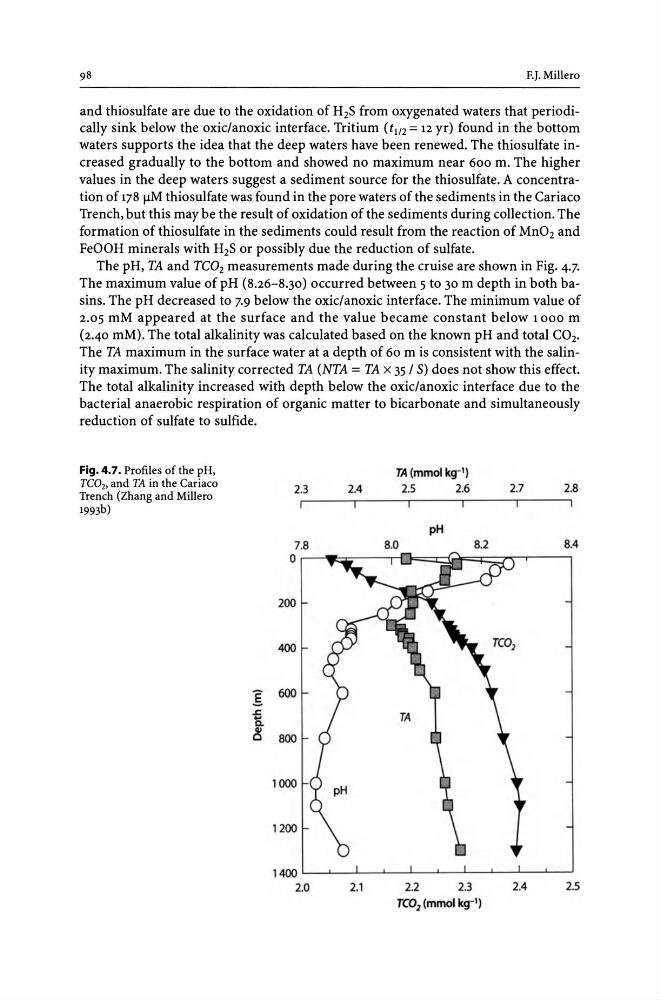
The pH, TA and Te02 measurements made during the cruise are shown in Fig. 4.7.
The maximum value of pH (8.26-8.30) occurred between 5 to 30 m depth in both basins. The pH decreased to 7.9 below the oxic/anoxic interface. The minimum value of
2.05 mM appeared at the surface and the value became constant below 1000 m
(2.40 mM). The total alkalinity was calculated based on the known pH and total CO 2 ,
The TA maximum in the surface water at a depth of 60 m is consistent with the salinity maximum. The salinity corrected TA (NTA = TA x 35 / S) does not show this effect.
The total alkalinity increased with depth below the oxic/anoxic interface due to the
bacterial anaerobic respiration of organic matter to bicarbonate and simultaneously
reduction of sulfate to sulfide.
Fig. 4.7. Profiles of the pH,
TA (mmol kg-I)
TeOz> and TA in the Cariaco
2.3
2.4
2.5
2.6
2.7
2.8
Trench (Zhang and Millero
1993b)
pH
7.8
8.0
8.2
8.4
0
200
400
g 600
..t:.
... a.
~ 800
1000
1200
1400
2.0
2.1
2.2
2.3
2.4
2.5
TeO l (mmol kg-I)
and thiosulfate are due to the oxidation of H2S from oxygenated waters that periodically sink below the oxic/anoxic interface. Tritium (t1/2 = 12 yr) found in the bottom
waters supports the idea that the deep waters have been renewed. The thiosulfate increased gradually to the bottom and showed no maximum near 600 m. The higher
values in the deep waters suggest a sediment source for the thiosulfate. A concentration of 178 j.1M thiosulfate was found in the pore waters of the sediments in the Cariaco
Trench, but this may be the result of oxidation of the sediments during collection. The
formation of thiosulfate in the sediments could result from the reaction of Mn02 and
FeOOH minerals with H2S or possibly due the reduction of sulfate.
The pH, TA and Te02 measurements made during the cruise are shown in Fig. 4.7.
The maximum value of pH (8.26-8.30) occurred between 5 to 30 m depth in both basins. The pH decreased to 7.9 below the oxic/anoxic interface. The minimum value of
2.05 mM appeared at the surface and the value became constant below 1000 m
(2.40 mM). The total alkalinity was calculated based on the known pH and total CO 2 ,
The TA maximum in the surface water at a depth of 60 m is consistent with the salinity maximum. The salinity corrected TA (NTA = TA x 35 / S) does not show this effect.
The total alkalinity increased with depth below the oxic/anoxic interface due to the
bacterial anaerobic respiration of organic matter to bicarbonate and simultaneously
reduction of sulfate to sulfide.
Fig. 4.7. Profiles of the pH,
TA (mmol kg-I)
TeOz> and TA in the Cariaco
2.3
2.4
2.5
2.6
2.7
2.8
Trench (Zhang and Millero
1993b)
pH
7.8
8.0
8.2
8.4
0
200
400
g 600
..t:.
... a.
~ 800
1000
1200
1400
2.0
2.1
2.2
2.3
2.4
2.5
TeO l (mmol kg-I)