

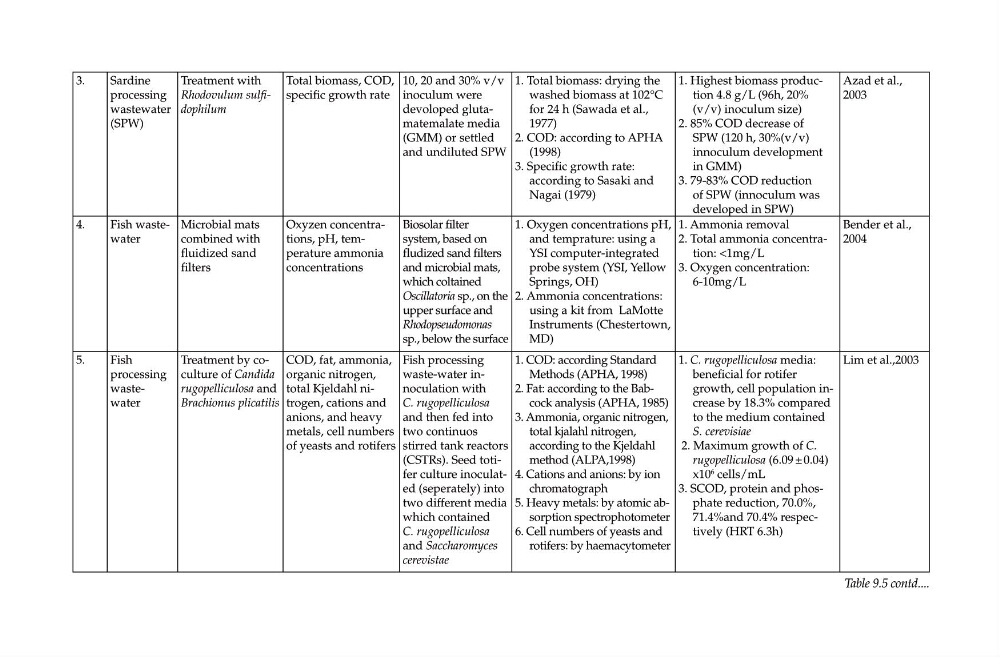
3.
Sardine
processing
wastewater
(SPW)
Treatment with
Rhodovulum sulfi -
dophilum
Total biomass, COD,
specifi c growth rate
10, 20 and 30% v/v
inoculum were
devoloped glutamatemalate media
(GMM) or settled
and undiluted SPW
1. Total biomass: drying the
washed biomass at 102°C
for 24 h (Sawada et al.,
1977)
2. COD: according to APHA
(1998)
3. Specifi c growth rate:
according to Sasaki and
Nagai (1979)
1. Highest biomass production 4.8 g/L (96h, 20%
(v/v) inoculum size)
2. 85% COD decrease of
SPW (120 h, 30%(v/v)
innoculum development
in GMM)
3. 79-83% COD reduction
of SPW (innoculum was
developed in SPW)
Azad et al.,
2003
4.
Fish wastewater
Microbial mats
combined with
fl uidized sand
fi lters
Oxyzen concentrations, pH, temperature ammonia
concentrations
Biosolar fi lter
system, based on
fl udized sand fi lters
and microbial mats,
which coltained
Oscillatoria sp., on the
upper surface and
Rhodopseudomonas
sp., below the surface
1. Oxygen concentrations pH,
and temprature: using a
YSI computer-integrated
probe system (YSI, Yellow
Springs, OH)
2. Ammonia concentrations:
using a kit from LaMotte
Instruments (Chestertown,
MD)
1. Ammonia removal
2. Total ammonia concentration: <1mg/L
3. Oxygen concentration:
6-10mg/L
Bender et al.,
2004
5.
Fish
processing
wastewater
Treatment by coculture of Candida
rugopelliculosa and
Brachionus plicatilis
COD, fat, ammonia,
organic nitrogen,
total Kjeldahl nitrogen, cations and
anions, and heavy
metals, cell numbers
of yeasts and rotifers
Fish processing
waste-water innoculation with
C. rugopelliculosa
and then fed into
two continuos
stirred tank reactors
(CSTRs). Seed totifer culture inoculated (seperately) into
two different media
which contained
C. rugopelliculosa
and Saccharomyces
cerevistae
1. COD: according Standard
Methods (APHA, 1998)
2. Fat: according to the Babcock analysis (APHA, 1985)
3. Ammonia, organic nitrogen,
total kjalahl nitrogen,
according to the Kjeldahl
method (ALPA,1998)
4. Cations and anions: by ion
chromatograph
5. Heavy metals: by atomic absorption spectrophotometer
6. Cell numbers of yeasts and
rotifers: by haemacytometer
1. C. rugopelliculosa media:
benefi cial for rotifer
growth, cell population increase by 18.3% compared
to the medium contained
S. cerevisiae
2. Maximum growth of C.
rugopelliculosa (6.09 ± 0.04)
x10
6 cells/mL
3. SCOD, protein and phosphate reduction, 70.0%,
71.4%and 70.4% respectively (HRT 6.3h)
Lim et al.,2003
Table 9.5 contd....
Sardine
processing
wastewater
(SPW)
Treatment with
Rhodovulum sulfi -
dophilum
Total biomass, COD,
specifi c growth rate
10, 20 and 30% v/v
inoculum were
devoloped glutamatemalate media
(GMM) or settled
and undiluted SPW
1. Total biomass: drying the
washed biomass at 102°C
for 24 h (Sawada et al.,
1977)
2. COD: according to APHA
(1998)
3. Specifi c growth rate:
according to Sasaki and
Nagai (1979)
1. Highest biomass production 4.8 g/L (96h, 20%
(v/v) inoculum size)
2. 85% COD decrease of
SPW (120 h, 30%(v/v)
innoculum development
in GMM)
3. 79-83% COD reduction
of SPW (innoculum was
developed in SPW)
Azad et al.,
2003
4.
Fish wastewater
Microbial mats
combined with
fl uidized sand
fi lters
Oxyzen concentrations, pH, temperature ammonia
concentrations
Biosolar fi lter
system, based on
fl udized sand fi lters
and microbial mats,
which coltained
Oscillatoria sp., on the
upper surface and
Rhodopseudomonas
sp., below the surface
1. Oxygen concentrations pH,
and temprature: using a
YSI computer-integrated
probe system (YSI, Yellow
Springs, OH)
2. Ammonia concentrations:
using a kit from LaMotte
Instruments (Chestertown,
MD)
1. Ammonia removal
2. Total ammonia concentration: <1mg/L
3. Oxygen concentration:
6-10mg/L
Bender et al.,
2004
5.
Fish
processing
wastewater
Treatment by coculture of Candida
rugopelliculosa and
Brachionus plicatilis
COD, fat, ammonia,
organic nitrogen,
total Kjeldahl nitrogen, cations and
anions, and heavy
metals, cell numbers
of yeasts and rotifers
Fish processing
waste-water innoculation with
C. rugopelliculosa
and then fed into
two continuos
stirred tank reactors
(CSTRs). Seed totifer culture inoculated (seperately) into
two different media
which contained
C. rugopelliculosa
and Saccharomyces
cerevistae
1. COD: according Standard
Methods (APHA, 1998)
2. Fat: according to the Babcock analysis (APHA, 1985)
3. Ammonia, organic nitrogen,
total kjalahl nitrogen,
according to the Kjeldahl
method (ALPA,1998)
4. Cations and anions: by ion
chromatograph
5. Heavy metals: by atomic absorption spectrophotometer
6. Cell numbers of yeasts and
rotifers: by haemacytometer
1. C. rugopelliculosa media:
benefi cial for rotifer
growth, cell population increase by 18.3% compared
to the medium contained
S. cerevisiae
2. Maximum growth of C.
rugopelliculosa (6.09 ± 0.04)
x10
6 cells/mL
3. SCOD, protein and phosphate reduction, 70.0%,
71.4%and 70.4% respectively (HRT 6.3h)
Lim et al.,2003
Table 9.5 contd....