

3.
Fish waste Valorisation
pH, dry matter,
ash, fat, total
nitrogen (TN),
non-protein-nitrogen (NPN), total
volatile nitrogen
(TVN) trimethylanune (TMA),
reducing sugars
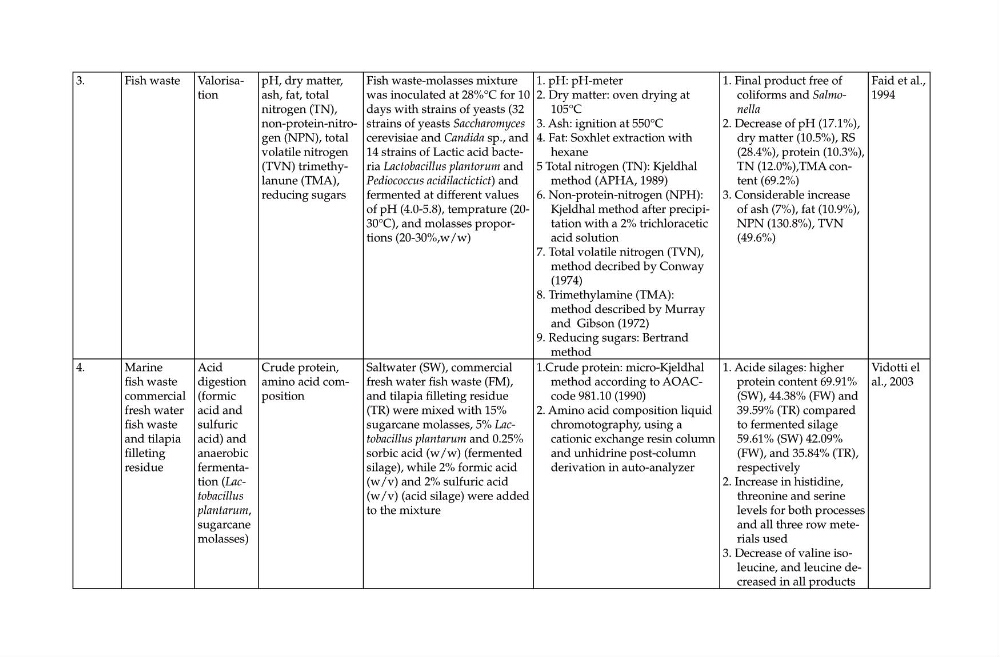
Fish waste-molasses mixture
was inoculated at 28%°C for 10
days with strains of yeasts (32
strains of yeasts Saccharomyces
cerevisiae and Candida sp., and
14 strains of Lactic acid bacteria Lactobacillus plantorum and
Pediococcus acidilactictict) and
fermented at different values
of pH (4.0-5.8), temprature (2030°C), and molasses proportions (20-30%,w/w)
1. pH: pH-meter
2. Dry matter: oven drying at
105°C
3. Ash: ignition at 550°C
4. Fat: Soxhlet extraction with
hexane
5 Total nitrogen (TN): Kjeldhal
method (APHA, 1989)
6. Non-protein-nitrogen (NPH):
Kjeldhal method after precipitation with a 2% trichloracetic
acid solution
7. Total volatile nitrogen (TVN),
method decribed by Conway
(1974)
8. Trimethylamine (TMA):
method described by Murray
and Gibson (1972)
9. Reducing sugars: Bertrand
method
1. Final product free of
coliforms and Salmonella
2. Decrease of pH (17.1%),
dry matter (10.5%), RS
(28.4%), protein (10.3%),
TN (12.0%),TMA content (69.2%)
3. Considerable increase
of ash (7%), fat (10.9%),
NPN (130.8%), TVN
(49.6%)
Faid et al.,
1994
4.
Marine
fi sh waste
commercial
fresh water
fi sh waste
and tilapia
fi lleting
residue
Acid
digestion
(formic
acid and
sulfuric
acid) and
anaerobic
fermentation (Lactobacillus
plantarum,
sugarcane
molasses)
Crude protein,
amino acid composition
Saltwater (SW), commercial
fresh water fi sh waste (FM),
and tilapia fi lleting residue
(TR) were mixed with 15%
sugarcane molasses, 5% Lactobacillus plantarum and 0.25%
sorbic acid (w/w) (fermented
silage), while 2% formic acid
(w/v) and 2% sulfuric acid
(w/v) (acid silage) were added
to the mixture
1.Crude protein: micro-Kjeldhal
method according to AOACcode 981.10 (1990)
2. Amino acid composition liquid
chromotography, using a
cationic exchange resin column
and unhidrine post-column
derivation in auto-analyzer
1. Acide silages: higher
protein content 69.91%
(SW), 44.38% (FW) and
39.59% (TR) compared
to fermented silage
59.61% (SW) 42.09%
(FW), and 35.84% (TR),
respectively
2. Increase in histidine,
threonine and serine
levels for both processes
and all three row meterials used
3. Decrease of valine isoleucine, and leucine decreased in all products
Vidotti el
al., 2003
Fish waste Valorisation
pH, dry matter,
ash, fat, total
nitrogen (TN),
non-protein-nitrogen (NPN), total
volatile nitrogen
(TVN) trimethylanune (TMA),
reducing sugars
Fish waste-molasses mixture
was inoculated at 28%°C for 10
days with strains of yeasts (32
strains of yeasts Saccharomyces
cerevisiae and Candida sp., and
14 strains of Lactic acid bacteria Lactobacillus plantorum and
Pediococcus acidilactictict) and
fermented at different values
of pH (4.0-5.8), temprature (2030°C), and molasses proportions (20-30%,w/w)
1. pH: pH-meter
2. Dry matter: oven drying at
105°C
3. Ash: ignition at 550°C
4. Fat: Soxhlet extraction with
hexane
5 Total nitrogen (TN): Kjeldhal
method (APHA, 1989)
6. Non-protein-nitrogen (NPH):
Kjeldhal method after precipitation with a 2% trichloracetic
acid solution
7. Total volatile nitrogen (TVN),
method decribed by Conway
(1974)
8. Trimethylamine (TMA):
method described by Murray
and Gibson (1972)
9. Reducing sugars: Bertrand
method
1. Final product free of
coliforms and Salmonella
2. Decrease of pH (17.1%),
dry matter (10.5%), RS
(28.4%), protein (10.3%),
TN (12.0%),TMA content (69.2%)
3. Considerable increase
of ash (7%), fat (10.9%),
NPN (130.8%), TVN
(49.6%)
Faid et al.,
1994
4.
Marine
fi sh waste
commercial
fresh water
fi sh waste
and tilapia
fi lleting
residue
Acid
digestion
(formic
acid and
sulfuric
acid) and
anaerobic
fermentation (Lactobacillus
plantarum,
sugarcane
molasses)
Crude protein,
amino acid composition
Saltwater (SW), commercial
fresh water fi sh waste (FM),
and tilapia fi lleting residue
(TR) were mixed with 15%
sugarcane molasses, 5% Lactobacillus plantarum and 0.25%
sorbic acid (w/w) (fermented
silage), while 2% formic acid
(w/v) and 2% sulfuric acid
(w/v) (acid silage) were added
to the mixture
1.Crude protein: micro-Kjeldhal
method according to AOACcode 981.10 (1990)
2. Amino acid composition liquid
chromotography, using a
cationic exchange resin column
and unhidrine post-column
derivation in auto-analyzer
1. Acide silages: higher
protein content 69.91%
(SW), 44.38% (FW) and
39.59% (TR) compared
to fermented silage
59.61% (SW) 42.09%
(FW), and 35.84% (TR),
respectively
2. Increase in histidine,
threonine and serine
levels for both processes
and all three row meterials used
3. Decrease of valine isoleucine, and leucine decreased in all products
Vidotti el
al., 2003