

CHAPTER 22 • Organic Matter Sources and Dynamics in Adriatic Coastal Waters
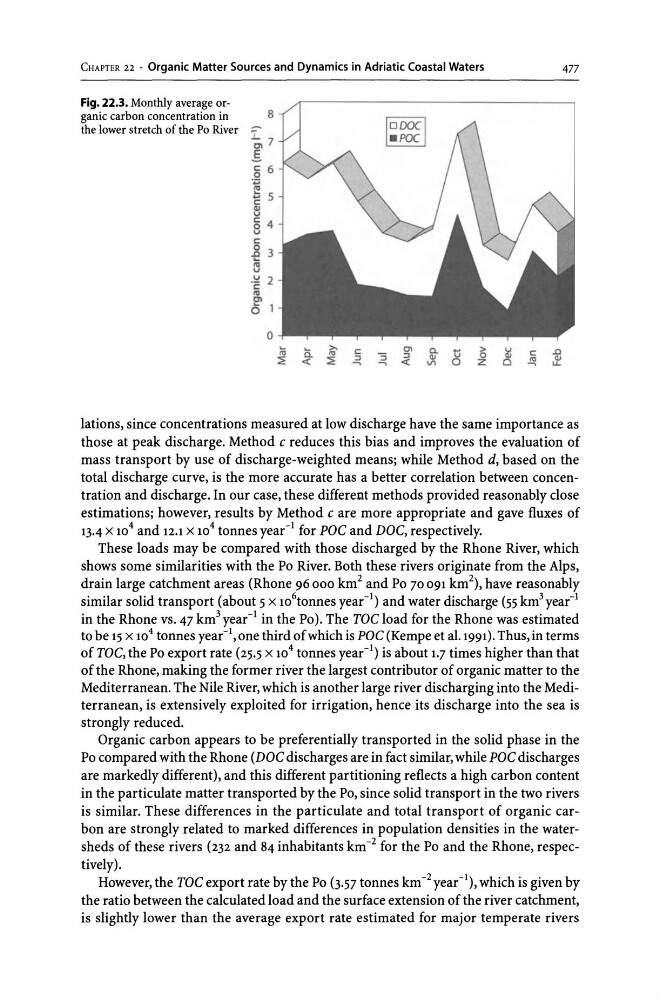
Fig. 22.3. Monthly average organic carbon concentration in
the lower stretch of the Po River
8
-;'7
.s
c: 6
o
·s 5
c:
5 4
v
c:
~ 3
el
.!:! 2
c:
E>
o
o
~
~
>.
c
:;E
~ ~ ~
fOOOCl
~
-
~
c. 1::
~
1)
:rl
Z
0
477
c:
~
..0
~
lations, since concentrations measured at low discharge have the same importance as
those at peak discharge. Method c reduces this bias and improves the evaluation of
mass transport by use of discharge-weighted means; while Method d, based on the
total discharge curve, is the more accurate has a better correlation between concentration and discharge. In our case, these different methods provided reasonably close
estimations; however, results by Method c are more appropriate and gave fluxes of
13.4 x 10 4 and 12.1 x 10 4 tonnes year- I for POC and DOC, respectively.
These loads may be compared with those discharged by the Rhone River, which
shows some similarities with the Po River. Both these rivers originate from the Alps,
drain large catchment areas (Rhone 96000 km 2 and Po 70091 km2), have reasonably
similar solid transport (about 5 x 10 6 tonnes year-I) and water discharge (55 km 3 year- 1
in the Rhone vs. 47 km\ear- I in the Po). The TOC load for the Rhone was estimated
to be 15 x 10 4 tonnes year-I, one third of which is POC (Kempe et al.I991). Thus, in terms
of TOC, the Po export rate (25.5 x 10 4 tonnes year-I) is about 1.7 times higher than that
of the Rhone, making the former river the largest contributor of organic matter to the
Mediterranean. The Nile River, which is another large river discharging into the Mediterranean, is extensively exploited for irrigation, hence its discharge into the sea is
strongly reduced.
Organic carbon appears to be preferentially transported in the solid phase in the
Po compared with the Rhone (DOC discharges are in fact similar, while POC discharges
are markedly different), and this different partitioning reflects a high carbon content
in the particulate matter transported by the Po, since solid transport in the two rivers
is similar. These differences in the particulate and total transport of organic carbon are strongly related to marked differences in population densities in the watersheds of these rivers (232 and 84 inhabitants km- 2 for the Po and the Rhone, respectively).
However, the TOC export rate by the Po (3.57 tonnes km- 2 year -I), which is given by
the ratio between the calculated load and the surface extension of the river catchment,
is slightly lower than the average export rate estimated for major temperate rivers
Fig. 22.3. Monthly average organic carbon concentration in
the lower stretch of the Po River
8
-;'7
.s
c: 6
o
·s 5
c:
5 4
v
c:
~ 3
el
.!:! 2
c:
E>
o
o
~
~
>.
c
:;E
~ ~ ~
fOOOCl
~
-
~
c. 1::
~
1)
:rl
Z
0
477
c:
~
..0
~
lations, since concentrations measured at low discharge have the same importance as
those at peak discharge. Method c reduces this bias and improves the evaluation of
mass transport by use of discharge-weighted means; while Method d, based on the
total discharge curve, is the more accurate has a better correlation between concentration and discharge. In our case, these different methods provided reasonably close
estimations; however, results by Method c are more appropriate and gave fluxes of
13.4 x 10 4 and 12.1 x 10 4 tonnes year- I for POC and DOC, respectively.
These loads may be compared with those discharged by the Rhone River, which
shows some similarities with the Po River. Both these rivers originate from the Alps,
drain large catchment areas (Rhone 96000 km 2 and Po 70091 km2), have reasonably
similar solid transport (about 5 x 10 6 tonnes year-I) and water discharge (55 km 3 year- 1
in the Rhone vs. 47 km\ear- I in the Po). The TOC load for the Rhone was estimated
to be 15 x 10 4 tonnes year-I, one third of which is POC (Kempe et al.I991). Thus, in terms
of TOC, the Po export rate (25.5 x 10 4 tonnes year-I) is about 1.7 times higher than that
of the Rhone, making the former river the largest contributor of organic matter to the
Mediterranean. The Nile River, which is another large river discharging into the Mediterranean, is extensively exploited for irrigation, hence its discharge into the sea is
strongly reduced.
Organic carbon appears to be preferentially transported in the solid phase in the
Po compared with the Rhone (DOC discharges are in fact similar, while POC discharges
are markedly different), and this different partitioning reflects a high carbon content
in the particulate matter transported by the Po, since solid transport in the two rivers
is similar. These differences in the particulate and total transport of organic carbon are strongly related to marked differences in population densities in the watersheds of these rivers (232 and 84 inhabitants km- 2 for the Po and the Rhone, respectively).
However, the TOC export rate by the Po (3.57 tonnes km- 2 year -I), which is given by
the ratio between the calculated load and the surface extension of the river catchment,
is slightly lower than the average export rate estimated for major temperate rivers