

30
F. J. Millero
S{Lakeh= S{Lakebnd + ~(Dens - Cond)
(1.51)
where ~(Dens - Cond) is a constant for function S{Lake>Cond'
The methods outlined above can be used without any detailed knowledge of the
composition of the lake. If it is not possible to make conductivity and density measurements on lake waters, the next best thing to do is to make measurements on artificially made lake waters. As we have shown, measurements of artificial waters can
provide reliable densities and conductivities of river, estuarine, brine and sea water of
known composition (Millero 1973a,b; Millero and Lepple 1973; Millero et al.1976a, 1982;
Millero and Chetirkin 1980).
If only composition data are available, one can determine the salinity from partial
molal volume data as described above. The conductivity of the lake can be estimated
from the conductivity of the components of the lake (Sorensen and Glass 1987; Wuest
et al. 1996) and dilute solution measurements on pure electrolytes (Robinson and
Stokes 1959). Wuest et al. (1996) have recently given equations for the equivalent conductivity of the major components of lakes as a function of temperature and composition. They have used these equations to estimate the conductivity of the waters from
Lake Malawi. The validity of these methods needs to be examined by making direct
measurements on waters of known composition as described above. To examine the
approximate relationships between the conductivity of lakes and sea water, I have determined the equivalent conductance of sea water and the lakes considered in this
paper using the infinite dilution ionic conductance taken from Robinson and
Stokes (1959) and Wuest et al. (1996). The equivalent conductance of the mixture
(Ao, flS cm- 1 (eq/lfl) at infinite dilution is determined from:
Ao=LjEj~{i)
(1.52)
where Ej is the equivalent fraction and ~(i) is the equivalent conductance of ionic
component i. The values of Ao at 25°C determined from this equation are given in
Table 1.5. The lake values are lower largely due to the decrease in the concentration of
Na+ and cr. The ratio of Ao{Lake)IAo{SW) at different temperatures are shown in
Fig. 1.24. The ratios are second degree functions of temperature and vary from 0.80 to
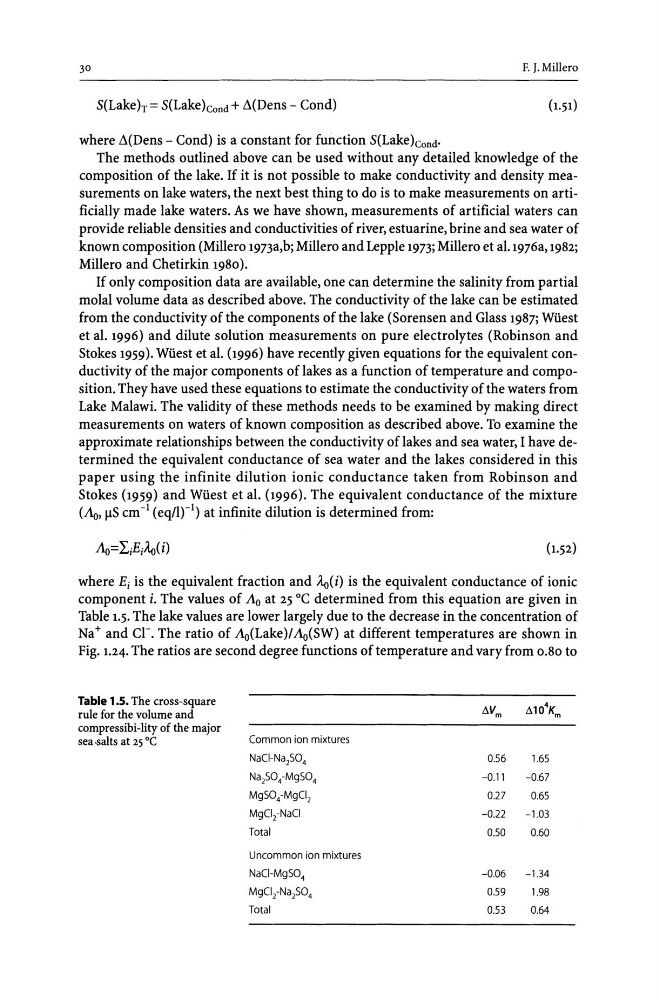
Table 1.5. The cross-square
LlV m
Lll0 4 K m
rule for the volume and
compressibi-lity of the major
sea.salts at 25°C
Common ion mixtures
NaCI-Na 2 S0 4
0.56
1.65
Na 2 S0 4 -MgS0 4
-0.11
-0.67
MgS0 4 -MgCI 2
0.27
0.65
MgCI 2 -NaCI
-0.22
-1.03
Total
0.50
0.60
Uncommon ion mixtures
NaCI-MgS0 4
-0.06
-1.34
MgCI 2 -Na 2 S0 4
0.59
1.98
Total
0.53
0.64
F. J. Millero
S{Lakeh= S{Lakebnd + ~(Dens - Cond)
(1.51)
where ~(Dens - Cond) is a constant for function S{Lake>Cond'
The methods outlined above can be used without any detailed knowledge of the
composition of the lake. If it is not possible to make conductivity and density measurements on lake waters, the next best thing to do is to make measurements on artificially made lake waters. As we have shown, measurements of artificial waters can
provide reliable densities and conductivities of river, estuarine, brine and sea water of
known composition (Millero 1973a,b; Millero and Lepple 1973; Millero et al.1976a, 1982;
Millero and Chetirkin 1980).
If only composition data are available, one can determine the salinity from partial
molal volume data as described above. The conductivity of the lake can be estimated
from the conductivity of the components of the lake (Sorensen and Glass 1987; Wuest
et al. 1996) and dilute solution measurements on pure electrolytes (Robinson and
Stokes 1959). Wuest et al. (1996) have recently given equations for the equivalent conductivity of the major components of lakes as a function of temperature and composition. They have used these equations to estimate the conductivity of the waters from
Lake Malawi. The validity of these methods needs to be examined by making direct
measurements on waters of known composition as described above. To examine the
approximate relationships between the conductivity of lakes and sea water, I have determined the equivalent conductance of sea water and the lakes considered in this
paper using the infinite dilution ionic conductance taken from Robinson and
Stokes (1959) and Wuest et al. (1996). The equivalent conductance of the mixture
(Ao, flS cm- 1 (eq/lfl) at infinite dilution is determined from:
Ao=LjEj~{i)
(1.52)
where Ej is the equivalent fraction and ~(i) is the equivalent conductance of ionic
component i. The values of Ao at 25°C determined from this equation are given in
Table 1.5. The lake values are lower largely due to the decrease in the concentration of
Na+ and cr. The ratio of Ao{Lake)IAo{SW) at different temperatures are shown in
Fig. 1.24. The ratios are second degree functions of temperature and vary from 0.80 to
Table 1.5. The cross-square
LlV m
Lll0 4 K m
rule for the volume and
compressibi-lity of the major
sea.salts at 25°C
Common ion mixtures
NaCI-Na 2 S0 4
0.56
1.65
Na 2 S0 4 -MgS0 4
-0.11
-0.67
MgS0 4 -MgCI 2
0.27
0.65
MgCI 2 -NaCI
-0.22
-1.03
Total
0.50
0.60
Uncommon ion mixtures
NaCI-MgS0 4
-0.06
-1.34
MgCI 2 -Na 2 S0 4
0.59
1.98
Total
0.53
0.64