

452
P. Rivaro . R. Frache
pronounced than physical ones, where tongues of warmer water intrude onto the continental shelf.
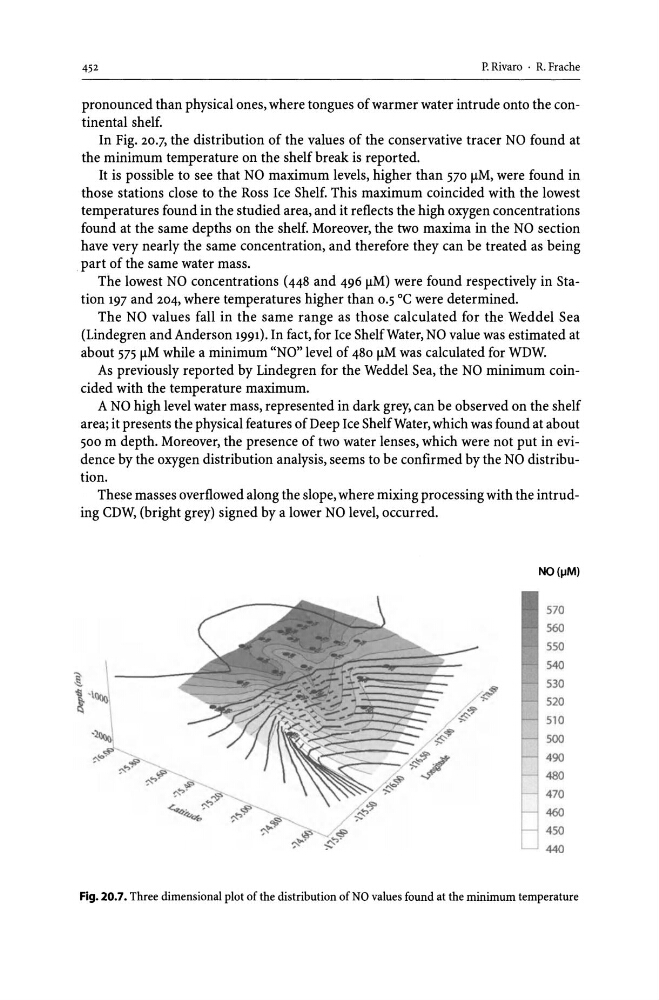
In Fig. 20.7, the distribution of the values of the conservative tracer NO found at
the minimum temperature on the shelf break is reported.
It is possible to see that NO maximum levels, higher than 570 IlM, were found in
those stations close to the Ross Ice Shelf. This maximum coincided with the lowest
temperatures found in the studied area, and it reflects the high oxygen concentrations
found at the same depths on the shelf. Moreover, the two maxima in the NO section
have very nearly the same concentration, and therefore they can be treated as being
part of the same water mass.
The lowest NO concentrations (448 and 496 IlM) were found respectively in Station 197 and 204, where temperatures higher than 0.5 °C were determined.
The NO values fall in the same range as those calculated for the Weddel Sea
(Lindegren and Anderson 1991). In fact, for Ice Shelf Water, NO value was estimated at
about 575 IlM while a minimum "NO" level of 480 IlM was calculated for WDW.
As previously reported by Lindegren for the Weddel Sea, the NO minimum coincided with the temperature maximum.
A NO high level water mass, represented in dark grey, can be observed on the shelf
area; it presents the physical features of Deep Ice Shelf Water, which was found at about
500 m depth. Moreover, the presence of two water lenses, which were not put in evidence by the oxygen distribution analysis, seems to be confirmed by the NO distribution.
These masses overflowed along the slope, where mixing processing with the intruding CDW, (bright grey) signed by a lower NO level, occurred.
~ \
i, . , ) ,~
-l
9" .....
~ <0
;-;.;i> "';s.
~
~.
~
.......
~"fi' ~
~
..!!Y
<..",. ,:,""
~
, ~..., "
","P
~
~!->~
",.
'"
~
>
?
'.<:;0':;.,..
NO (IlM)
570
560
550
540
. 530
~ ~~~
500
490
480
470
460
450
440
Fig. 20.7. Three dimensional plot of the distribution of NO values found at the minimum temperature
P. Rivaro . R. Frache
pronounced than physical ones, where tongues of warmer water intrude onto the continental shelf.
In Fig. 20.7, the distribution of the values of the conservative tracer NO found at
the minimum temperature on the shelf break is reported.
It is possible to see that NO maximum levels, higher than 570 IlM, were found in
those stations close to the Ross Ice Shelf. This maximum coincided with the lowest
temperatures found in the studied area, and it reflects the high oxygen concentrations
found at the same depths on the shelf. Moreover, the two maxima in the NO section
have very nearly the same concentration, and therefore they can be treated as being
part of the same water mass.
The lowest NO concentrations (448 and 496 IlM) were found respectively in Station 197 and 204, where temperatures higher than 0.5 °C were determined.
The NO values fall in the same range as those calculated for the Weddel Sea
(Lindegren and Anderson 1991). In fact, for Ice Shelf Water, NO value was estimated at
about 575 IlM while a minimum "NO" level of 480 IlM was calculated for WDW.
As previously reported by Lindegren for the Weddel Sea, the NO minimum coincided with the temperature maximum.
A NO high level water mass, represented in dark grey, can be observed on the shelf
area; it presents the physical features of Deep Ice Shelf Water, which was found at about
500 m depth. Moreover, the presence of two water lenses, which were not put in evidence by the oxygen distribution analysis, seems to be confirmed by the NO distribution.
These masses overflowed along the slope, where mixing processing with the intruding CDW, (bright grey) signed by a lower NO level, occurred.
~ \
i, . , ) ,~
-l
9" .....
~ <0
;-;.;i> "';s.
~
~.
~
.......
~"fi' ~
~
..!!Y
<..",. ,:,""
~
, ~..., "
","P
~
~!->~
",.
'"
~
>
?
'.<:;0':;.,..
NO (IlM)
570
560
550
540
. 530
~ ~~~
500
490
480
470
460
450
440
Fig. 20.7. Three dimensional plot of the distribution of NO values found at the minimum temperature