

448
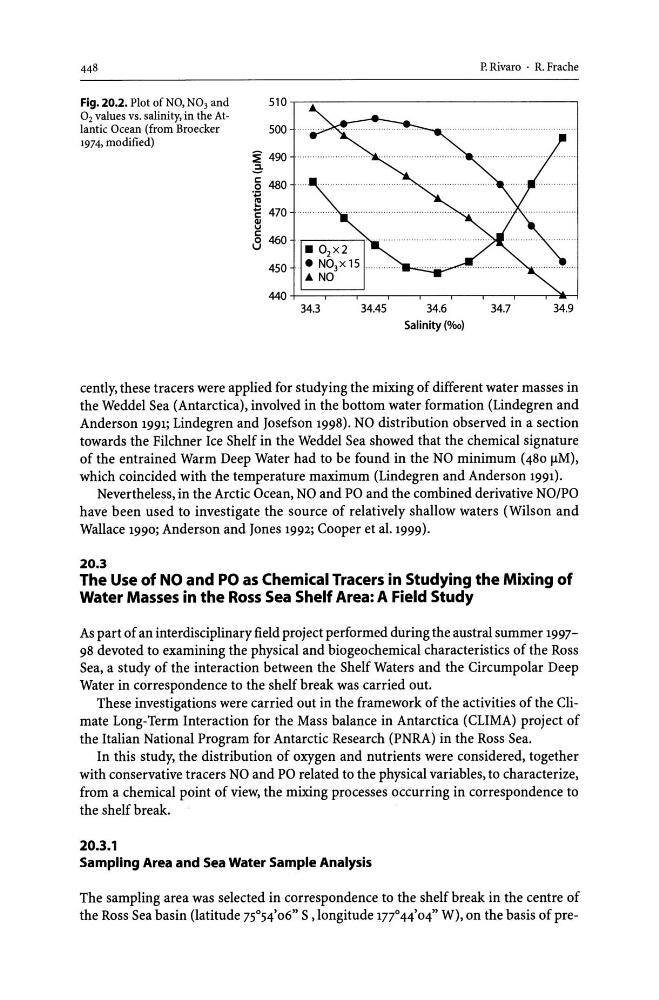
Fig. 20.2. Plot of NO, N03 and
O2 values vs. salinity, in the At1antic Ocean (from Broecker
1974, modified)
510
500
~ 490
2.§ 480
...
~
1: 470
c:
8 460
450
440
34.3
34.45
34.6
Salinity (%0)
P. RivarD . R. Frache
34.7
34.9
cently, these tracers were applied for studying the mixing of different water masses in
the Weddel Sea (Antarctica), involved in the bottom water formation (Lindegren and
Anderson 1991; Lindegren and Josefson 1998). NO distribution observed in a section
towards the Fiichner Ice Shelf in the Weddel Sea showed that the chemical signature
of the entrained Warm Deep Water had to be found in the NO minimum (480 11M),
which coincided with the temperature maximum (Lindegren and Anderson 1991).
Nevertheless, in the Arctic Ocean, NO and PO and the combined derivative NO/PO
have been used to investigate the source of relatively shallow waters (Wilson and
Wallace 1990; Anderson and Jones 1992; Cooper et al. 1999).
20.3
The Use of NO and PO as Chemical Tracers in Studying the Mixing of
Water Masses in the Ross Sea Shelf Area: A Field Study
As part of an interdisciplinary field project performed during the austral summer 199798 devoted to examining the physical and biogeochemical characteristics of the Ross
Sea, a study of the interaction between the Shelf Waters and the Circumpolar Deep
Water in correspondence to the shelf break was carried out.
These investigations were carried out in the framework of the activities of the Climate Long-Term Interaction for the Mass balance in Antarctica (CLIMA) project of
the Italian National Program for Antarctic Research (PNRA) in the Ross Sea.
In this study, the distribution of oxygen and nutrients were considered, together
with conservative tracers NO and PO related to the physical variables, to characterize,
from a chemical point of view, the mixing processes occurring in correspondence to
the shelf break.
20.3.1
Sampling Area and Sea Water Sample Analysis
The sampling area was selected in correspondence to the shelf break in the centre of
the Ross Sea basin (latitude 75°54'06" S ,longitude 177°44'04" W), on the basis of pre-
Fig. 20.2. Plot of NO, N03 and
O2 values vs. salinity, in the At1antic Ocean (from Broecker
1974, modified)
510
500
~ 490
2.§ 480
...
~
1: 470
c:
8 460
450
440
34.3
34.45
34.6
Salinity (%0)
P. RivarD . R. Frache
34.7
34.9
cently, these tracers were applied for studying the mixing of different water masses in
the Weddel Sea (Antarctica), involved in the bottom water formation (Lindegren and
Anderson 1991; Lindegren and Josefson 1998). NO distribution observed in a section
towards the Fiichner Ice Shelf in the Weddel Sea showed that the chemical signature
of the entrained Warm Deep Water had to be found in the NO minimum (480 11M),
which coincided with the temperature maximum (Lindegren and Anderson 1991).
Nevertheless, in the Arctic Ocean, NO and PO and the combined derivative NO/PO
have been used to investigate the source of relatively shallow waters (Wilson and
Wallace 1990; Anderson and Jones 1992; Cooper et al. 1999).
20.3
The Use of NO and PO as Chemical Tracers in Studying the Mixing of
Water Masses in the Ross Sea Shelf Area: A Field Study
As part of an interdisciplinary field project performed during the austral summer 199798 devoted to examining the physical and biogeochemical characteristics of the Ross
Sea, a study of the interaction between the Shelf Waters and the Circumpolar Deep
Water in correspondence to the shelf break was carried out.
These investigations were carried out in the framework of the activities of the Climate Long-Term Interaction for the Mass balance in Antarctica (CLIMA) project of
the Italian National Program for Antarctic Research (PNRA) in the Ross Sea.
In this study, the distribution of oxygen and nutrients were considered, together
with conservative tracers NO and PO related to the physical variables, to characterize,
from a chemical point of view, the mixing processes occurring in correspondence to
the shelf break.
20.3.1
Sampling Area and Sea Water Sample Analysis
The sampling area was selected in correspondence to the shelf break in the centre of
the Ross Sea basin (latitude 75°54'06" S ,longitude 177°44'04" W), on the basis of pre-