

28
F. J. Millero
0.6
NaCI-Na 2 S0 4
0.4
MgCl 2 -Na 2 S0 4
/
-~--4t--~-.~
\
~
I I /
.~
,>E 02
0.0
-0.2
NaCI-MgS0 4
MgCI 2 -NaCI
1.0
0.8
0.6
0.4
0.2
0.0 1.0
0.8
0.6
0.4
0.2
0.0
y
y
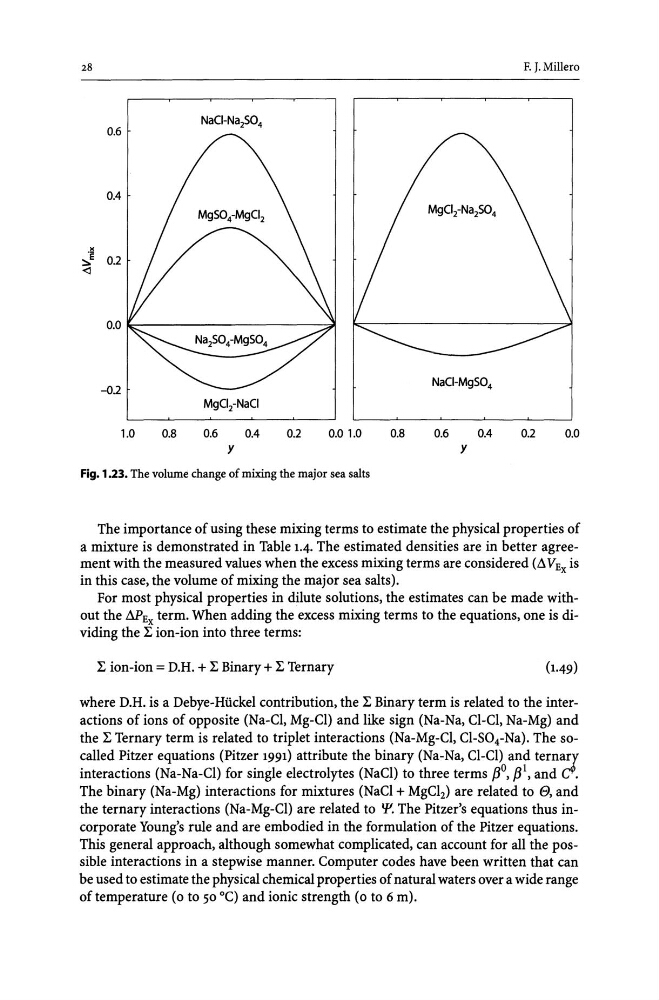
Fig. 1.23. The volume change of mixing the major sea salts
The importance of using these mixing terms to estimate the physical properties of
a mixture is demonstrated in Table 1.4. The estimated densities are in better agreement with the measured values when the excess mixing terms are considered (~VEx is
in this case, the volume of mixing the major sea salts).
For most physical properties in dilute solutions, the estimates can be made without the !!.PEx term. When adding the excess mixing terms to the equations, one is dividing the ~ ion-ion into three terms:
~ ion-ion = D.H. + ~ Binary + ~ Ternary
(1.49)
where D.H. is a Debye-Hiickel contribution, the ~ Binary term is related to the interactions of ions of opposite (Na-CI, Mg-CI) and like sign (Na-Na, CI-CI, Na-Mg) and
the ~ Ternary term is related to triplet interactions (Na-Mg-CI, CI-S0 4 -Na). The socalled Pitzer equations (Pitzer 1991) attribute the binary (Na-Na, CI-Cl) and ternar;
interactions (Na-Na-CI) for single electrolytes (NaCl) to three terms /30, /31, and C .
The binary (Na-Mg) interactions for mixtures (NaCl + MgClz) are related to (3, and
the ternary interactions (Na-Mg-CI) are related to 'I'. The Pitzer's equations thus incorporate Young's rule and are embodied in the formulation of the Pitzer equations.
This general approach, although somewhat complicated, can account for all the possible interactions in a stepwise manner. Computer codes have been written that can
be used to estimate the physical chemical properties of natural waters over a wide range
of temperature (o to 50°C) and ionic strength (o to 6 m).
F. J. Millero
0.6
NaCI-Na 2 S0 4
0.4
MgCl 2 -Na 2 S0 4
/
-~--4t--~-.~
\
~
I I /
.~
,>E 02
0.0
-0.2
NaCI-MgS0 4
MgCI 2 -NaCI
1.0
0.8
0.6
0.4
0.2
0.0 1.0
0.8
0.6
0.4
0.2
0.0
y
y
Fig. 1.23. The volume change of mixing the major sea salts
The importance of using these mixing terms to estimate the physical properties of
a mixture is demonstrated in Table 1.4. The estimated densities are in better agreement with the measured values when the excess mixing terms are considered (~VEx is
in this case, the volume of mixing the major sea salts).
For most physical properties in dilute solutions, the estimates can be made without the !!.PEx term. When adding the excess mixing terms to the equations, one is dividing the ~ ion-ion into three terms:
~ ion-ion = D.H. + ~ Binary + ~ Ternary
(1.49)
where D.H. is a Debye-Hiickel contribution, the ~ Binary term is related to the interactions of ions of opposite (Na-CI, Mg-CI) and like sign (Na-Na, CI-CI, Na-Mg) and
the ~ Ternary term is related to triplet interactions (Na-Mg-CI, CI-S0 4 -Na). The socalled Pitzer equations (Pitzer 1991) attribute the binary (Na-Na, CI-Cl) and ternar;
interactions (Na-Na-CI) for single electrolytes (NaCl) to three terms /30, /31, and C .
The binary (Na-Mg) interactions for mixtures (NaCl + MgClz) are related to (3, and
the ternary interactions (Na-Mg-CI) are related to 'I'. The Pitzer's equations thus incorporate Young's rule and are embodied in the formulation of the Pitzer equations.
This general approach, although somewhat complicated, can account for all the possible interactions in a stepwise manner. Computer codes have been written that can
be used to estimate the physical chemical properties of natural waters over a wide range
of temperature (o to 50°C) and ionic strength (o to 6 m).