

CHAPTER 1 . Sea Water as an Electrolyte
27
Table 1.4. Comparisons of the
measured and calculated denIonic Strength
L\p(Meas) -p(Calc) (ppm)
sity of Red Sea Brines at 25 °C
Without L\V EX
With L\V EX
as a function of ionic strength
0.47
-18
-22
1.22
81
8
1.75
134
13
2.61
199
11
3.56
211
-29
4.23
235
-25
5.33
297
20
6.11
444
188
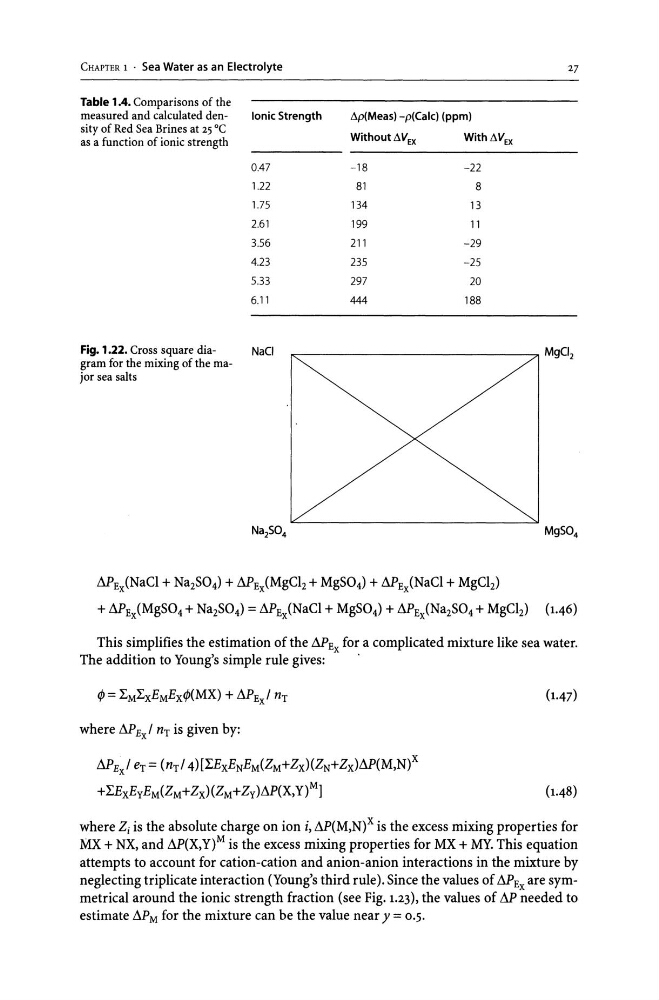
Fig. 1.22. Cross square diaNaCI
71 MgCI2
gram for the mixing of the maK
jar sea salts
Na 2 S0 4
MgS0 4
MEx(NaCl + Na2S04) + M Ex (MgCl2 + MgS04) + ~PEx(NaCl + MgCl2)
+ M Ex (MgS04 + Na2S04) = MEx(NaCl + MgS04) + MEx(Na2S04 + MgCl2) (1.46)
This simplifies the estimation of the MEx for a complicated mixture like sea water.
The addition to Young's simple rule gives:
.
I/J = LMLxEMEXI/J(MX) + ~PEx' nT
where MEx' nT is given by:
MEx' eT = (nT' 4)[LExENEM(ZM+ZX)(ZN+Zx)M(M,N)X
+ LExEyEM(ZM+ZX)(ZM+ Zy )M(X, y)M]
(1.47)
(1.48)
where Zi is the absolute charge on ion i, M(M,N)x is the excess mixing properties for
MX + NX, and M(X,y)M is the excess mixing properties for MX + MY. This equation
attempts to account for cation-cation and anion-anion interactions in the mixture by
neglecting triplicate interaction (Young's third rule). Since the values of MEx are symmetrical around the ionic strength fraction (see Fig. 1.23), the values of ~P needed to
estimate ~PM for the mixture can be the value near y = 0.5.
27
Table 1.4. Comparisons of the
measured and calculated denIonic Strength
L\p(Meas) -p(Calc) (ppm)
sity of Red Sea Brines at 25 °C
Without L\V EX
With L\V EX
as a function of ionic strength
0.47
-18
-22
1.22
81
8
1.75
134
13
2.61
199
11
3.56
211
-29
4.23
235
-25
5.33
297
20
6.11
444
188
Fig. 1.22. Cross square diaNaCI
71 MgCI2
gram for the mixing of the maK
jar sea salts
Na 2 S0 4
MgS0 4
MEx(NaCl + Na2S04) + M Ex (MgCl2 + MgS04) + ~PEx(NaCl + MgCl2)
+ M Ex (MgS04 + Na2S04) = MEx(NaCl + MgS04) + MEx(Na2S04 + MgCl2) (1.46)
This simplifies the estimation of the MEx for a complicated mixture like sea water.
The addition to Young's simple rule gives:
.
I/J = LMLxEMEXI/J(MX) + ~PEx' nT
where MEx' nT is given by:
MEx' eT = (nT' 4)[LExENEM(ZM+ZX)(ZN+Zx)M(M,N)X
+ LExEyEM(ZM+ZX)(ZM+ Zy )M(X, y)M]
(1.47)
(1.48)
where Zi is the absolute charge on ion i, M(M,N)x is the excess mixing properties for
MX + NX, and M(X,y)M is the excess mixing properties for MX + MY. This equation
attempts to account for cation-cation and anion-anion interactions in the mixture by
neglecting triplicate interaction (Young's third rule). Since the values of MEx are symmetrical around the ionic strength fraction (see Fig. 1.23), the values of ~P needed to
estimate ~PM for the mixture can be the value near y = 0.5.