

CHAPTER 19 . Palaeoenvironmental Reconstructions
439
18
Nd""'~ 0
+ Em/d(T)
-5
'()
~ 16
0.
"l
14
+~m/f
---, Op (Dissolved (02)
-10
12
013(
t-15
(%oPDB)
I
Ep= 13.9%
-20
,--+ 1 ~'e (Photo""'''''')
+3.8%
-25
10
5.4
6
7
8
9
10
Dissolved CO 2 (Ilmoll-')
1
180
210
240
270 300
340
LpC0 2 (Ilatm)
(37
Alkadienone
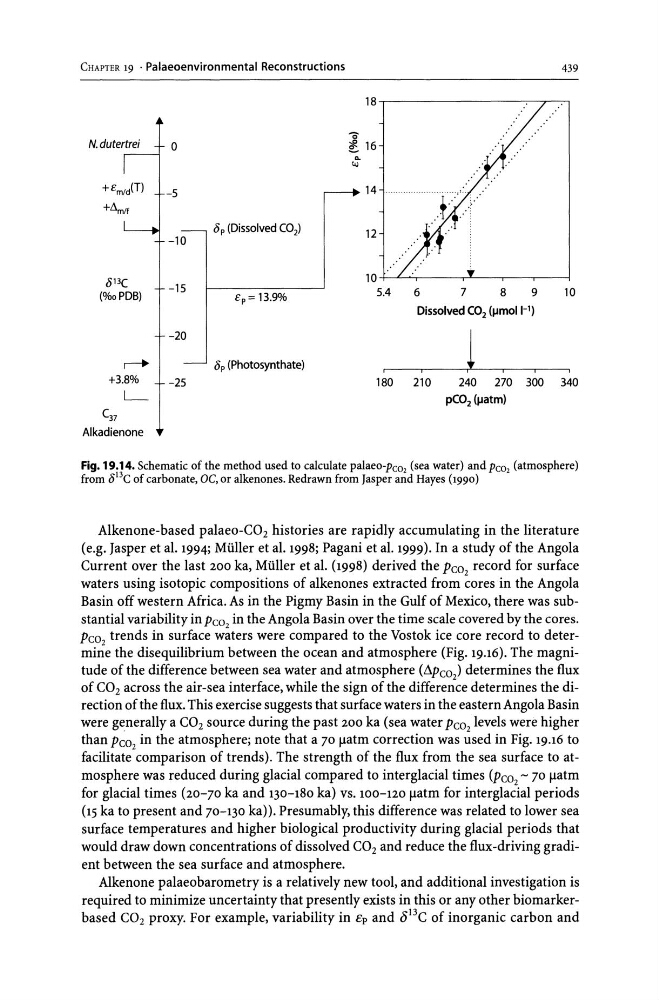
Fig. 19.14. Schematic of the method used to calculate palaeo-pco, (sea water) and Pco, (atmosphere)
from 013C of carbonate, OC, or alkenones. Redrawn from Jasper and Hayes (1990)
Alkenone-based palaeo-C02 histories are rapidly accumulating in the literature
(e.g. Jasper et al. 1994; Muller et al. 1998; Pagani et al. 1999). In a study of the Angola
Current over the last 200 ka, Muller et al. (1998) derived the Pe0 2 record for surface
waters using isotopic compositions of alkenones extracted from cores in the Angola
Basin off western Africa. As in the Pigmy Basin in the Gulf of Mexico, there was substantial variability in Peo 2 in the Angola Basin over the time scale covered by the cores.
Pco z trends in surface waters were compared to the Vostok ice core record to determine the disequilibrium between the ocean and atmosphere (Fig. 19.16). The magnitude of the difference between sea water and atmosphere (I:!.peo) determines the flux
of CO 2 across the air-sea interface, while the sign of the difference determines the direction of the flux. This exercise suggests that surface waters in the eastern Angola Basin
were generally a CO2 source during the past 200 ka (sea water Peozlevels were higher
than Pco 2 in the atmosphere; note that a 70 flatm correction was used in Fig. 19.16 to
facilitate comparison of trends). The strength of the flux from the sea surface to atmosphere was reduced during glacial compared to interglacial times (Peo 2 - 70 flatm
for glacial times (20-70 ka and 130-180 ka) vs. 100-120 flatm for interglacial periods
(15 ka to present and 70-130 ka». Presumably, this difference was related to lower sea
surface temperatures and higher biological productivity during glacial periods that
would draw down concentrations of dissolved CO2 and reduce the flux-driving gradient between the sea surface and atmosphere.
Alkenone palaeo barometry is a relatively new tool, and additional investigation is
required to minimize uncertainty that presently exists in this or any other biomarkerbased CO2 proxy. For example, variability in Ep and oJ3C of inorganic carbon and
439
18
Nd""'~ 0
+ Em/d(T)
-5
'()
~ 16
0.
"l
14
+~m/f
---, Op (Dissolved (02)
-10
12
013(
t-15
(%oPDB)
I
Ep= 13.9%
-20
,--+ 1 ~'e (Photo""'''''')
+3.8%
-25
10
5.4
6
7
8
9
10
Dissolved CO 2 (Ilmoll-')
1
180
210
240
270 300
340
LpC0 2 (Ilatm)
(37
Alkadienone
Fig. 19.14. Schematic of the method used to calculate palaeo-pco, (sea water) and Pco, (atmosphere)
from 013C of carbonate, OC, or alkenones. Redrawn from Jasper and Hayes (1990)
Alkenone-based palaeo-C02 histories are rapidly accumulating in the literature
(e.g. Jasper et al. 1994; Muller et al. 1998; Pagani et al. 1999). In a study of the Angola
Current over the last 200 ka, Muller et al. (1998) derived the Pe0 2 record for surface
waters using isotopic compositions of alkenones extracted from cores in the Angola
Basin off western Africa. As in the Pigmy Basin in the Gulf of Mexico, there was substantial variability in Peo 2 in the Angola Basin over the time scale covered by the cores.
Pco z trends in surface waters were compared to the Vostok ice core record to determine the disequilibrium between the ocean and atmosphere (Fig. 19.16). The magnitude of the difference between sea water and atmosphere (I:!.peo) determines the flux
of CO 2 across the air-sea interface, while the sign of the difference determines the direction of the flux. This exercise suggests that surface waters in the eastern Angola Basin
were generally a CO2 source during the past 200 ka (sea water Peozlevels were higher
than Pco 2 in the atmosphere; note that a 70 flatm correction was used in Fig. 19.16 to
facilitate comparison of trends). The strength of the flux from the sea surface to atmosphere was reduced during glacial compared to interglacial times (Peo 2 - 70 flatm
for glacial times (20-70 ka and 130-180 ka) vs. 100-120 flatm for interglacial periods
(15 ka to present and 70-130 ka». Presumably, this difference was related to lower sea
surface temperatures and higher biological productivity during glacial periods that
would draw down concentrations of dissolved CO2 and reduce the flux-driving gradient between the sea surface and atmosphere.
Alkenone palaeo barometry is a relatively new tool, and additional investigation is
required to minimize uncertainty that presently exists in this or any other biomarkerbased CO2 proxy. For example, variability in Ep and oJ3C of inorganic carbon and