

434
S. Wakeham
I. Diunsaturated compounds
0
II. Triunsaturated compounds
I
(CH 2 1 n - C
\ R
o
I
(CH 2 1 n - C
\
III.Tetraunsaturated compounds
0
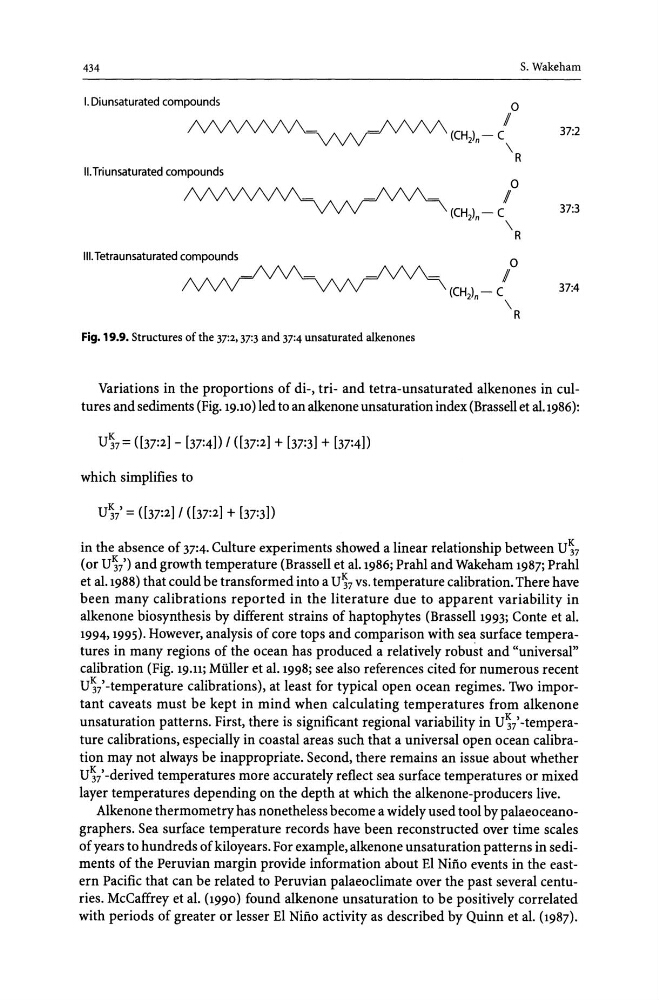
Fig. 19.9. Structures of the 37:2, 37:3 and 37:4 unsaturated alkenones
I
(CH 2 1 n - C
\ R
37:2
37:3
37:4
Variations in the proportions of di-, tri- and tetra-unsaturated alkenones in cultures and sediments (Fig. 19.10) led to an alkenone unsaturation index (Brassell et al.1986):
U~7 = ([37:2]- [37:4]) / ([37:2] + [37=3] + [37:4])
which simplifies to
u~/ = ([37=2] / ([37:2] + [37:3])
in the absence of 37:4. Culture experiments showed a linear relationship between U~7
(or U~7') and growth temperature (Brassell et al. 1986; Prahl and Wakeham 1987; Prahl
et al.1988) that could be transformed into a U~7 vs. temperature calibration. There have
been many calibrations reported in the literature due to apparent variability in
alkenone biosynthesis by different strains of haptophytes (Brassell 1993; Conte et al.
1994,1995). However, analysis of core tops and comparison with sea surface temperatures in many regions of the ocean has produced a relatively robust and "universal"
calibration (Fig. 19.11; MUller et al. 1998; see also references cited for numerous recent
U~/-temperature calibrations), at least for typical open ocean regimes. Two important caveats must be kept in mind when calculating temperatures from alkenone
unsaturation patterns. First, there is significant regional variability in U~/ -temperature calibrations, especially in coastal areas such that a universal open ocean calibration may not always be inappropriate. Second, there remains an issue about whether
U~/ -derived temperatures more accurately reflect sea surface temperatures or mixed
layer temperatures depending on the depth at which the alkenone-producers live.
Alkenone thermometry has nonetheless become a widely used tool by palaeoceanographers. Sea surface temperature records have been reconstructed over time scales
of years to hundreds of kiloyears. For example, alkenone unsaturation patterns in sediments of the Peruvian margin provide information about El Nino events in the eastern Pacific that can be related to Peruvian palaeoclimate over the past several centuries. McCaffrey et al. (1990) found alkenone unsaturation to be positively correlated
with periods of greater or lesser El Nino activity as described by Quinn et al. (1987).
S. Wakeham
I. Diunsaturated compounds
0
II. Triunsaturated compounds
I
(CH 2 1 n - C
\ R
o
I
(CH 2 1 n - C
\
III.Tetraunsaturated compounds
0
Fig. 19.9. Structures of the 37:2, 37:3 and 37:4 unsaturated alkenones
I
(CH 2 1 n - C
\ R
37:2
37:3
37:4
Variations in the proportions of di-, tri- and tetra-unsaturated alkenones in cultures and sediments (Fig. 19.10) led to an alkenone unsaturation index (Brassell et al.1986):
U~7 = ([37:2]- [37:4]) / ([37:2] + [37=3] + [37:4])
which simplifies to
u~/ = ([37=2] / ([37:2] + [37:3])
in the absence of 37:4. Culture experiments showed a linear relationship between U~7
(or U~7') and growth temperature (Brassell et al. 1986; Prahl and Wakeham 1987; Prahl
et al.1988) that could be transformed into a U~7 vs. temperature calibration. There have
been many calibrations reported in the literature due to apparent variability in
alkenone biosynthesis by different strains of haptophytes (Brassell 1993; Conte et al.
1994,1995). However, analysis of core tops and comparison with sea surface temperatures in many regions of the ocean has produced a relatively robust and "universal"
calibration (Fig. 19.11; MUller et al. 1998; see also references cited for numerous recent
U~/-temperature calibrations), at least for typical open ocean regimes. Two important caveats must be kept in mind when calculating temperatures from alkenone
unsaturation patterns. First, there is significant regional variability in U~/ -temperature calibrations, especially in coastal areas such that a universal open ocean calibration may not always be inappropriate. Second, there remains an issue about whether
U~/ -derived temperatures more accurately reflect sea surface temperatures or mixed
layer temperatures depending on the depth at which the alkenone-producers live.
Alkenone thermometry has nonetheless become a widely used tool by palaeoceanographers. Sea surface temperature records have been reconstructed over time scales
of years to hundreds of kiloyears. For example, alkenone unsaturation patterns in sediments of the Peruvian margin provide information about El Nino events in the eastern Pacific that can be related to Peruvian palaeoclimate over the past several centuries. McCaffrey et al. (1990) found alkenone unsaturation to be positively correlated
with periods of greater or lesser El Nino activity as described by Quinn et al. (1987).